Home
Department Of Physics text logo
  • Research
    • Our research
    • Our research groups
    • Our research in action
    • Research funding support
    • Summer internships for undergraduates
  • Study
    • Undergraduates
    • Postgraduates
  • Engage
    • For young people
    • For teachers
    • For the public
    • For alumni
    • For business
  • Support
Menu
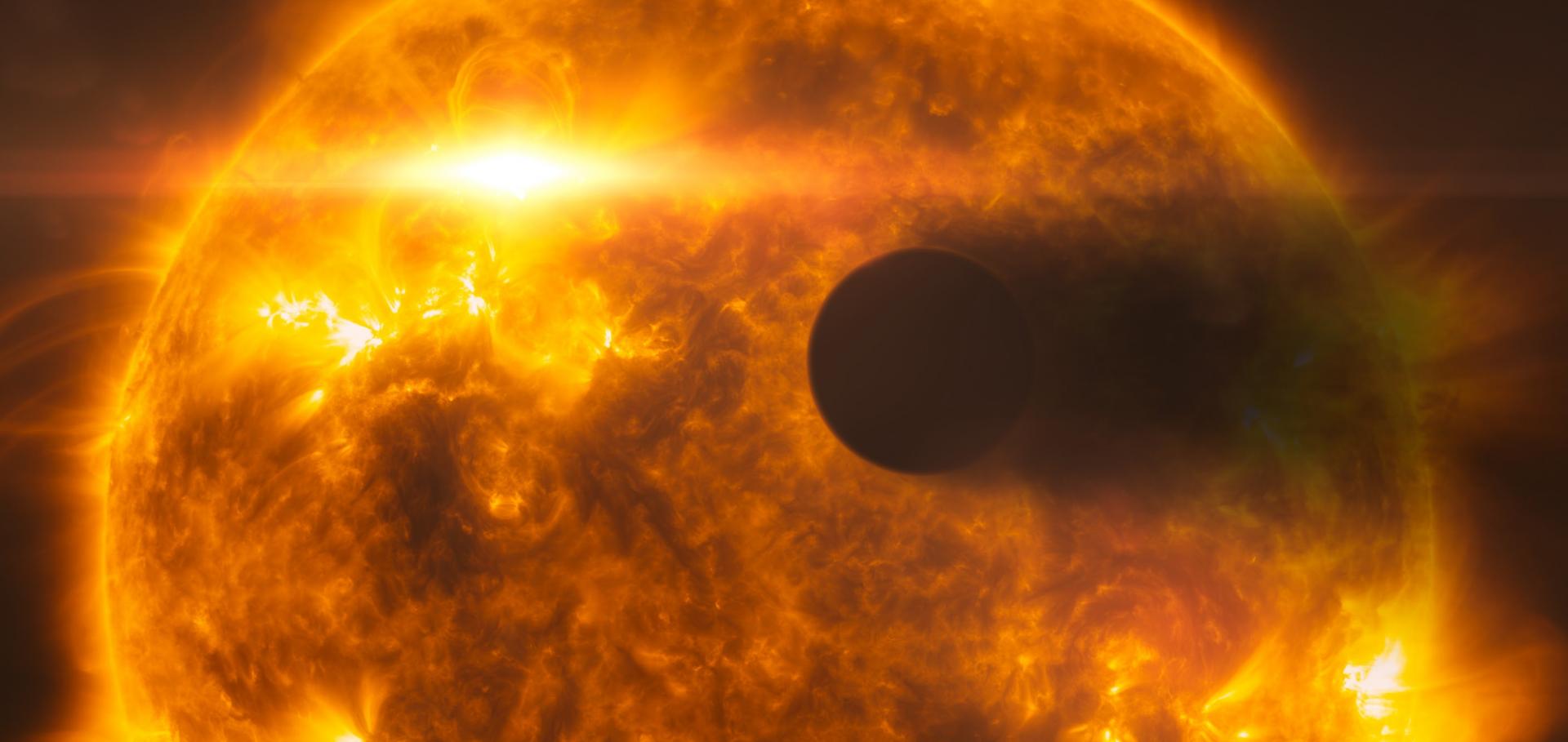
Stellar_flare_hits_HD_189733_b_(artist's_impression)

This artist's impression shows the hot Jupiter HD 189733b, as it passes in front of its parent star, as the latter is flaring, driving material away from the planet. The escaping atmosphere is seen silhouetted against the starlight. The surface of the star, which is around 80% the mass of the Sun, is based on observations of the Sun from NASA's Solar Dynamics Observatory.

Credit: NASA, ESA, L. Calçada, Solar Dynamics Observatory

Prof Suzanne Aigrain

Professor of Astrophysics

Research theme

  • Astronomy and astrophysics
  • Exoplanets and planetary physics

Sub department

  • Astrophysics

Research groups

  • Exoplanets and Stellar Physics
Suzanne.Aigrain@physics.ox.ac.uk
Telephone: 01865 (2)73339
Denys Wilkinson Building, room 762
Stars & Planets @ Oxford research group website
  • About
  • Publications

PlatoSim: an end-to-end PLATO camera simulator for modelling high-precision space-based photometry

Astronomy and Astrophysics EDP Sciences 681 (2024) A18

Authors:

N Jannsen, J De Ridder, D Seynaeve, S Regibo, R Huygen, P Royer, C Paproth, D Grießbach, R Samadi, Dr Reese, M Pertenais, E Grolleau, R Heller, Sm Niemi, J Cabrera, A Börner, S Aigrain, J Mccormac, P Verhoeve, P Astier, N Kutrowski, B Vandenbussche, A Tkachenko, C Aerts

Abstract:

Context. PLAnetary Transits and Oscillations of stars (PLATO) is the ESA M3 space mission dedicated to detect and characterise transiting exoplanets including information from the asteroseismic properties of their stellar hosts. The uninterrupted and high-precision photometry provided by space-borne instruments such as PLATO require long preparatory phases. An exhaustive list of tests are paramount to design a mission that meets the performance requirements and, as such, simulations are an indispensable tool in the mission preparation.

Aims. To accommodate PLATO’s need of versatile simulations prior to mission launch that at the same time describe innovative yet complex multi-telescope design accurately, in this work we present the end-to-end PLATO simulator specifically developed for that purpose, namely PlatoSim. We show, step-by-step, the algorithms embedded into the software architecture of PlatoSim that allow the user to simulate photometric time series of charge-coupled device (CCD) images and light curves in accordance to the expected observations of PLATO.

Methods. In the context of the PLATO payload, a general formalism of modelling, end-to-end, incoming photons from the sky to the final measurement in digital units is discussed. According to the light path through the instrument, we present an overview of the stellar field and sky background, the short- and long-term barycentric pixel displacement of the stellar sources, the cameras and their optics, the modelling of the CCDs and their electronics, and all main random and systematic noise sources.

Results. We show the strong predictive power of PlatoSim through its diverse applicability and contribution to numerous working groups within the PLATO mission consortium. This involves the ongoing mechanical integration and alignment, performance studies of the payload, the pipeline development, and assessments of the scientific goals.

Conclusions. PlatoSim is a state-of-the-art simulator that is able to produce the expected photometric observations of PLATO to a high level of accuracy. We demonstrate that PlatoSim is a key software tool for the PLATO mission in the preparatory phases until mission launch and prospectively beyond.

More details from the publisher
Details from ORA
More details

Stellar surface information from the Ca II H&K lines – I. Intensity profiles of the solar activity components

Monthly Notices of the Royal Astronomical Society Oxford University Press 527:2 (2023) 2940-2962

Authors:

M Cretignier, Agm Pietrow, S Aigrain

Abstract:

The detection of Earth-like planets with the radial-velocity (RV) method is currently limited by the presence of stellar activity signatures. On rotational time-scales, spots and plages (or faculae) are known to introduce different RV signals, but their corrections require better activity proxies. The best-known chromospheric activity proxies in the visible are the Ca II H&K lines, but the physical quantities measured by their profiles need to be clarified. We first investigate resolved images of the Sun in order to better understand the spectrum of plages, spots, and the network using the Meudon spectroheliogram. We show that distinct line profiles are produced by plages, spots, and by the network component and we also derived the centre-to-limb variations of the three profiles. Some care is required to disentangle their contributions due to their similarities. By combining disc-integrated spectra from the ISS high-resolution spectrograph with SDO direct images of the Sun, we managed to extract a high-resolution emission spectrum of the different components, which tend to confirm the spectra extracted from the Meudon spectroheliogram datacubes. Similar results were obtained with the HARPS-N Sun-as-a-star spectra. We concluded using a three-component model that the temporal variation of the popular Sindex contains, on average for the 24th solar cycle: 70 ± 12 per cent of plage, 26 ± 12 per cent of network, and 4 ± 4 per cent of spots. This preliminary investigation suggests that a detailed study of the Ca II H&K profiles may provide rich information about the filling factor and distribution of different types of active regions.
More details from the publisher
Details from ORA
More details

Stellar surface information from the Ca II H&K lines I. Intensity profiles of the solar activity components

(2023)

Authors:

M Cretignier, AGM Pietrow, S Aigrain
More details from the publisher
Details from ArXiV

HD152843 b & c: the masses and orbital periods of a sub-Neptune and a super-puff Neptune

(2023)

Authors:

BA Nicholson, S Aigrain, NL Eisner, M Cretignier, O Barragán, L Kaye, J Taylor, J Owen, A Mortier, L Affer, W Boschin, A Collier Cameron, M Damasso, L Di Fabrizio, V DiTomasso, X Dumusque, A Gehdina, A Harutyunyan, DW Latham, M Lopez-Morales, V Lorenzi, AF Martínez Fiorenzano, E Molinari, M Pedani, M Pinamonti, A Sozzetti, K Rice
More details from the publisher
Details from ArXiV

PlatoSim: An end-to-end PLATO camera simulator for modelling high-precision space-based photometry

(2023)

Authors:

N Jannsen, J De Ridder, D Seynaeve, S Regibo, R Huygen, P Royer, C Paproth, D Grießbach, R Samadi, DR Reese, M Pertenais, E Grolleau, R Heller, SM Niemi, J Cabrera, A Börner, S Aigrain, J McCormac, P Verhoeve, P Astier, N Kutrowski, B Vandenbussche, A Tkachenko, C Aerts
More details from the publisher
Details from ArXiV

Pagination

  • First page First
  • Previous page Prev
  • …
  • Page 9
  • Page 10
  • Page 11
  • Page 12
  • Current page 13
  • Page 14
  • Page 15
  • Page 16
  • Page 17
  • …
  • Next page Next
  • Last page Last

Footer Menu

  • Contact us
  • Giving to the Dept of Physics
  • Work with us
  • Media

User account menu

  • Log in

Follow us

FIND US

Clarendon Laboratory,

Parks Road,

Oxford,

OX1 3PU

CONTACT US

Tel: +44(0)1865272200

University of Oxfrod logo Department Of Physics text logo
IOP Juno Champion logo Athena Swan Silver Award logo

© University of Oxford - Department of Physics

Cookies | Privacy policy | Accessibility statement

Built by: Versantus

  • Home
  • Research
  • Study
  • Engage
  • Our people
  • News & Comment
  • Events
  • Our facilities & services
  • About us
  • Giving to Physics
  • Current students
  • Staff intranet