Home
Department Of Physics text logo
  • Research
    • Our research
    • Our research groups
    • Our research in action
    • Research funding support
    • Summer internships for undergraduates
  • Study
    • Undergraduates
    • Postgraduates
  • Engage
    • For young people
    • For teachers
    • For the public
    • For alumni
    • For business
  • Support
Menu
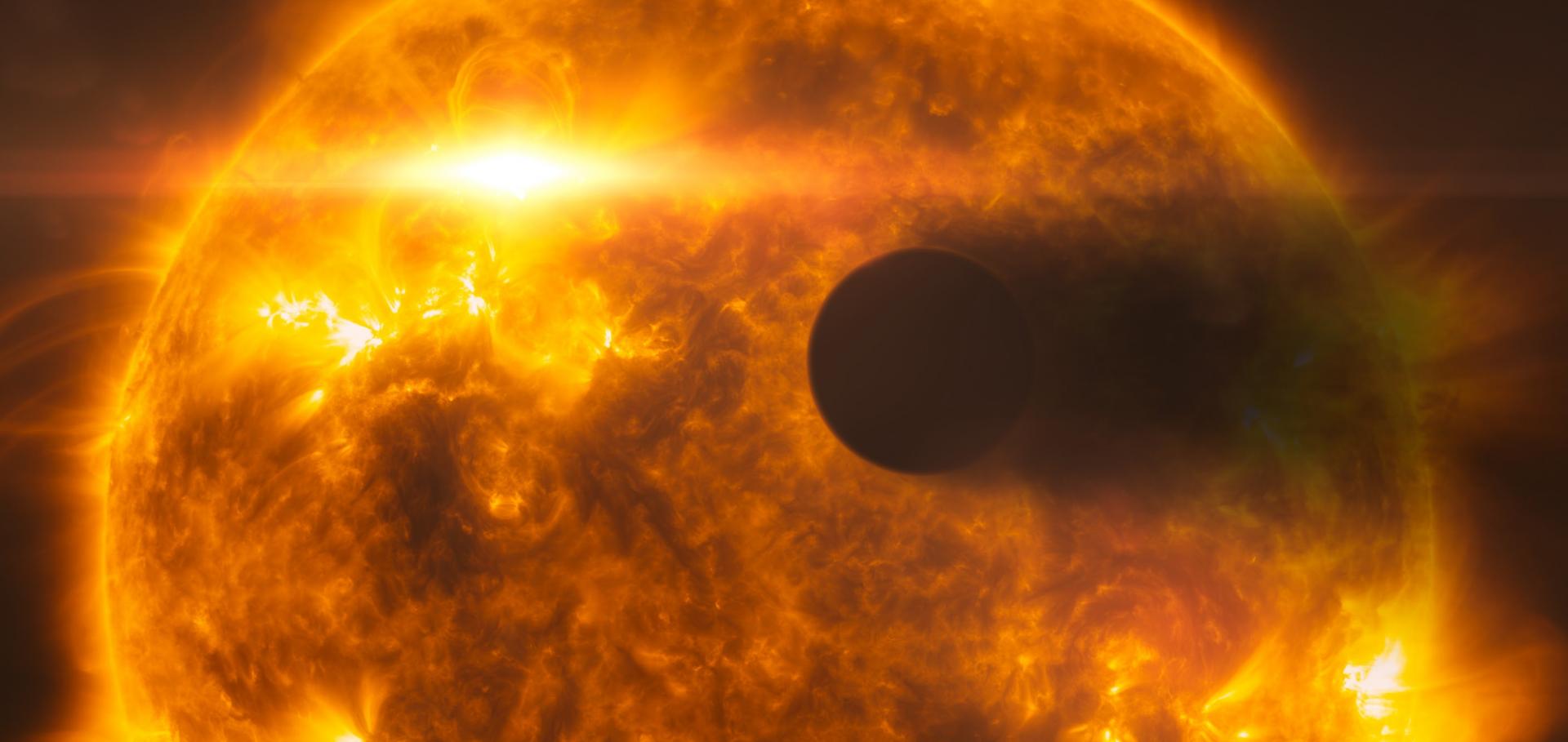
Stellar_flare_hits_HD_189733_b_(artist's_impression)

This artist's impression shows the hot Jupiter HD 189733b, as it passes in front of its parent star, as the latter is flaring, driving material away from the planet. The escaping atmosphere is seen silhouetted against the starlight. The surface of the star, which is around 80% the mass of the Sun, is based on observations of the Sun from NASA's Solar Dynamics Observatory.

Credit: NASA, ESA, L. Calçada, Solar Dynamics Observatory

Prof Suzanne Aigrain

Professor of Astrophysics

Research theme

  • Astronomy and astrophysics
  • Exoplanets and planetary physics

Sub department

  • Astrophysics

Research groups

  • Exoplanets and Stellar Physics
Suzanne.Aigrain@physics.ox.ac.uk
Telephone: 01865 (2)73339
Denys Wilkinson Building, room 762
Stars & Planets @ Oxford research group website
  • About
  • Publications

Gaussian Process regression for astronomical time-series

(2022)

Authors:

Suzanne Aigrain, Daniel Foreman-Mackey
Details from ArXiV
More details from the publisher

Direct discovery of the inner exoplanet in the HD206893 system. Evidence for deuterium burning in a planetary-mass companion

(2022)

Authors:

S Hinkley, S Lacour, G-D Marleau, AM Lagrange, JJ Wang, J Kammerer, A Cumming, M Nowak, L Rodet, T Stolker, W-O Balmer, S Ray, M Bonnefoy, P Mollière, C Lazzoni, G Kennedy, C Mordasini, R Abuter, S Aigrain, A Amorim, R Asensio-Torres, C Babusiaux, M Benisty, J-P Berger, H Beust, S Blunt, A Boccaletti, A Bohn, H Bonnet, G Bourdarot, W Brandner, F Cantalloube, P Caselli, B Charnay, G Chauvin, A Chomez, E Choquet, V Christiaens, Y Clénet, V Coudé du Foresto, A Cridland, P Delorme, R Dembet, PT de Zeeuw, A Drescher, G Duvert, A Eckart, F Eisenhauer, H Feuchtgruber, F Galland, P Garcia, R Garcia Lopez, T Gardner, E Gendron, R Genzel, S Gillessen, JH Girard, A Grandjean, X Haubois, G Heißel, Th Henning, S Hippler, M Horrobin, M Houllé, Z Hubert, L Jocou, M Keppler, P Kervella, L Kreidberg, V Lapeyrère, J-B Le Bouquin, P Léna, D Lutz, A-L Maire, F Mang, A Mérand, N Meunier, JD Monnier, C Mordasini, D Mouillet, E Nasedkin, T Ott, GPPL Otten, C Paladini, T Paumard, K Perraut, G Perrin, F Philipot, O Pfuhl, N Pourré, L Pueyo, J Rameau, E Rickman, P Rubini, Z Rustamkulov, M Samland, J Shangguan, T Shimizu, D Sing, C Straubmeier, E Sturm, LJ Tacconi, EF van Dishoeck, A Vigan, F Vincent, K Ward-Duong, F Widmann, E Wieprecht, E Wiezorrek, J Woillez, S Yazici, A Young, N Zicher, the GRAVITY Collaboration
More details from the publisher
Details from ArXiV

Quasi-periodic Gaussian processes for stellar activity: From physical to kernel parameters

Monthly Notices of the Royal Astronomical Society Oxford University Press 515:4 (2022) 5251-5266

Authors:

Ba Nicholson, S Aigrain

Abstract:

In recent years, Gaussian Process (GP) regression has become widely used to analyse stellar and exoplanet time-series data sets. For spotted stars, the most popular GP covariance function is the quasi-periodic (QP) kernel, whose hyperparameters of the GP have a plausible interpretation in terms of physical properties of the star and spots. In this paper, we test the reliability of this interpretation by modelling data simulated using a spot model using a QP GP, and the recently proposed quasi-periodic plus cosine (QPC) GP, comparing the posterior distributions of the GP hyperparameters to the input parameters of the spot model. We find excellent agreement between the input stellar rotation period and the QP and QPC GP period, and very good agreement between the spot decay time-scale and the length scale of the squared exponential term. We also compare the hyperparameters derived from light and radial velocity (RV) curves for a given star, finding that the period and evolution time-scales are in good agreement. However, the harmonic complexity of the GP, while displaying no clear correlation with the spot properties in our simulations, is systematically higher for the RV than for the light-curve data. Finally, for the QP kernel, we investigate the impact of noise and time-sampling on the hyperparameters in the case of RVs. Our results indicate that good coverage of rotation period and spot evolution time-scales is more important than the total number of points, and noise characteristics govern the harmonic complexity.
More details from the publisher
Details from ORA
More details

Quasi-periodic Gaussian Processes for stellar activity: from physical to kernel parameters

(2022)

Authors:

Belinda A Nicholson, Suzanne Aigrain
More details from the publisher
Details from ArXiV

One year of AU Mic with HARPS - II. Stellar activity and star-planet interaction

MONTHLY NOTICES OF THE ROYAL ASTRONOMICAL SOCIETY 512:4 (2022) 5067-5084

Authors:

Baptiste Klein, Norbert Zicher, Robert D Kavanagh, Louise D Nielsen, Suzanne Aigrain, Aline A Vidotto, Oscar Barragan, Antoine Strugarek, Belinda Nicholson, Jean-Francois Donati, Jerome Bouvier
More details from the publisher
Details from ORA
More details
More details

Pagination

  • First page First
  • Previous page Prev
  • …
  • Page 12
  • Page 13
  • Page 14
  • Page 15
  • Current page 16
  • Page 17
  • Page 18
  • Page 19
  • Page 20
  • …
  • Next page Next
  • Last page Last

Footer Menu

  • Contact us
  • Giving to the Dept of Physics
  • Work with us
  • Media

User account menu

  • Log in

Follow us

FIND US

Clarendon Laboratory,

Parks Road,

Oxford,

OX1 3PU

CONTACT US

Tel: +44(0)1865272200

University of Oxfrod logo Department Of Physics text logo
IOP Juno Champion logo Athena Swan Silver Award logo

© University of Oxford - Department of Physics

Cookies | Privacy policy | Accessibility statement

Built by: Versantus

  • Home
  • Research
  • Study
  • Engage
  • Our people
  • News & Comment
  • Events
  • Our facilities & services
  • About us
  • Giving to Physics
  • Current students
  • Staff intranet