

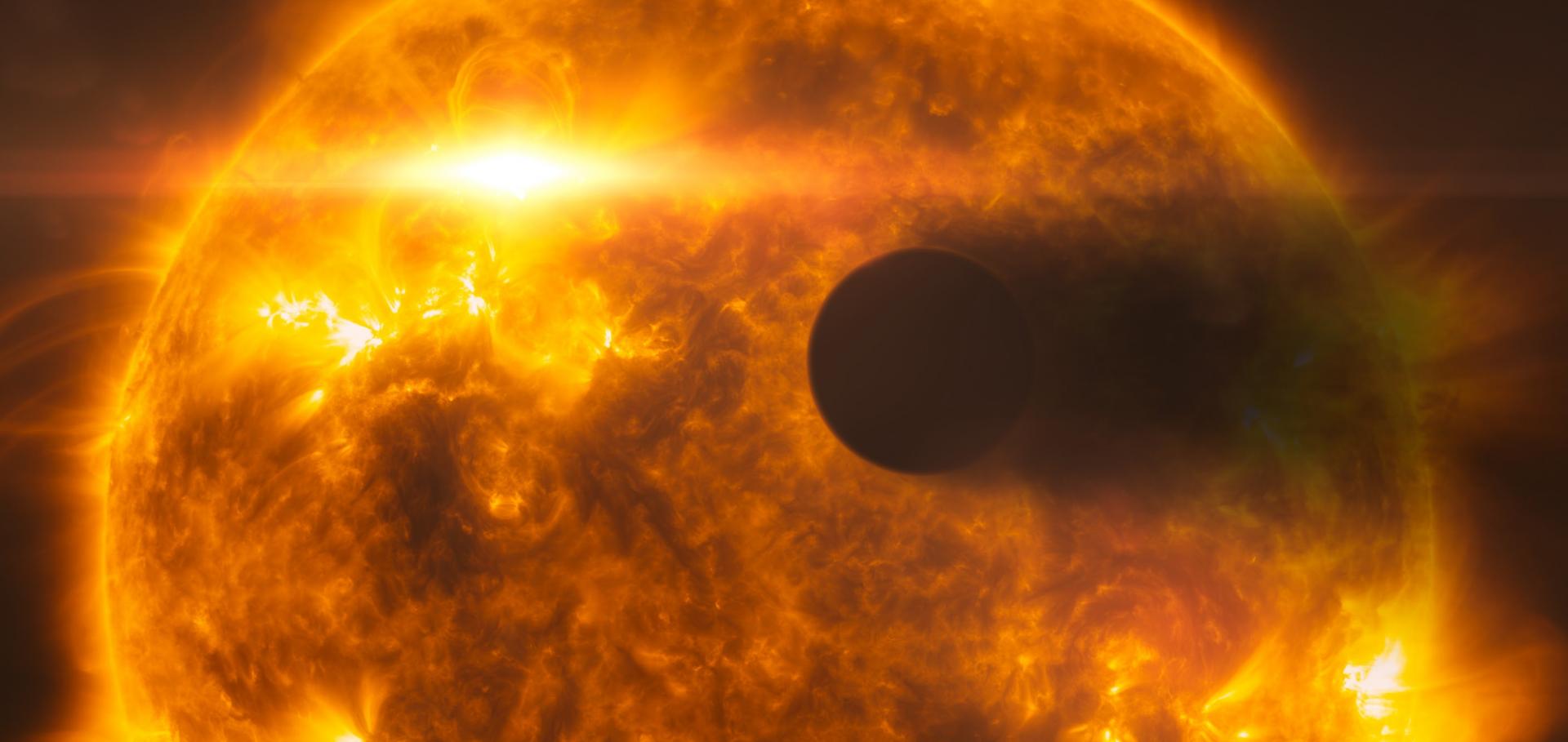

Revisiting K2-233 spectroscopic time-series with multidimensional Gaussian processes
Monthly Notices of the Royal Astronomical Society Oxford University Press 522:3 (2023) 3458-3471
Abstract:
Detecting planetary signatures in radial velocity time-series of young stars is challenging due to their inherently strong stellar activity. However, it is possible to learn information about the properties of the stellar signal by using activity indicators measured from the same stellar spectra used to extract radial velocities. In this manuscript, we present a reanalysis of spectroscopic High Accuracy Radial Velocity Planet Searcher data of the young star K2-233, which hosts three transiting planets. We perform a multidimensional Gaussian process regression on the radial velocity and the activity indicators to characterize the planetary Doppler signals. We demonstrate, for the first time on a real data set, that the use of a multidimensional Gaussian process can boost the precision with which we measure the planetary signals compared to a one-dimensional Gaussian process applied to the radial velocities alone. We measure the semi-amplitudes of K2-233 b, c, and d as 1.31+0.81−0.74, 1.81+0.71−0.67, and 2.72+0.66−0.70 m s−1, which translate into planetary masses of 2.4+1.5−1.3, 4.6+1.8−1.7, and 10.3+2.4−2.6 M⊕, respectively. These new mass measurements make K2-233 d a valuable target for transmission spectroscopy observations with JWST. K2-233 is the only young system with two detected inner planets below the radius valley and a third outer planet above it. This makes it an excellent target to perform comparative studies, to inform our theories of planet evolution, formation, migration, and atmospheric evolution.Discovering planets with PLATO: comparison of algorithms for stellar activity filtering
Astronomy and Astrophysics EDP Sciences 672 (2023) A144
Abstract:
Context. To date, stellar activity is one of the main limitations in detecting small exoplanets via the transit photometry technique. Since this activity is enhanced in young stars, traditional filtering algorithms may severely underperform in attempting to detect such exoplanets, with shallow transits often obscured by the photometric modulation of the light curve.Aims. This paper aims to compare the relative performances of four algorithms developed by independent research groups specifically for the filtering of activity in the light curves of young active stars, prior to the search for planetary transit signals: Notch and LOCoR (N&L), Young Stars Detrending (YSD), K2 Systematics Correction (K2SC), and VARLET. Our comparison also includes the two best-performing algorithms implemented in the Wōtan package: Tukey’s biweight and Huber spline algorithms.
Methods. For this purpose, we performed a series of injection-retrieval tests of planetary transits of different types, from Jupiter down to Earth-sized planets, moving both on circular and eccentric orbits. These experiments were carried out over a set of 100 realistically simulated light curves of both quiet and active solar-like stars (i.e., F and G types) that will be observed by the ESA Planetary Transits and Oscillations of stars (PLATO) space telescope, starting 2026.
Results. From the experiments for transit detections, we found that N&L is the best choice in many cases, since it misses the lowest number of transits. However, this algorithm is shown to underperform when the planetary orbital period closely matches the stellar rotation period, especially in the case of small planets for which the biweight and VARLET algorithms work better. Moreover, for light curves with a large number of data-points, the combined results of two algorithms, YSD and Huber spline, yield the highest recovery percentage. Filtering algorithms allow us to obtain a very precise estimate of the orbital period and the mid-transit time of the detected planets, while the planet-to-star radius is underestimated most of the time, especially in cases of grazing transits or eccentric orbits. A refined filtering that takes into account the presence of the planet is thus compulsory for proper planetary characterization analyses.
Revisiting K2-233 spectroscopic time-series with multidimensional Gaussian Processes
(2023)
Direct discovery of the inner exoplanet in the HD 206893 system : Evidence for deuterium burning in a planetary-mass companion
Astronomy and Astrophysics EDP Sciences 671 (2023) L5
Abstract:
Aims. HD 206893 is a nearby debris disk star that hosts a previously identified brown dwarf companion with an orbital separation of ∼10 au. Long-term precise radial velocity (RV) monitoring, as well as anomalies in the system proper motion, has suggested the presence of an additional, inner companion in the system.Methods. Using information from ongoing precision RV measurements with the HARPS spectrograph, as well as Gaia host star astrometry, we have undertaken a multi-epoch search for the purported additional planet using the VLTI/GRAVITY instrument.
Results. We report a high-significance detection over three epochs of the companion HD 206893c, which shows clear evidence for Keplerian orbital motion. Our astrometry with ∼50−100 μarcsec precision afforded by GRAVITY allows us to derive a dynamical mass of 12.7MJup and an orbital separation of 3.53 au for HD 206893c. Our fits to the orbits of both companions in the system use both Gaia astrometry and RVs to also provide a precise dynamical estimate of the previously uncertain mass of the B component, and therefore allow us to derive an age of 155 ± 15 Myr for the system. We find that theoretical atmospheric and evolutionary models that incorporate deuterium burning for HD 206893c, parameterized by cloudy atmosphere models as well as a “hybrid sequence” (encompassing a transition from cloudy to cloud-free), provide a good simultaneous fit to the luminosity of both HD 206893B and c. Thus, accounting for both deuterium burning and clouds is crucial to understanding the luminosity evolution of HD 206893c.
Conclusions. In addition to using long-term RV information, this effort is an early example of a direct imaging discovery of a bona fide exoplanet that was guided in part by Gaia astrometry. Utilizing Gaia astrometry is expected to be one of the primary techniques going forward for identifying and characterizing additional directly imaged planets. In addition, HD 206893c is an example of an object narrowly straddling the deuterium-burning limit but unambiguously undergoing deuterium burning. Additional discoveries like this may therefore help clarify the discrimination between a brown dwarf and an extrasolar planet. Lastly, this discovery is another example of the power of optical interferometry to directly detect and characterize extrasolar planets where they form, at ice-line orbital separations of 2−4 au.
Discovering planets with PLATO: Comparison of algorithms for stellar activity filtering
(2023)