Home
Department Of Physics text logo
  • Research
    • Our research
    • Our research groups
    • Our research in action
    • Research funding support
    • Summer internships for undergraduates
  • Study
    • Undergraduates
    • Postgraduates
  • Engage
    • For alumni
    • For business
    • For schools
    • For the public
  • Support
Menu
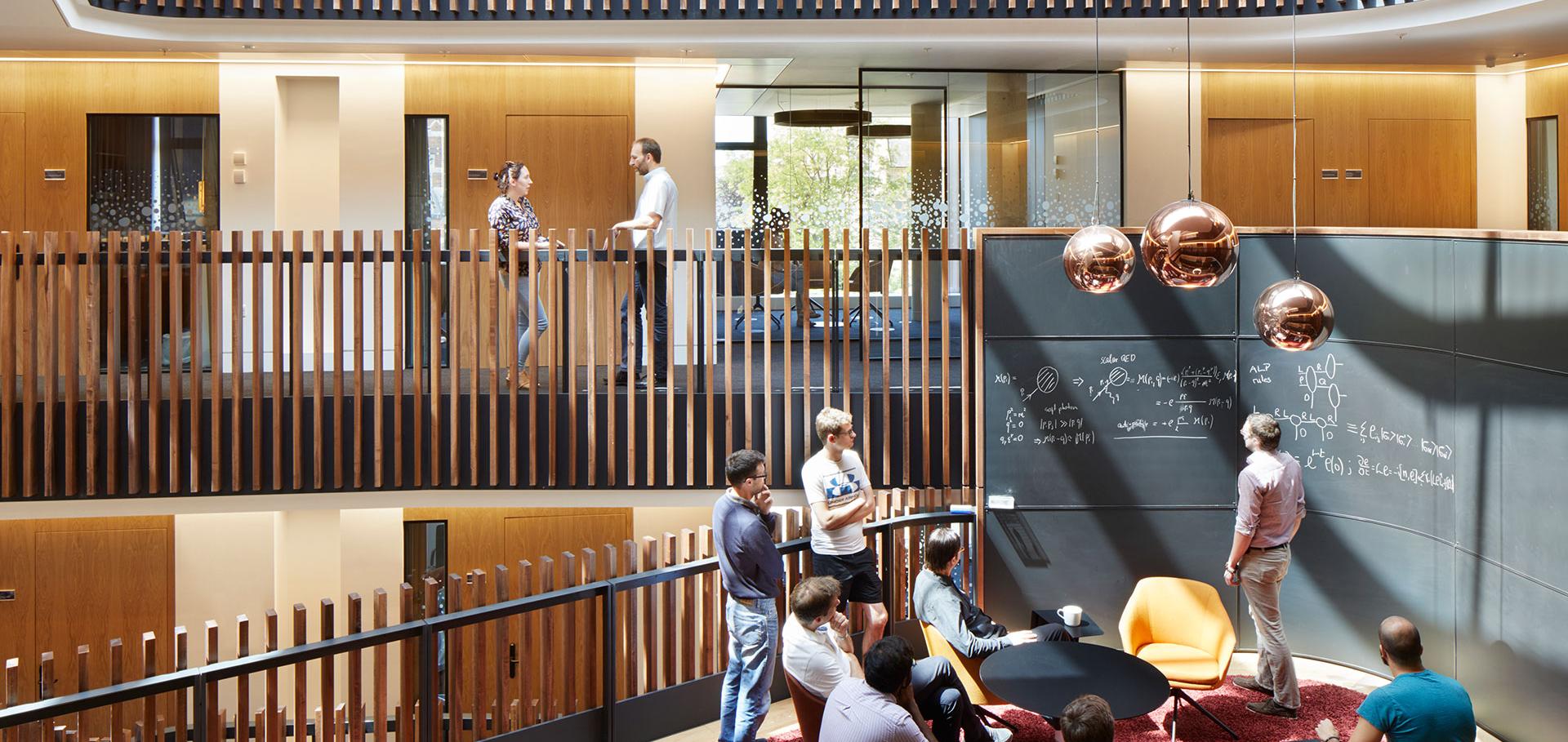
Theoretical physicists working at a blackboard collaboration pod in the Beecroft building.
Credit: Jack Hobhouse

Prof Michael Barnes

Professor in Theoretical Physics

Sub department

  • Rudolf Peierls Centre for Theoretical Physics

Research groups

  • Theoretical astrophysics and plasma physics at RPC
michael.barnes@physics.ox.ac.uk
Telephone: 01865 (2)73960
Rudolf Peierls Centre for Theoretical Physics, room 50.10
  • About
  • Publications

Extended electron tails in electrostatic microinstabilities and the nonadiabatic response of passing electrons

(2021)

Authors:

MR Hardman, FI Parra, C Chong, T Adkins, MS Anastopoulos-Tzanis, M Barnes, D Dickinson, JF Parisi, H Wilson
More details from the publisher

Electrostatic gyrokinetic simulations in Wendelstein 7-X geometry: benchmark between the codes stella and GENE

(2021)

Authors:

A González-Jerez, P Xanthopoulos, JM García-Regaña, I Calvo, J Alcusón, A Bañón-Navarro, M Barnes, FI Parra, J Geiger
More details from the publisher
Details from ArXiV

Turbulent transport of impurities in 3D devices

(2021)

Authors:

JM García-Regaña, M Barnes, I Calvo, A González-Jerez, H Thienpondt, E Sánchez, FI Parra, D St -Onge
More details from the publisher

Gyrokinetic simulations in stellarators using different computational domains

(2021)

Authors:

E Sánchez, JM García-Regaña, A Bañón Navarro, JHE Proll, C Mora Moreno, A González-Jerez, I Calvo, R Kleiber, J Riemann, J Smoniewski, M Barnes, FI Parra
More details from the publisher
Details from ArXiV

Continuous-in-time approach to flow shear in a linearly implicit local δf gyrokinetic code

Journal of Plasma Physics Cambridge University Press 87:2 (2021) 905870230

Authors:

Nicolas Christen, Michael Barnes, Felix I Parra

Abstract:

A new algorithm for toroidal flow shear in a linearly implicit, local δf gyrokinetic code is described. Unlike the current approach followed by a number of codes, it treats flow shear continuously in time. In the linear gyrokinetic equation, time-dependences arising from the presence of flow shear are decomposed in such a way that they can be treated explicitly in time with no stringent constraint on the time step. Flow shear related time dependences in the nonlinear term are taken into account exactly, and time dependences in the quasineutrality equation are interpolated. Test cases validating the continuous-in-time implementation in the code GS2 are presented. Lastly, nonlinear gyrokinetic simulations of a JET discharge illustrate the differences observed in turbulent transport compared with the usual, discrete-in-time approach. The continuous-in-time approach is shown, in some cases, to produce fluxes that converge to a different value than with the discrete approach. The new approach can also lead to substantial computational savings by requiring radially narrower boxes. At fixed box size, the continuous implementation is only modestly slower than the previous, discrete approach.
More details from the publisher
Details from ORA
More details

Pagination

  • First page First
  • Previous page Prev
  • …
  • Page 9
  • Page 10
  • Page 11
  • Page 12
  • Current page 13
  • Page 14
  • Page 15
  • Page 16
  • Page 17
  • …
  • Next page Next
  • Last page Last

Footer Menu

  • Contact us
  • Giving to the Dept of Physics
  • Work with us
  • Media

User account menu

  • Log in

Follow us

FIND US

Clarendon Laboratory,

Parks Road,

Oxford,

OX1 3PU

CONTACT US

Tel: +44(0)1865272200

University of Oxfrod logo Department Of Physics text logo
IOP Juno Champion logo Athena Swan Silver Award logo

© University of Oxford - Department of Physics

Cookies | Privacy policy | Accessibility statement

Built by: Versantus

  • Home
  • Research
  • Study
  • Engage
  • Our people
  • News & Comment
  • Events
  • Our facilities & services
  • About us
  • Giving to Physics
  • Current students
  • Staff intranet