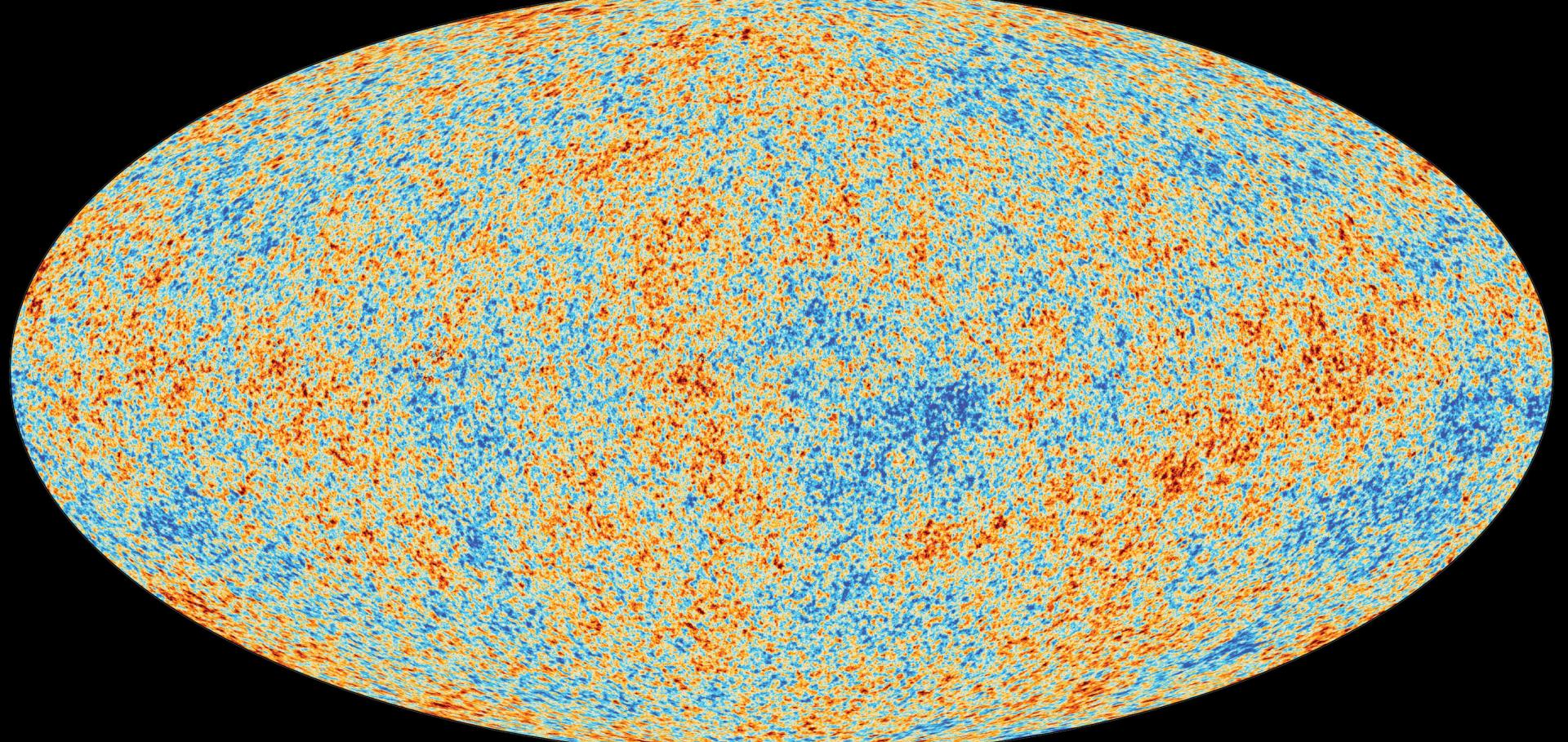
A Test of the Cosmological Principle with Quasars

Letters of the Astrophysical Journal American Astronomical Society 908 (2021) L51-L51

Authors:

Nathan Secrest, Sebastian von Hausegger, Mohamed Rameez, Roya Mohayaee, Subir Sarkar, Jacques Colin

Abstract:

We study the large-scale anisotropy of the Universe by measuring the dipole in the angular distribution of a flux-limited, all-sky sample of 1.36 million quasars observed by the Wide-field Infrared Survey Explorer (WISE). This sample is derived from the new CatWISE2020 catalog, which contains deep photometric measurements at 3.4 and 4.6 $\mu$m from the cryogenic, post-cryogenic, and reactivation phases of the WISE mission. While the direction of the dipole in the quasar sky is similar to that of the cosmic microwave background (CMB), its amplitude is over twice as large as expected, rejecting the canonical, exclusively kinematic interpretation of the CMB dipole with a p-value of $5\times10^{-7}$ ($4.9\sigma$ for a normal distribution, one-sided), the highest significance achieved to date in such studies. Our results are in conflict with the cosmological principle, a foundational assumption of the concordance $\Lambda$CDM model.

Growth of accretion driven scalar hair around Kerr black holes

Physical Review D American Physical Society (APS) 103:4 (2021) 44059

Authors:

Jamie Bamber, Katy Clough, Pedro G Ferreira, Lam Hui, Macarena Lagos

KiDS-1000 Cosmology: Multi-probe weak gravitational lensing and spectroscopic galaxy clustering constraints

ASTRONOMY & ASTROPHYSICS 646 (2021) ARTN A140

Authors:

Catherine Heymans, Tilman Troester, Marika Asgari, Chris Blake, Hendrik Hildebrandt, Benjamin Joachimi, Konrad Kuijken, Chieh-An Lin, Ariel G Sanchez, Jan Luca van den Busch, Angus H Wright, Alexandra Amon, Maciej Bilicki, Jelte de Jong, Martin Crocce, Andrej Dvornik, Thomas Erben, Maria Cristina Fortuna, Fedor Getman, Benjamin Giblin, Karl Glazebrook, Henk Hoekstra, Shahab Joudaki, Arun Kannawadi, Fabian Koehlinger, Chris Lidman, Lance Miller, Nicola R Napolitano, David Parkinson, Peter Schneider, HuanYuan Shan, Edwin A Valentijn, Gijs Verdoes Kleijn, Christian Wolf

Probing galaxy bias and intergalactic gas pressure with KiDS Galaxies-tSZ-CMB lensing cross-correlations

(2021)

Authors:

Ziang Yan, Ludovic van Waerbeke, Tilman Tröster, Angus H Wright, David Alonso, Marika Asgari, Maciej Bilicki, Thomas Erben, Shiming Gu, Catherine Heymans, Hendrik Hildebrandt, Gary Hinshaw, Nick Koukoufilippas, Arun Kannawadi, Konrad Kuijken, Alexander Mead, HuanYuan Shan

Novel Probes Project: Tests of gravity on astrophysical scales

REVIEWS OF MODERN PHYSICS 93:1 (2021) 15003

Authors:

Tessa Baker, Alexandre Barreira, Harry Desmond, Pedro Ferreira, Bhuvnesh Jain, Kazuya Koyama, Baojiu Li, Lucas Lombriser, Andrina Nicola, Jeremy Sakstein, Fabian Schmidt

Abstract:

The Novel Probes Project, an initiative to advance the field of astrophysical tests of the dark sector by creating a forum that connects observers and theorists, is introduced. This review focuses on tests of gravity and is intended to be of use primarily to observers, as well as theorists with an interest in the development of experimental tests. It is twinned with a separate upcoming review on dark matter self-interactions. The review focuses on astrophysical tests of gravity in the weak-field regime, ranging from stars to quasilinear cosmological scales. This regime is complementary to both strong-field tests of gravity and background and linear probes in cosmology. In particular, the nonlinear screening mechanisms that are an integral part of viable modified-gravity models lead to characteristic signatures, specifically on astrophysical scales. The potential of these probes is not limited by cosmic variance but comes with the challenge of building robust theoretical models of the nonlinear dynamics of stars, galaxies, and large-scale structure. The groundwork is laid for a thorough exploration of the weak-field, nonlinear regime, with an eye to using the current and next generation of observations for tests of gravity. The scene is set by showing how gravitational theories beyond general relativity are expected to behave, focusing primarily on screening mechanisms. Analytic and numerical techniques for exploring the relevant astrophysical regime are described, as are the pertinent observational signals. With these in hand a range of astrophysical tests of gravity are presented, and prospects for future measurements and theoretical developments are discussed.