A robust, template-free approach to precise radial velocity extraction

(2019)

Authors:

Vinesh M Rajpaul, Suzanne Aigrain, Lars A Buchhave

Transit signatures of inhomogeneous clouds on hot Jupiters: insights from microphysical cloud modeling

Astrophysical Journal American Astronomical Society 887:2 (2019) 170

Authors:

Diana Powell, Tom Louden, Laura Kreidberg, Xi Zhang, Peter Gao, Vivien Parmentier

Abstract:

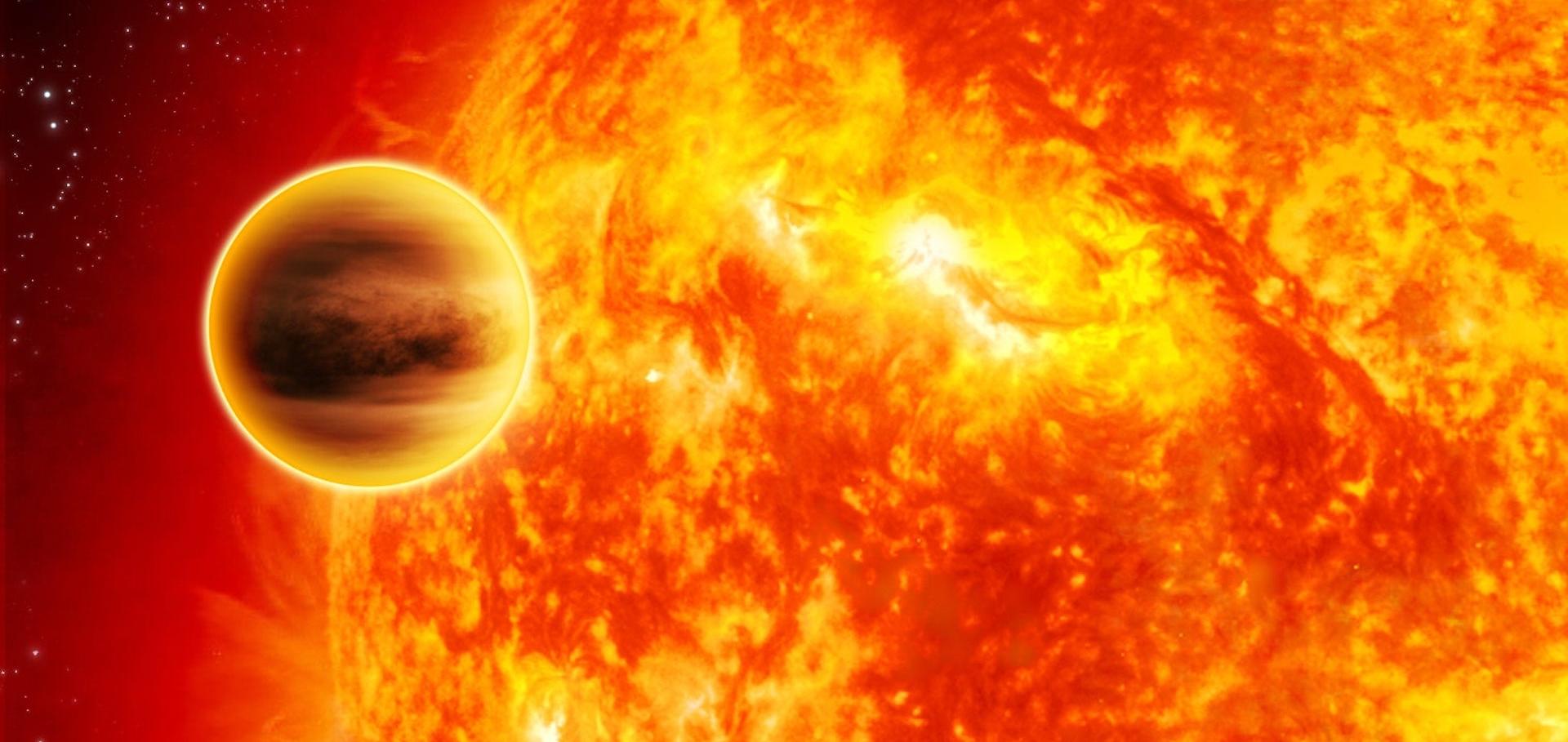
We determine the observability in transmission of inhomogeneous cloud cover on the limbs of hot Jupiters through post-processing a general circulation model to include cloud distributions computed using a cloud microphysics model. We find that both the east and west limbs often form clouds, but that the different properties of these clouds enhance the limb-to-limb differences compared to the clear case. Using the James Webb Space Telescope, it should be possible to detect the presence of cloud inhomogeneities by comparing the shape of the transit light curve at multiple wavelengths because inhomogeneous clouds impart a characteristic, wavelength-dependent signature. This method is statistically robust even with limited wavelength coverage, uncertainty on limb-darkening coefficients, and imprecise transit times. We predict that the short-wavelength slope varies strongly with temperature. The hot limbs of the hottest planets form higher-altitude clouds composed of smaller particles, leading to a strong Rayleigh slope. The near-infrared spectral features of clouds are almost always detectable, even when no spectral slope is visible in the optical. In some of our models a spectral window between 5 and 9 μm can be used to probe through the clouds and detect chemical spectral features. Our cloud particle size distributions are not lognormal and differ from species to species. Using the area- or mass-weighted particle size significantly alters the relative strength of the cloud spectral features compared to using the predicted size distribution. Finally, the cloud content of a given planet is sensitive to a species' desorption energy and contact angle, two parameters that could be constrained experimentally in the future.

Black Hole-Galaxy Scaling Relation Evolution From z~2.5: Simulated Observations With HARMONI on the ELT

Frontiers in Astronomy and Space Sciences Frontiers 6 (2019) 73

Authors:

Begoña García-Lorenzo, Ana Monreal-Ibero, Evencio Mediavilla, Miguel Pereira-Santaella, Niranjan Thatte

Non–adiabatic tidal oscillations induced by a planetary companion

Monthly Notices of the Royal Astronomical Society Oxford University Press (OUP) (2019)

Authors:

Andrew Bunting, John CB Papaloizou, Caroline Terquem

Abstract:

Abstract We calculate the dynamical tides raised by a close planetary companion on non–rotating stars of 1 M⊙ and 1.4 M⊙. Using the Henyey method, we solve the fully non–adiabatic equations throughout the star. The horizontal Lagrangian displacement is found to be 10 to 100 times larger than the equilibrium tide value in a thin region near the surface of the star. This is because non–adiabatic effects dominate in a region that extends from below the outer edge of the convection zone up to the stellar surface, and the equilibrium tide approximation is inconsistent with non–adiabaticity. Although this approximation generally applies in the low frequency limit, it also fails in the parts of the convection zone where the forcing frequency is small but larger than the Brunt-Väisälä frequency. We derive analytical estimates which give a good approximation to the numerical values of the magnitude of the ratio of the horizontal and radial displacements at the surface. The relative surface flux perturbation is also significant, on the order of 0.1% for a system modelled on 51 Pegasi b. Observations affected by the horizontal displacement may therefore be more achievable than previously thought, and brightness perturbations may be the result of flux perturbations rather than due to the radial displacement. We discuss the implication of this on the possibility of detecting such tidally excited oscillations, including the prospect of utilising the large horizontal motion for observations of systems such as 51 Pegasi.

An unusually large gaseous transit in a debris disc

Monthly Notices of the Royal Astronomical Society 490:4 (2019) 5218-5227

Authors:

DP Iglesias, J Olofsson, A Bayo, S Zieba, M Montesinos, J Smoker, GM Kennedy, N Godoy, B Pantoja, GJ Talens, Z Wahhaj, C Zamora

Abstract:

We present the detection of an unusually large transient gas absorption in several ionized species in the debris disc star HD 37306 using high-resolution optical spectra. We have been analysing a large sample of debris discs searching for circumstellar gas absorptions aiming to determine the frequency of gas in debris discs. HD 37306 stood out showing remarkably broad absorptions superimposed on to several photospheric Ca II, Fe II, and Ti II lines. The observed absorptions, unlike typical exocometary transits, lasted for at least eight days. Here, we analyse simultaneous spectroscopic and photometric data of the event and evaluate different scenarios that might explain the observed features. We conclude that the most likely scenario might be an exocometary break-up releasing a significant amount of gas close to the star, producing an occulting 'ring'/'torus' shape.