

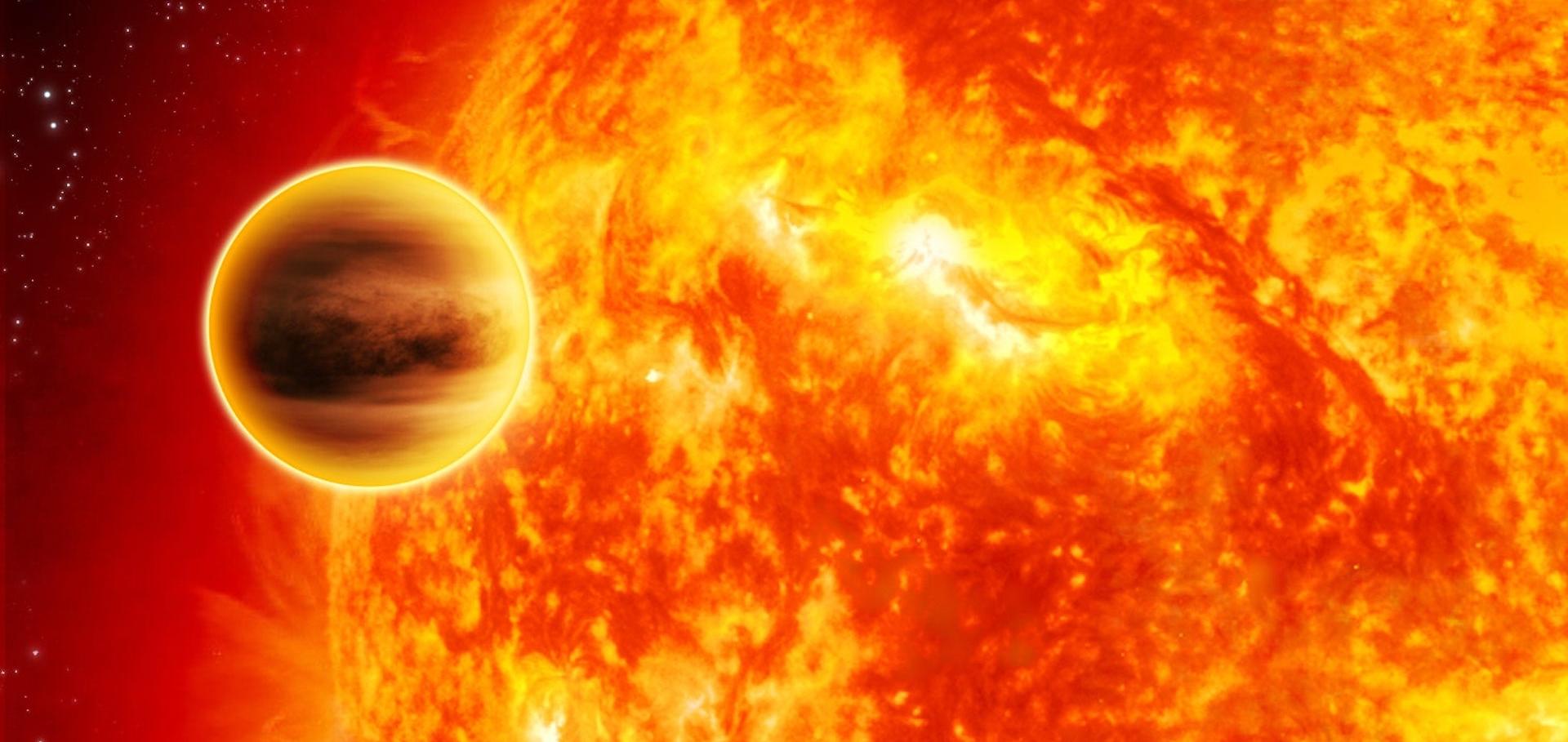
Dynamically Coupled Three-dimensional Cloud Chemistry in Rapidly Rotating Irradiated Atmospheres: An Application to the Compact White Dwarf–Brown Dwarf System ZTFJ0038+2030
Astrophysical Journal 1011:2 (2026)
Abstract:
Clouds and disequilibrium chemistry shape the observable properties of substellar and planetary atmospheres, and JWST time-resolved spectroscopy now enables direct tests of their three-dimensional (3D) structures. We present an update to the 3D atmospheric framework ADAM, coupling the dynamical core to a miniature kinetic chemistry scheme (mini-chem) and a saturation–relaxation-tracer cloud module. Using this framework, we investigate the atmosphere of the brown dwarf orbiting the white dwarf ZTFJ0038+2030 in a 10 hr orbit. The brown dwarf receives stellar irradiation comparable to its internal heat flux, placing the atmosphere in a regime where the circulation is characterized by a standing Matsuno–Gill wave response and equatorial superrotation. Rapid rotation confines these structures closer to the equator, producing more symmetric broadband light curves with smaller hotspot offsets than canonical hot Jupiters, in agreement with recent JWST observations of this system. Circulation-driven disequilibrium chemistry enhances global mean CO and COThe tale of the three planets: 3D cloud feedback increases the spectral diversity of warm Jupiters
Astronomy and Astrophysics 715 (2026)
Abstract:
Context. The JWST has revealed a large diversity of warm Jupiter spectra, despite broadly similar planetary parameters across the population. The main driver of this diversity remains unclear. Aims. We aim to identify the mechanisms responsible for the spectral differences of three warm Jupiter-size exoplanets observed by JWST: whereas WASP-80b appears mostly cloud-free, both WASP-107b and WASP-69b have spectra dominated by clouds. Methods. We modeled each planet using the same framework, ADAM (formerly SPARC/MITgcm), which solves for the interactions among cloud transport, radiative transfer, and atmospheric circulation in 3D. We investigated three condensate species (NaBreaking the Blend: A multi-tracer kinematic decomposition method for IFS data applied to disentangling the AGN outflow and circumnuclear ring in NGC 5728 with JWST
Monthly Notices of the Royal Astronomical Society (2026) stag1917
Abstract:
Integral field spectroscopy (IFS) of the central kiloparsecs of active galactic nuclei (AGN) reveals a mixture of spatially coincident emission from star-formation and AGN feedback exciting the interstellar medium. Disentangling these components remains a challenge, as most spectral tracers are affected by both processes, limiting robust interpretation of kinematics and energetics. We present a new framework for decomposing IFS data into distinct components on a spaxel-by-spaxel basis using a multi-tracer, stacked kinematics approach. This method combines kinematic modelling with imposed flux decomposition per spaxel, quantifying the contribution of each component across the field of view. We apply this method to JWST IFS observations of the Seyfert galaxy NGC 5728 from the Galaxy Activity, Torus, and Outflow Survey (GATOS), analysing twelve mid-infrared fine-structure lines (4.49 ≤ λ ≤ 25.89μm, 7.9 ≤ IP ≤126.2 eV). We find that the circumnuclear emission can be decomposed into two dominant components: a star-forming ring and an AGN-driven biconical outflow. Our method separates these structures and recovers their detailed spatial morphology. This framework provides a general and scalable method for physically motivated component separation in IFS data, applicable across many wavelength ranges and targets, enabling reliable interpretation of complex emission line structures (or morphologies) in active galaxies and beyond.Detecting transiting exoplanets in simulated PLATO data. A comparison of light curve filter and transit search algorithms
Astronomy & Astrophysics EDP Sciences (2026)
Abstract:
Our goal is to test and compare transit search methodologies, and provide recommendations as to the best practices to be implemented by the upcoming ESA PLATO mission, in order to achieve its goal of detecting Earth-like planets in the habitable zones of Sun-like stars. We generated simulated two-year PLATO light curves with injected planets with sizes 0.5--2.0 R_⊕, and compared the performance of the ̧etra , ̆mbra , and νance transit search methods. ̧etra and ̆mbra require pre-filtered light curves and we tested four filters: the biweight, Huber spline, LOcally WEighted Scatterplot Smoothing (LOWESS), and the LOWESS-based young stars detrending (YSD) filters. νance uses a Gaussian process to model the stellar variability at all proposed transit parameters. νance achieves the best performance, recovering 61.2% of signals using a simple harmonic oscillator Gaussian process kernel, and it performs especially well for both hot and fast-rotating stars. However, when multiple Huber spline filter windows are considered, both ̧etra and ̆mbra can match νance 's performance. Using four windows ̧etra recovers 61.3% of signals, and using just two windows ̆mbra recovers 61.7% of signals. Recovery rates exceeding νance are possible by using more windows. The computational cost of running νance is so high that running ̧etra or ̆mbra on multiple windows is preferred. The PLATO pipeline should use the Huber spline with a range of window sizes as its primary light curve filter. ̧etra should be updated to use the warped least-squares templates implemented in ̆mbra . The use of νance should be considered for hot, rapidly rotating stars.A Neptune Sized Planet Candidate Orbiting K-dwarf TIC 392664683 from TESS Data
Research Notes of the AAS American Astronomical Society 10:10 (2026) 284