

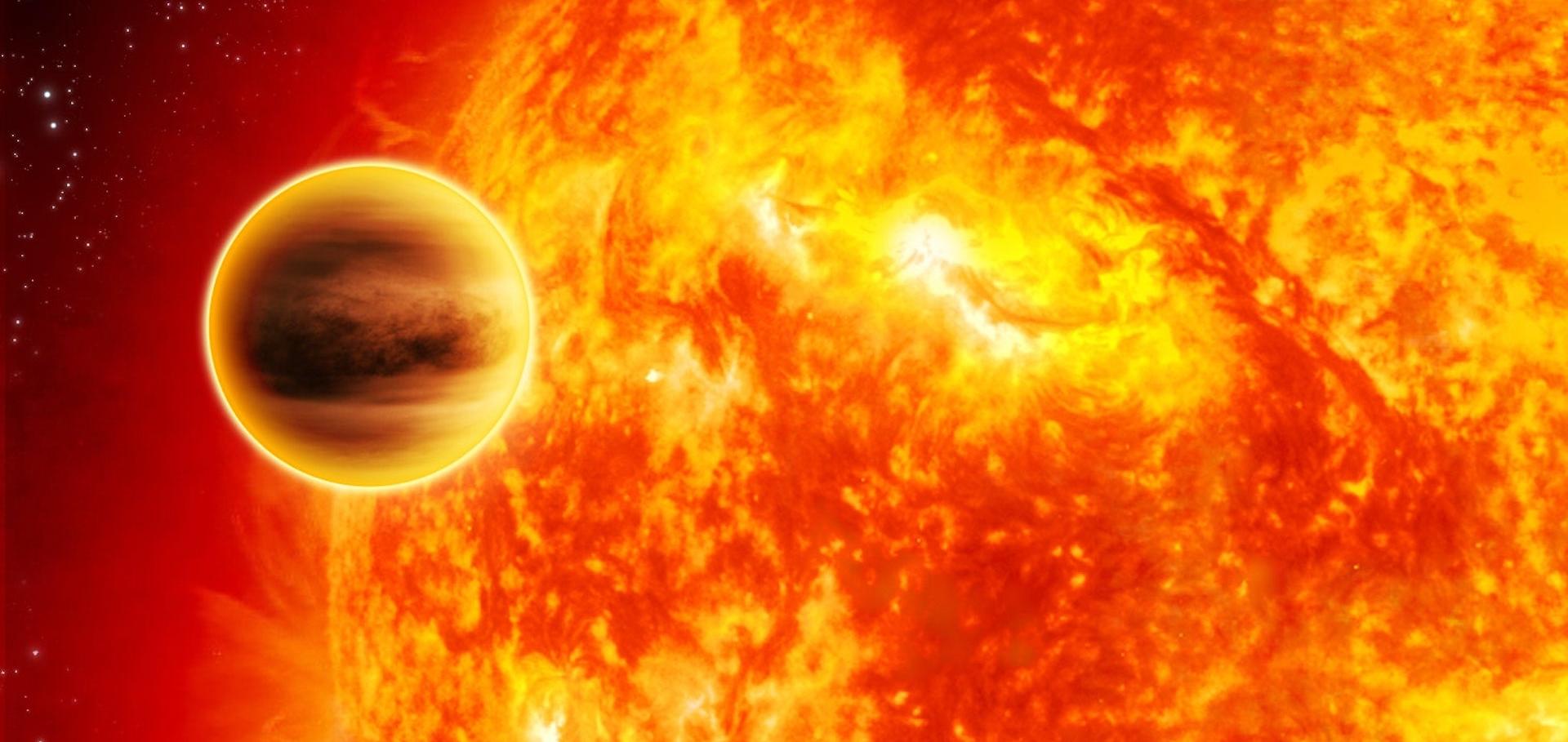
HST hot Jupiter transmission spectral survey: evidence for aerosols and lack of TiO in the atmosphere of WASP-12b
(2013)
Nonlinear Phenomena in Atmospheric and Oceanic Sciences
Springer, 2013
Abstract:
This IMA Volume in Mathematics and its Applications NONLINEAR PHENOMENA IN ATMOSPHERIC AND OCEANIC SCIENCES is based on the proceedings of a workshop which was an integral part of the 1989-90 IMA program on "Dynamical Systems and their ...Stellar rotation periods of the Kepler objects of interest: A dearth of close-in planets around fast rotators
Astrophysical Journal Letters 775:1 (2013)
Abstract:
We present a large sample of stellar rotation periods for Kepler Objects of Interest, based on three years of public Kepler data. These were measured by detecting periodic photometric modulation caused by star spots, using an algorithm based on the autocorrelation function of the light curve, developed recently by McQuillan, Aigrain & Mazeh (2013). Of the 1919 main-sequence exoplanet hosts analyzed, robust rotation periods were detected for 737. Comparing the detected stellar periods to the orbital periods of the innermost planet in each system reveals a notable lack of close-in planets around rapid rotators. It appears that only slowly spinning stars with rotation periods longer than 5-10 days host planets on orbits shorter than 2 or 3 days, although the mechanism(s) that lead(s) to this is not clear. © 2013. The American Astronomical Society. All rights reserved.Hubble Space Telescope hot Jupiter Transmission Spectral Survey: detection of water in HAT-P-1b from Wide Field Camera 3 near-infrared spatial scan observations
Monthly Notices of the Royal Astronomical Society Blackwell Publishing Inc. (2013)
Abstract:
We present Hubble Space Telescope near-infrared transmission spectroscopy of the transiting hot-Jupiter HAT-P-1b. We observed one transit with Wide Field Camera 3 using the G141 low-resolution grism to cover the wavelength range 1.087- 1.678 {\mu}m. These time series observations were taken with the newly available spatial scan mode that increases the duty cycle by nearly a factor of two, thus improving the resulting photometric precision of the data. We measure a planet-to-star radius ratio of Rp/R*=0.11709+/-0.00038 in the white light curve with the centre of transit occurring at 2456114.345+/-0.000133 (JD). We achieve S/N levels per exposure of 1840 (0.061%) at a resolution of {\Delta\lambda}=19.2nm (R~70) in the 1.1173 - 1.6549{\mu}m spectral region, providing the precision necessary to probe the transmission spectrum of the planet at close to the resolution limit of the instrument. We compute the transmission spectrum using both single target and differential photometry with similar results. The resultant transmission spectrum shows a significant absorption above the 5-{\sigma} level matching the 1.4{\mu}m water absorption band. In solar composition models, the water absorption is sensitive to the ~1 mbar pressure levels at the terminator. The detected absorption agrees with that predicted by an 1000 K isothermal model, as well as with that predicted by a planetary-averaged temperature model.Kepler-77b: A very low albedo, Saturn-mass transiting planet around a metal-rich solar-like star
Astronomy and Astrophysics 557 (2013)