Home
Department Of Physics text logo
  • Research
    • Our research
    • Our research groups
    • Our research in action
    • Research funding support
    • Summer internships for undergraduates
  • Study
    • Undergraduates
    • Postgraduates
  • Engage
    • For alumni
    • For business
    • For schools
    • For the public
  • Support
Menu
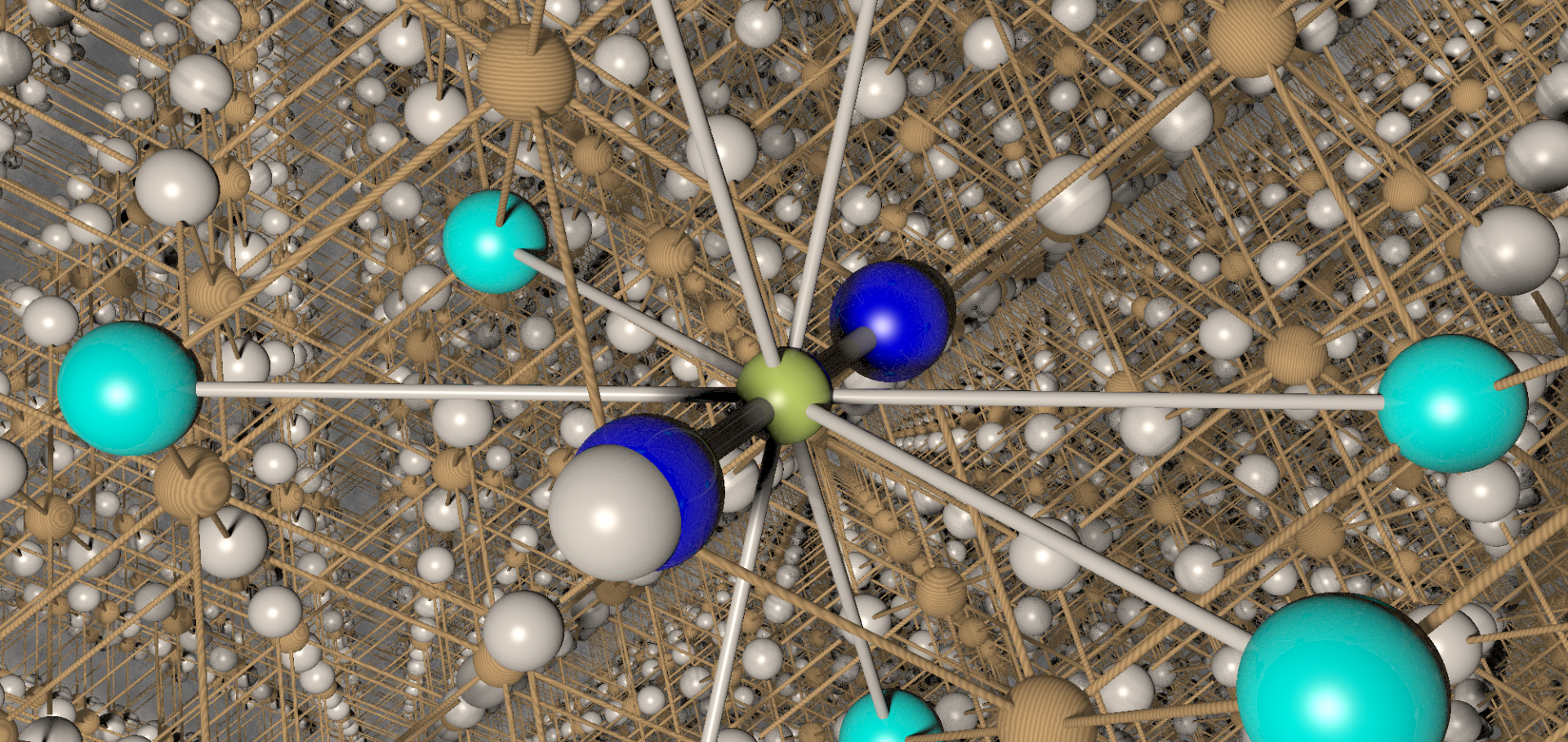
Crystal structure inside calcium fluoride with an implanted muon
Credit: SJB

Professor Stephen Blundell

Professor of Physics

Research theme

  • Quantum materials

Sub department

  • Condensed Matter Physics

Research groups

  • Muons and magnets
Stephen.Blundell@physics.ox.ac.uk
Telephone: 01865 (2)72347
Clarendon Laboratory, room 108
  • About
  • Books
  • Teaching
  • Research
  • Publications

HiFi-A new high field muon spectrometer at ISIS

Physica B Condensed Matter 404:5-7 (2009) 978-981

Authors:

Z Salman, PJ Baker, SJ Blundell, SP Cottrell, SR Giblin, AD Hillier, BH Holsman, PJC King, T Lancaster, JS Lord, I McKenzie, J Nightingale, FL Pratt, R Scheuermann

Abstract:

A new μ SR spectrometer (HiFi) is being constructed at the ISIS pulsed muon source. The spectrometer is intended for measurements in longitudinal magnetic fields up to 5 T. Here we discuss various aspects of the design and future operation of the HiFi spectrometer. Detailed analysis of the detector design is presented, and results from tests on detector prototypes are compared to simulations. Potential applications of this spectrometer in the fields of condensed matter and chemistry are also discussed. © 2008 Elsevier B.V. All rights reserved.
More details from the publisher
More details

Characterization of the antiferromagnetism in Ag(pyz)2(S2O8) (pyz = pyrazine) with a two-dimensional square lattice of Ag2+ ions.

J Am Chem Soc 131:13 (2009) 4590-4591

Authors:

Jamie L Manson, Kevin H Stone, Heather I Southerland, Tom Lancaster, Andrew J Steele, Stephen J Blundell, Francis L Pratt, Peter J Baker, Ross D McDonald, Pinaki Sengupta, John Singleton, Paul A Goddard, Changhoon Lee, Myung-Hwan Whangbo, Michelle M Warter, Charles H Mielke, Peter W Stephens

Abstract:

X-ray powder diffraction and magnetic susceptibility measurements show that Ag(pyz)(2)(S(2)O(8)) consists of 2D square nets of Ag(2+) ions resulting from the corner-sharing of axially elongated AgN(4)O(2) octahedra and exhibits characteristic 2D antiferromagnetism. Nevertheless, mu(+)SR measurements indicate that Ag(pyz)(2)(S(2)O(8)) undergoes 3D magnetic ordering below 7.8(3) K.
More details from the publisher
More details

Two-dimensional XY behavior observed in quasi-two-dimensional quantum Heisenberg antiferromagnets

Physical Review B - Condensed Matter and Materials Physics 79:13 (2009)

Authors:

F Xiao, FM Woodward, CP Landee, MM Turnbull, C Mielke, N Harrison, T Lancaster, SJ Blundell, PJ Baker, P Babkevich, FL Pratt

Abstract:

The magnetic properties of a family of molecular-based quasi-two- dimensional S=1/2 Heisenberg antiferromagnets are reported. Three compounds, [Cu (pz) 2 (ClO4) 2, Cu (pz) 2 (BF4) 2, and [Cu (pz) 2 (NO3)] (PF6)] contain similar planes of Cu2+ ions linked into magnetically square lattices by bridging pyrazine molecules (pz= C4 H4 N2). The anions provide charge balance as well as isolation between the layers. Single crystal measurements of susceptibility and magnetization, as well as muon-spin-relaxation studies, reveal low ratios of Néel temperatures to exchange strengths (4.25/17.5=0.243, 3.80/15.3=0.248, and 3.05/10.8=0.282, respectively) while the ratio of the anisotropy fields HA (kOe) to the saturation field HSAT (kOe) are small (2.6/490=5.3× 10-3, 2.4/430=5.5× 10-3, and 0.07/300=2.3× 10-4, respectively), demonstrating close approximations to a two-dimensional Heisenberg model. The susceptibilities of ClO4 and BF4 show evidence of an exchange-anisotropy crossover (Heisenberg to XY) at low temperatures; their ordering transitions are primarily driven by the XY behavior with the ultimate three-dimensional transition appearing parasitically. The PF6 compound remains Heisenberg type at all temperatures, with its transition to the Néel state due to the interlayer interactions. Effects of field-induced anisotropy have been observed. © 2009 The American Physical Society.
More details from the publisher
More details

Coexistence of static magnetism and superconductivity in SmFeAsO(1-x)F(x) as revealed by muon spin rotation.

Nat Mater 8:4 (2009) 310-314

Authors:

AJ Drew, Ch Niedermayer, PJ Baker, FL Pratt, SJ Blundell, T Lancaster, RH Liu, G Wu, XH Chen, I Watanabe, VK Malik, A Dubroka, M Rössle, KW Kim, C Baines, C Bernhard

Abstract:

The recent observation of superconductivity with critical temperatures (Tc) up to 55 K in the pnictide RFeAsO(1-x)F(x), where R is a lanthanide, marks the first discovery of a non-copper-oxide-based layered high-Tc superconductor. It has raised the suspicion that these new materials share a similar pairing mechanism to the cuprate superconductors, as both families exhibit superconductivity following charge doping of a magnetic parent material. In this context, it is important to follow the evolution of the microscopic magnetic properties of the pnictides with doping and hence to determine whether magnetic correlations coexist with superconductivity. Here, we present a muon spin rotation study on SmFeAsO(1-x)F(x), with x=0-0.30 that shows that, as in the cuprates, static magnetism persists well into the superconducting regime. This analogy is quite surprising as the parent compounds of the two families have rather different magnetic ground states: itinerant spin density wave for the pnictides contrasted with the Mott-Hubbard insulator in the cuprates. Our findings therefore suggest that the proximity to magnetic order and associated soft magnetic fluctuations, rather than strong electronic correlations in the vicinity of a Mott-Hubbard transition, may be the key ingredients of high-Tc superconductors.
More details from the publisher
More details

Muon spin relaxation studies of critical fluctuations and diffusive spin dynamics in molecular magnets

Physica B Condensed Matter Elsevier 404:5-7 (2009) 585-589

Authors:

Francis Pratt, Tom Lancaster, Peter Baker, Stephen Blundell, Wakako Kaneko, Masaaki Ohba, Susumu Kitagawa, Seiko Ohira-Kawamura, Seishi Takagi
More details from the publisher

Pagination

  • First page First
  • Previous page Prev
  • …
  • Page 112
  • Page 113
  • Page 114
  • Page 115
  • Current page 116
  • Page 117
  • Page 118
  • Page 119
  • Page 120
  • …
  • Next page Next
  • Last page Last

Footer Menu

  • Contact us
  • Giving to the Dept of Physics
  • Work with us
  • Media

User account menu

  • Log in

Follow us

FIND US

Clarendon Laboratory,

Parks Road,

Oxford,

OX1 3PU

CONTACT US

Tel: +44(0)1865272200

University of Oxfrod logo Department Of Physics text logo
IOP Juno Champion logo Athena Swan Silver Award logo

© University of Oxford - Department of Physics

Cookies | Privacy policy | Accessibility statement

Built by: Versantus

  • Home
  • Research
  • Study
  • Engage
  • Our people
  • News & Comment
  • Events
  • Our facilities & services
  • About us
  • Giving to Physics
  • Current students
  • Staff intranet