Home
Department Of Physics text logo
  • Research
    • Our research
    • Our research groups
    • Our research in action
    • Research funding support
    • Summer internships for undergraduates
  • Study
    • Undergraduates
    • Postgraduates
  • Engage
    • For alumni
    • For business
    • For schools
    • For the public
  • Support
Menu
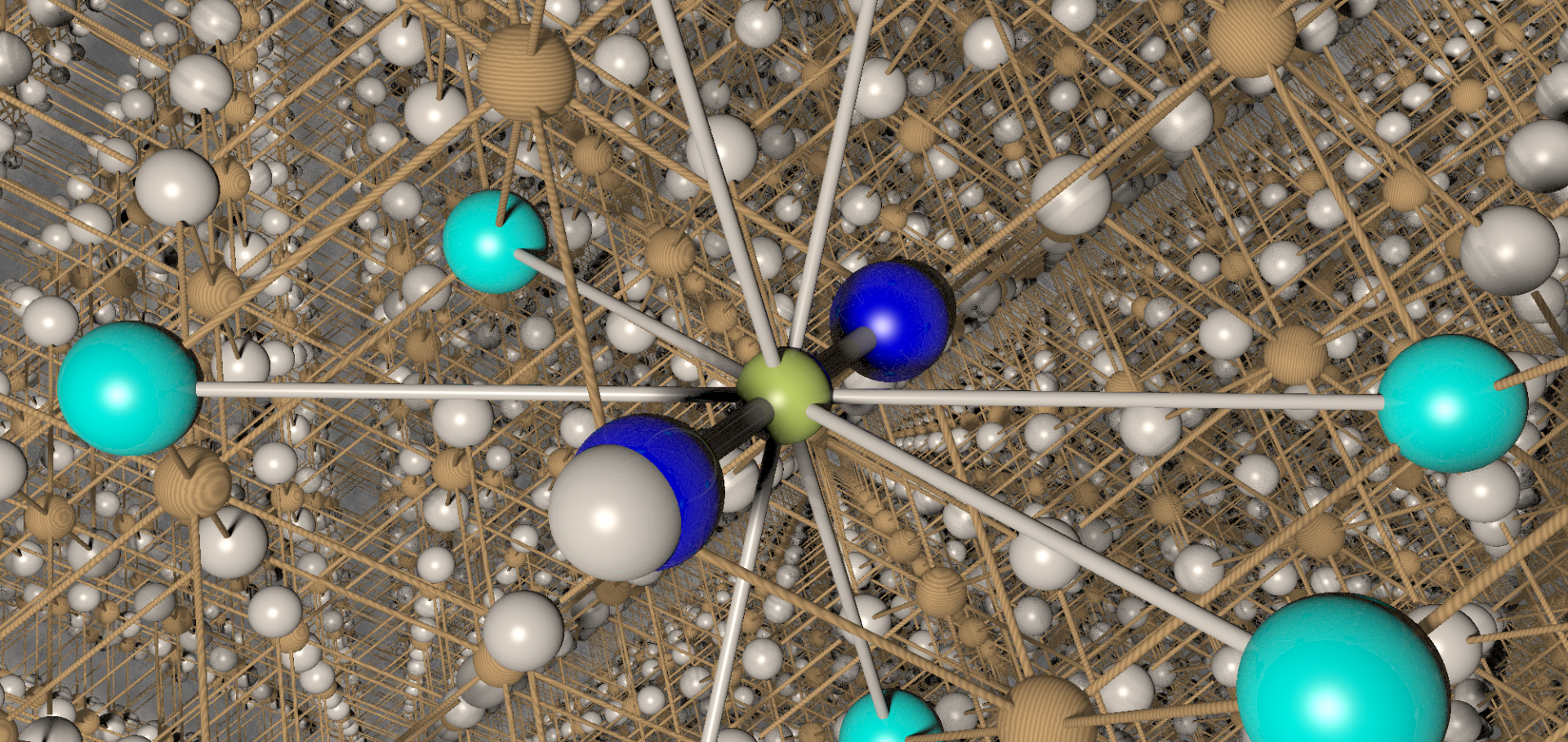
Crystal structure inside calcium fluoride with an implanted muon
Credit: SJB

Professor Stephen Blundell

Professor of Physics

Research theme

  • Quantum materials

Sub department

  • Condensed Matter Physics

Research groups

  • Muons and magnets
Stephen.Blundell@physics.ox.ac.uk
Telephone: 01865 (2)72347
Clarendon Laboratory, room 108
  • About
  • Books
  • Teaching
  • Research
  • Publications

Tuning the interlayer spacing of high-T_{c} Bi-based superconductors by intercalation: measuring the penetration depth and the two-dimensional superfluid density.

Phys Rev Lett 102:8 (2009) 087002

Authors:

PJ Baker, T Lancaster, SJ Blundell, FL Pratt, ML Brooks, S-J Kwon

Abstract:

Substantial control of the interlayer spacing in Bi-based high temperature superconductors has been achieved through the intercalation of guest molecules between the superconducting layers. Measurements using implanted muons reveal that the penetration depth increases with increasing layer separation while T_{c} does not vary appreciably, demonstrating that the bulk superfluid density is not the determining factor controlling T_{c}. Our results strongly suggest that for Bi-based high temperature superconductors the superfluid density appearing in the Uemura scaling relation rho_{s} proportional, variantT_{c} should be interpreted as the two-dimensional density within the superconducting layers, which we find to be constant for each class of system investigated.
More details from the publisher
More details

Enhanced superfluid stiffness, lowered superconducting transition temperature, and field-induced magnetic state of the pnictide superconductor LiFeAs

Physical Review B - Condensed Matter and Materials Physics 79:5 (2009)

Authors:

FL Pratt, PJ Baker, SJ Blundell, T Lancaster, HJ Lewtas, P Adamson, MJ Pitcher, DR Parker, SJ Clarke

Abstract:

Transverse-field muon-spin rotation measurements performed on two samples of LiFeAs demonstrate that the superfluid stiffness of the superconducting condensate in relation to its superconducting transition temperature is enhanced compared to other pnictide superconductors. Evidence is seen for a field-induced magnetic state in a sample with a significantly suppressed superconducting transition temperature. The results in this system highlight the role of direct Fe-Fe interactions in frustrating pairing mediated by antiferromagnetic fluctuations and indicate that, in common with other pnictide superconductors, the system is close to a magnetic instability. © 2009 The American Physical Society.
More details from the publisher
More details

Two-dimensional magnetism in the pnictide superconductor parent material SrFeAsF probed by muon-spin relaxation

Physical Review B - Condensed Matter and Materials Physics 79:6 (2009)

Authors:

PJ Baker, I Franke, T Lancaster, SJ Blundell, L Kerslake, SJ Clarke

Abstract:

We report muon-spin relaxation measurements on SrFeAsF, which is the parent compound of an iron-arsenic- fluoride based series of superconducting materials. We find that this material has very similar magnetic properties to LaFeAsO, such as separated magnetic and structural transitions (TN =122 K, Ts =175 K), contrasting with SrFe2 As2 where they are coincident. The muon oscillation frequencies fall away very sharply at TN [β=0.22 (3)], which suggests that the magnetic exchange between the layers is weaker than in comparable oxypnictide compounds. Our specific-heat measurements show that a small but distinct feature occurs at Ts. There is no anomaly evident at TN as is typical for quasi-two-dimensional magnets. The magnetic entropy change between 100 and 185 K is ΔS=0.5 J mol-1 K-1. © 2009 The American Physical Society.
More details from the publisher
More details

ChemInform Abstract: Magnetic Properties and Magnetic Structures of Synthetic Natrochalcites, NaM2II(D3O2) (MoO4)2, M: Co or Ni.

ChemInform Wiley 40:1 (2009) no-no

Authors:

Serge Vilminot, Gilles Andre, Francoise Bouree‐Vigneron, Peter J Baker, Stephen J Blundell, Mohamedally Kurmoo
More details from the publisher

Magnetic breakdown and angle-dependent magnetoresistance oscillations

Physica B: Condensed Matter (2009)

Authors:

SJ Blundell, A Nowojewski, PA Goddard
More details from the publisher

Pagination

  • First page First
  • Previous page Prev
  • …
  • Page 114
  • Page 115
  • Page 116
  • Page 117
  • Current page 118
  • Page 119
  • Page 120
  • Page 121
  • Page 122
  • …
  • Next page Next
  • Last page Last

Footer Menu

  • Contact us
  • Giving to the Dept of Physics
  • Work with us
  • Media

User account menu

  • Log in

Follow us

FIND US

Clarendon Laboratory,

Parks Road,

Oxford,

OX1 3PU

CONTACT US

Tel: +44(0)1865272200

University of Oxfrod logo Department Of Physics text logo
IOP Juno Champion logo Athena Swan Silver Award logo

© University of Oxford - Department of Physics

Cookies | Privacy policy | Accessibility statement

Built by: Versantus

  • Home
  • Research
  • Study
  • Engage
  • Our people
  • News & Comment
  • Events
  • Our facilities & services
  • About us
  • Giving to Physics
  • Current students
  • Staff intranet