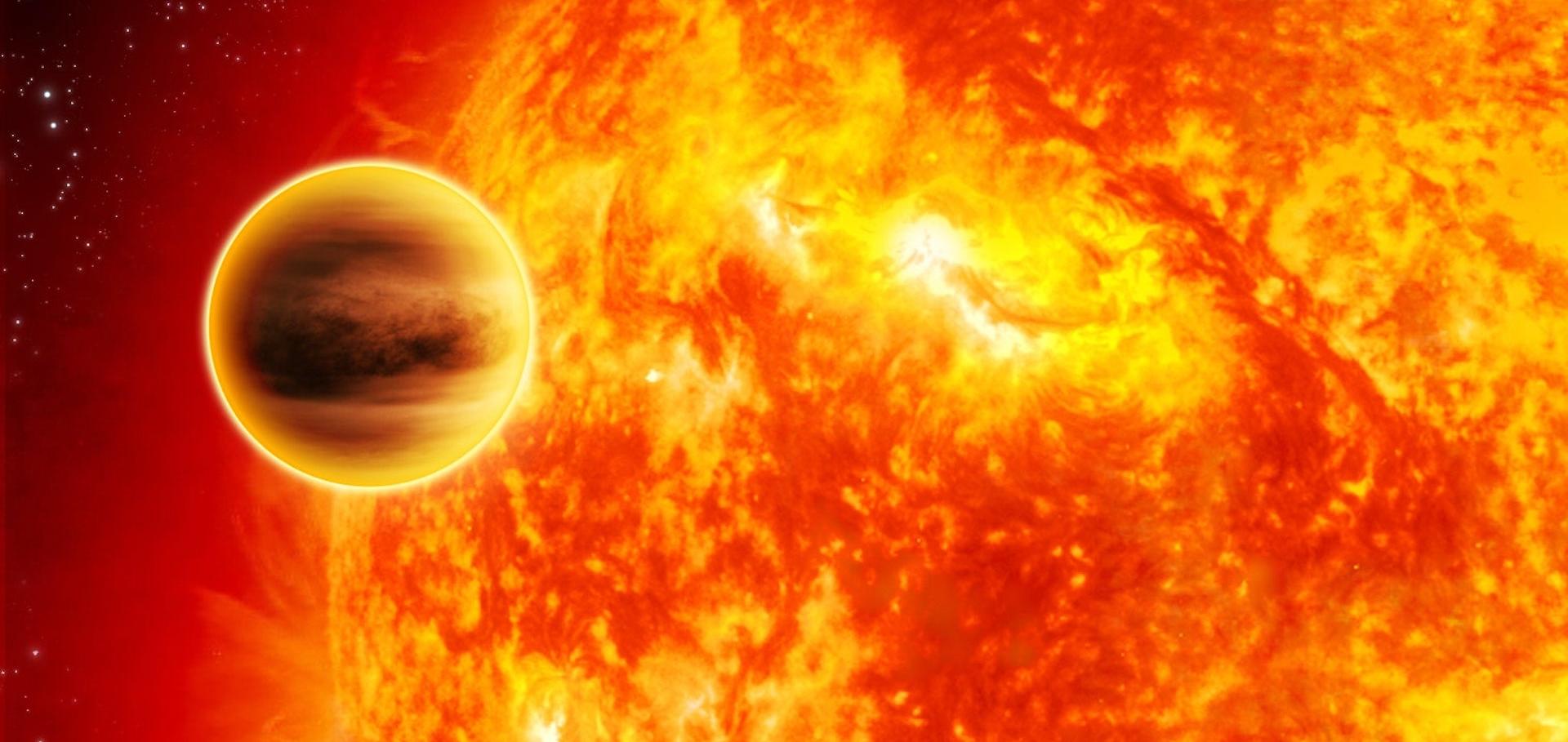
A Universal Spin-Mass Relation for Brown Dwarfs and Planets

Astrophysical Journal 859:2 (2018)

Authors:

A Scholz, K Moore, R Jayawardhana, S Aigrain, D Peterson, B Stelzer

Abstract:

© 2018. The American Astronomical Society. All rights reserved. While brown dwarfs show similarities to stars early in their lives, their spin evolutions are much more akin to those of planets. We have used light curves from the K2 mission to measure new rotation periods for 18 young brown dwarfs in the Taurus star-forming region. Our sample spans masses from 0.02 to 0.08 Moand has been characterized extensively in the past. To search for periods, we utilize three different methods (autocorrelation, periodogram, Gaussian processes). The median period for brown dwarfs with disks is twice as long as for those without (3.1 versus 1.6 days), a signature of rotational braking by the disk, albeit with small numbers. With an overall median period of 1.9 days, brown dwarfs in Taurus rotate slower than their counterparts in somewhat older (3-10 Myr) star-forming regions, consistent with spin-up of the latter due to contraction and angular momentum conservation, a clear sign that disk braking overall is inefficient and/or temporary in this mass domain. We confirm the presence of a linear increase of the typical rotation period as a function of mass in the substellar regime. The rotational velocities, when calculated forward to the age of the solar system, assuming angular momentum conservation, fit the known spin-mass relation for solar system planets and extra-solar planetary-mass objects. This spin-mass trend holds over six orders of magnitude in mass, including objects from several different formation paths. Our result implies that brown dwarfs by and large retain their primordial angular momentum through the first few Myr of their evolution.

The K2 M67 Study: Establishing the Limits of Stellar Rotation Period Measurements in M67 with K2 Campaign 5 Data

ASTROPHYSICAL JOURNAL 859:2 (2018) ARTN 167

Authors:

R Esselstein, S Aigrain, A Vanderburg, JC Smith, S Meibom, J Van Saders, R Mathieu

The K2 M67 Study: Establishing the Limits of Stellar Rotation Period Measurements in M67 with K2 Campaign 5 Data

(2018)

Authors:

Rebecca Esselstein, Suzanne Aigrain, Andrew Vanderburg, Jeffrey C Smith, Soren Meibom, Jennifer Van Saders, Robert Mathieu

Planets, candidates, and binaries from the CoRoT/Exoplanet programme: the CoRoT transit catalogue

(2018)

Authors:

M Deleuil, S Aigrain, C Moutou, J Cabrera, F Bouchy, HJ Deeg, J-M Almenara, G Hébrard, A Santerne, R Alonso, AS Bonomo, P Bordé, Sz Csizmadia, A Erikson, M Fridlund, D Gandolfi, E Guenther, T Guillot, P Guterman, S Grziwa, A Hatzes, A Léger, T Mazeh, A Ofir, M Ollivier, M Pätzold, H Parviainen, H Rauer, D Rouan, J Schneider, R Titz-Weider, B Tingley, J Weingrill

Exploring the atmosphere of Neoproterozoic Earth: The effect of O2 on haze formation and composition

Astrophysical Journal American Astronomical Society 858:2 (2018) 119

Authors:

S Hörst, C He, AM Jellinek, Raymond Pierrehumbert, MA Tolbert

Abstract:

Previous studies of haze formation in the atmosphere of the early Earth have focused on N2/CO2/CH4 atmospheres. Here, we experimentally investigate the effect of O2 on the formation and composition of aerosols to improve our understanding of haze formation on the Neoproterozoic Earth. We obtained in situ size, particle density, and composition measurements of aerosol particles produced from N2/CO2/CH4/O2 gas mixtures subjected to FUV radiation (115–400 nm) for a range of initial CO2/CH4/O2 mixing ratios (O2 ranging from 2 ppm to 0.2%). At the lowest O2 concentration (2 ppm), the addition increased particle production for all but one gas mixture. At higher oxygen concentrations (20 ppm and greater), particles are still produced, but the addition of O2 decreases the production rate. Both the particle size and number density decrease with increasing O2, indicating that O2 affects particle nucleation and growth. The particle density increases with increasing O2. The addition of CO2 and O2 not only increases the amount of oxygen in the aerosol, but it also increases the degree of nitrogen incorporation. In particular, the addition of O2 results in the formation of nitrate-bearing molecules. The fact that the presence of oxygen-bearing molecules increases the efficiency of nitrogen fixation has implications for the role of haze as a source of molecules required for the origin and evolution of life. The composition changes also likely affect the absorption and scattering behavior of these particles but optical property measurements are required to fully understand the implications for the effect on the planetary radiative energy balance and climate.