

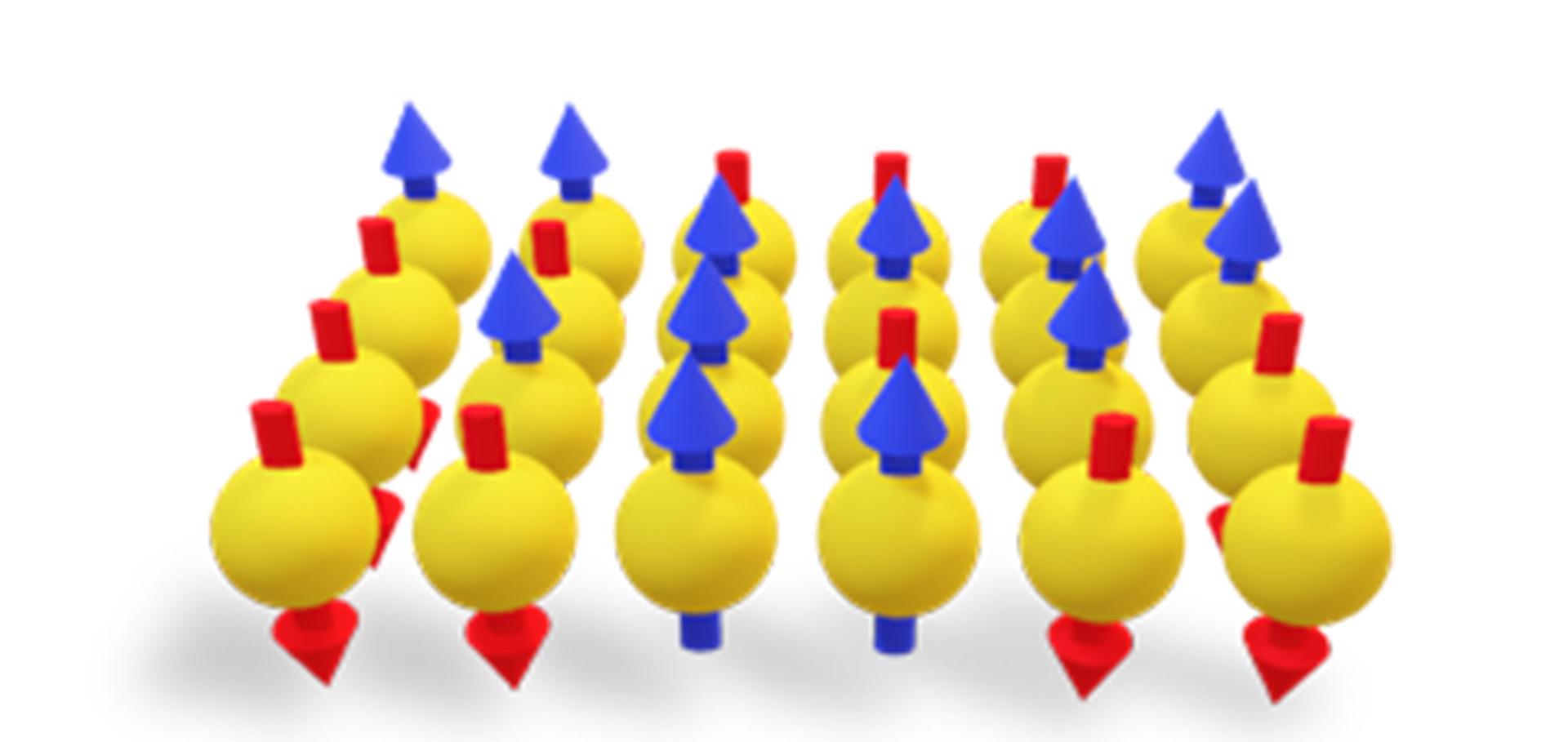
Out-of-time-ordered crystals and fragmentation
Physical Review Letters American Physical Society 128 (2021) 100601
Abstract:
Is a spontaneous perpetual reversal of the arrow of time possible? The out-of-time-ordered correlator (OTOC) is a standard measure of irreversibility, quantum scrambling, and the arrow of time. The question may be thus formulated more precisely and conveniently: can spatially ordered perpetual OTOC oscillations exist in many-body systems? Here we give a rigorous lower bound on the amplitude of OTOC oscillations in terms of a strictly local dynamical algebra allowing for identification of systems that are out-of-time-ordered (OTO) crystals. While OTOC oscillations are possible for few-body systems, due to the spatial order requirement OTO crystals cannot be achieved by effective single or few body dynamics, e.g., a pendulum or a condensate. Rather they signal perpetual motion of quantum scrambling. It is likewise shown that if a Hamiltonian satisfies this novel algebra, it has an exponentially large number of local invariant subspaces, i.e., Hilbert space fragmentation. Crucially, the algebra, and hence the OTO crystal, are stable to local unitary and dissipative perturbations. A Creutz ladder is shown to be an OTO crystal, which thus perpetually reverses its arrow of time.Analytical solution for the steady states of the driven Hubbard model
Physical Review B American Physical Society 103:3 (2021) 35146
Abstract:
Under the action of coherent periodic driving a generic quantum system will undergo Floquet heating and continuously absorb energy until it reaches a featureless thermal state. The phase-space constraints induced by certain symmetries can, however, prevent this and allow the system to dynamically form robust steady states with off-diagonal long-range order. In this work, we take the Hubbard model on an arbitrary lattice with arbitrary filling and, by simultaneously diagonalizing the two possible SU(2) symmetries of the system, we analytically construct the correlated steady states for different symmetry classes of driving. This construction allows us to make verifiable, quantitative predictions about the long-range particle-hole and spin-exchange correlations that these states can possess. In the case when both SU(2) symmetries are preserved in the thermodynamic limit we show how the driving can be used to form a unique condensate which simultaneously hosts particle-hole and spin-wave order.Tuning Metastable Light-Induced Superconductivity in K3C60 with a Hybrid CO2-Ti:Sapphire Laser
Optica Publishing Group (2021) ff1a.5
Bethe ansatz approach for dissipation: exact solutions of quantum many-body dynamics under loss
New Journal of Physics IOP Publishing 22 (2020) 123040
Abstract:
We develop a Bethe ansatz based approach to study dissipative systems experiencing loss. The method allows us to exactly calculate the spectra of interacting, many-body Liouvillians. We discuss how the dissipative Bethe ansatz opens the possibility of analytically calculating the dynamics of a wide range of experimentally relevant models including cold atoms subjected to one and two body losses, coupled cavity arrays with bosons escaping the cavity, and cavity quantum electrodynamics. As an example of our approach we study the relaxation properties in a boundary driven XXZ spin chain. We exactly calculate the Liouvillian gap and find different relaxation rates with a novel type of dynamical dissipative phase transition. This physically translates into the formation of a stable domain wall in the easy-axis regime despite the presence of loss. Such analytic results have previously been inaccessible for systems of this type.Quantum many-body attractors
Research Square Platform (2020)