

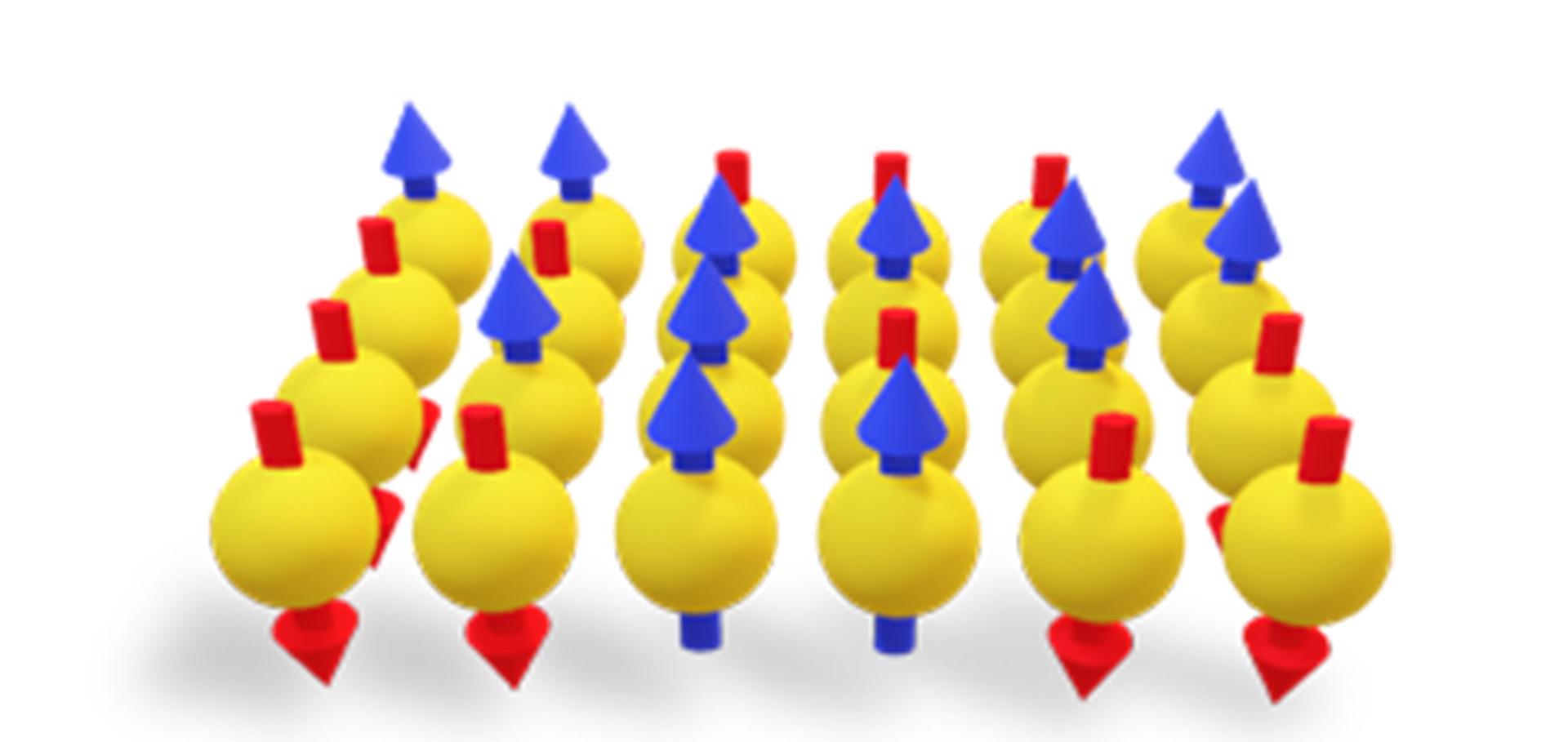
Magnetization of Electronic Ground States in Frustrated Superstable Graphs
Physical Review Letters American Physical Society (APS) 137:7 (2026) 076501
Abstract:
Geometric frustration lies at the heart of many unconventional quantum phases in strongly interacting electron systems. Here, we analytically determine the ground state magnetization of the half-filled Hubbard model on frustrated geometries where superstable states—eigenstates which are robust against frustration—are manifest. Our results apply to a broad class of lattices, including those where altermagnetic and superconducting states are known to emerge. Furthermore, they provide evidence for phase transitions involving a geometric rearrangement of magnetic correlations in the thermodynamic limit.Resource-efficient quantum optimization via higher-order encoding
EPJ Quantum Technology SpringerOpen 13:1 (2026) 59
Abstract:
Quantum approaches to combinatorial optimization problems (COPs) are often limited by the resource demands of Quadratic Unconstrained Binary Optimization (QUBO) encodings, which enlarge circuits through penalty terms and increase qubit and gate counts. We show that Higher-Order Unconstrained Binary Optimization (HUBO) enables a more resource-efficient formulation. Our method systematically constructs HUBO Hamiltonians and, compared to a QUBO formulation in benchmarks on Gate Assignment (GAP), Maximum k-Colorable Subgraph (MkCS), and Integer Programming (IP) problems, significantly reduces qubit requirements and decreases total CNOT gate counts by at least 89.6% for all tested instances. These results highlight HUBO as a practical alternative for quantum optimization on near-term devices. To promote adoption, we release an open-source Python library that automates HUBO model construction, extends beyond the examples presented in this work, and broadens access to resource-efficient quantum optimization.Quantum-Inspired Tensor-Network Fractional-Step Method for Incompressible Flow in Curvilinear Coordinates
Computer Physics Communications Elsevier (2026) 110169
Abstract:
We introduce an algorithmic framework based on tensor networks for computing fluid flows around immersed objects in curvilinear coordinates. We show that the tensor network simulations can be carried out solely using highly compressed tensor representations of the flow fields and the differential operators and discuss the numerical implementation of the tensor operations required for computing fluid flows in detail. The applicability of our method is demonstrated by applying it to the paradigm example of steady and transient flows around stationary and rotating cylinders. We find excellent quantitative agreement in comparison to finite difference simulations for Strouhal numbers, forces and velocity fields. The properties of our approach are discussed in terms of reduced order models. We estimate the memory saving and potential runtime advantages in comparison to standard finite difference simulations. We find accurate results with errors of less than 0.3% for flow-field compressions by a factor of up to 20 and differential operators compressed by factors of up to 1000 compared to sparse matrix representations. We provide strong numerical evidence that the runtime scaling advantages of the tensor network approach with system size will provide substantial resource savings when simulating larger systems. Finally, we note that, like other tensor network-based fluid flow simulations, our algorithmic framework is directly portable to a quantum computer leading to further scaling advantages.Time Crystals as Passively Protected Oscillating Qubits
(2026)
Toward Variational Quantum Algorithms for Generalized Linear and Nonlinear Transport Phenomena
AIAA Journal 64:2 (2026) 585-604