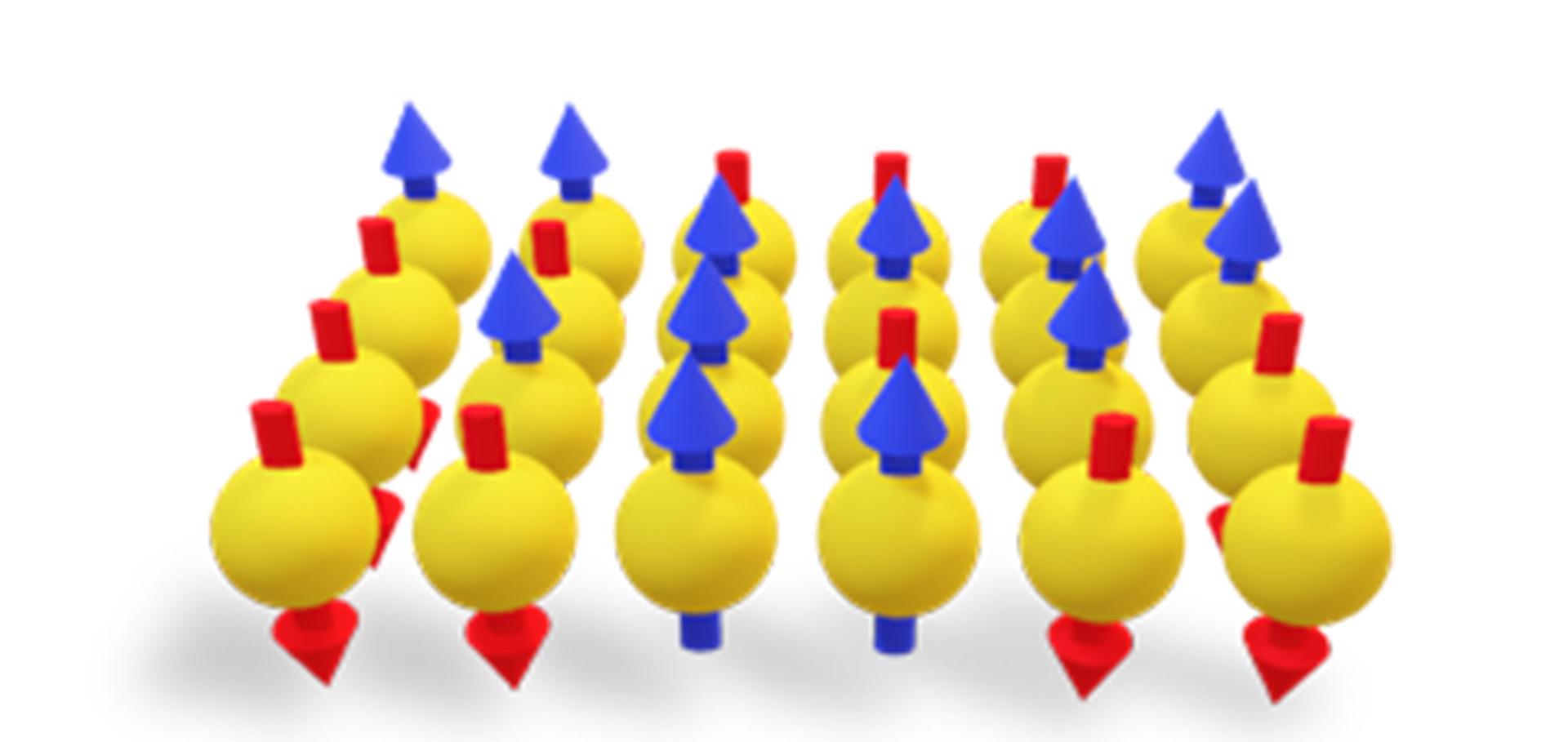
Exact bistability and time pseudo-crystallization of driven-dissipative fermionic lattices

(2022)

Authors:

Hadiseh Alaeian, Berislav Buča

A quantum-inspired approach to exploit turbulence structures

Nature Computational Science Springer Nature 2:2022 (2022) 30-37

Authors:

Nikita Gourianov, Michael Lubasch, Sergey Dolgov, van den Berg Quincy Yves, Hessam Babaee, Peyman Givi, Martin Kiffner, Dieter Jaksch

Abstract:

Understanding turbulence is key to our comprehension of many natural and technological flow processes. At the heart of this phenomenon lies its intricate multiscale nature, describing the coupling between different-sized eddies in space and time. Here we analyze the structure of turbulent flows by quantifying correlations between different length scales using methods inspired from quantum many-body physics. We present the results for interscale correlations of two paradigmatic flow examples, and use these insights along with tensor network theory to design a structure-resolving algorithm for simulating turbulent flows. With this algorithm, we find that the incompressible Navier–Stokes equations can be accurately solved even when reducing the number of parameters required to represent the velocity field by more than one order of magnitude compared to direct numerical simulation. Our quantum-inspired approach provides a pathway towards conducting computational fluid dynamics on quantum computers.

A quantum-inspired approach to exploit turbulence structures

Nature Computational Science

Authors:

Nikita Gourianov, Michael Lubasch, Sergey Dolgov, Quincy Y. van den Berg, Hessam Babaee, Peyman Givi, Martin Kiffner & Dieter Jaksch

Abstract:

Algebraic theory of quantum synchronization and limit cycles under dissipation

SCIPOST PHYSICS 12:3 (2022) ARTN 097

Authors:

Berislav Buca, Cameron Booker, Dieter Jaksch

Lieb's Theorem and Maximum Entropy Condensates

Quantum 5 (2021)

Authors:

J Tindall, F Schlawin, MA Sentef, D Jaksch

Abstract:

Coherent driving has established itself as a powerful tool for guiding a many-body quantum system into a desirable, coherent non-equilibrium state. A thermodynamically large system will, however, almost always saturate to a featureless infinite temperature state under continuous driving and so the optical manipulation of many-body systems is considered feasible only if a transient, prethermal regime exists, where heating is suppressed. Here we show that, counterintuitively, in a broad class of lattices Floquet heating can actually be an advantageous effect. Specifically, we prove that the maximum entropy steady states which form upon driving the ground state of the Hubbard model on unbalanced bi-partite lattices possess uniform off-diagonal long-range order which remains finite even in the thermodynamic limit. This creation of a 'hot' condensate can occur on any driven unbalanced lattice and provides an understanding of how heating can, at the macroscopic level, expose and alter the order in a quantum system. We discuss implications for recent experiments observing emergent superconductivity in photoexcited materials.