

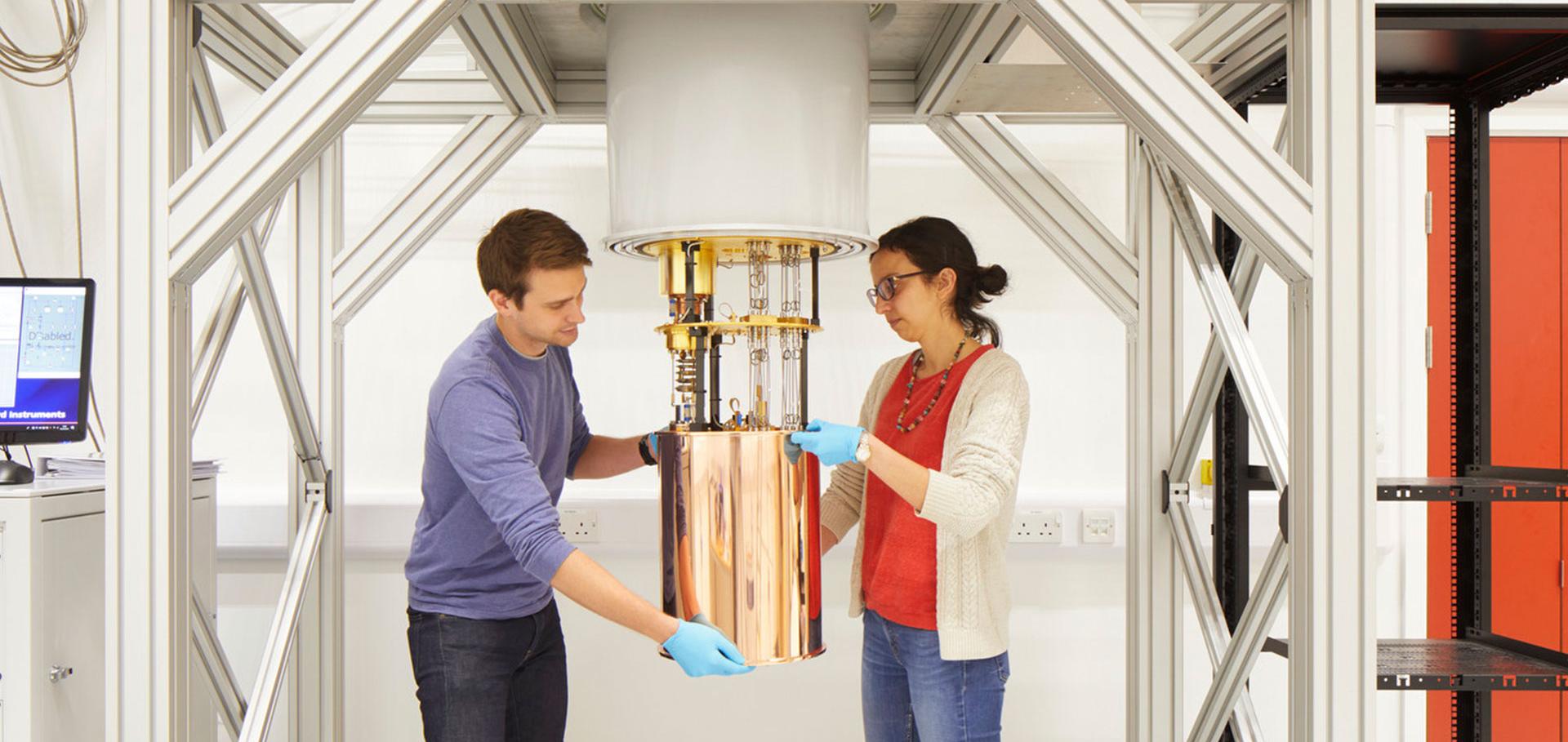

High Coherence in a Tileable 3D Integrated Superconducting Circuit Architecture
(2021)
Improving dispersive readout of a superconducting qubit by machine learning on path signature
Abstract:
One major challenge that arises from quantum computing is to implement fast, high-accuracy quantum state readout. For superconducting circuits, this problem reduces to a time series classification problem on readout signals. We propose that using path signature methods to extract features can enhance existing techniques for quantum state discrimination. We demonstrate the superior performance of our proposed approach over conventional methods in distinguishing three different quantum states on real experimental data from a superconducting transmon qubit.Crosstalk dispersion and spatial scaling in superconducting qubit arrays
Physical Review Research American Physical Society (APS) 8:3 (2026) 033193
Abstract:
Crosstalk between qubits fundamentally limits the scalability of quantum processors, necessitating physics-based models that can handle the complexity of large qubit arrays. Here, we develop a comprehensive theoretical and experimental framework that captures residual interactions between both adjacent and nonadjacent qubits in fixed-frequency transmon lattices. The model integrates the combined effects of exponential localization in banded capacitance matrices, suppression of virtual couplings through detuning products across intermediate modes, and evanescent decay of below-cutoff electromagnetic fields, yielding predictive scaling relations for coupling strength as a function of spatial separation and spectral detuning. Experimental characterization of a superconducting qubit lattice with inductive shunt pillars reveals exponential spatial decay and frequency-dependent suppression consistent with theoretical predictions, achieving quantitative agreement for all nearest-neighbor couplings across the operating range. Our results show that standard dispersive Hamiltonian approximations systematically overestimate long-range coupling when spatial and spectral dependencies are neglected; these errors propagate into circuit simulation and design strategies. Our framework provides design guidance for crosstalk mitigation in larger-scale quantum processors under realistic fabrication constraints, addressing a bottleneck in scalability.Electromagnetic modes in spherical cavities: Angular spectra, dispersion relations, and self-adjoint extensions
Physical Review Applied American Physical Society (APS) 26:2 (2026) 024050
Abstract:
We present a comprehensive theory of electromagnetic modes in spherical cavities, resolving questions about the nature of angular quantization. The standard result that angular indices ( ) must be integers is shown to be a consequence of domain constraints—regularity at both poles and single valuedness in the azimuthal coordinate—rather than a requirement imposed by Maxwell’s equations themselves. We demonstrate that, for the sectoral case , the function exactly solves the angular eigenvalue equation for any real , giving rise to a continuous dispersion curve. We demonstrate why nonsectoral modes (tesseral and zonal) appear only at isolated integer points on the full sphere and show how boundary modifications such as cones and wedges convert these isolated points into continuous families of modes. Complete field solutions, wave impedances, and energy integrability conditions are derived. At the limiting point , the electromagnetic field vanishes identically while the underlying Debye potential remains nontrivial—a distinction with implications for mode counting that connects to longstanding questions in gauge theory and cavity quantization. Full-wave simulations validate the theoretical predictions with sub-percent accuracy. These results raise the possibility of structural analogs in wave equations on curved spacetimes, where conical deficits or horizon excisions similarly modify the angular domain.Low crosstalk in a scalable superconducting quantum lattice
EPJ Quantum Technology SpringerOpen 13:1 (2026) 19