

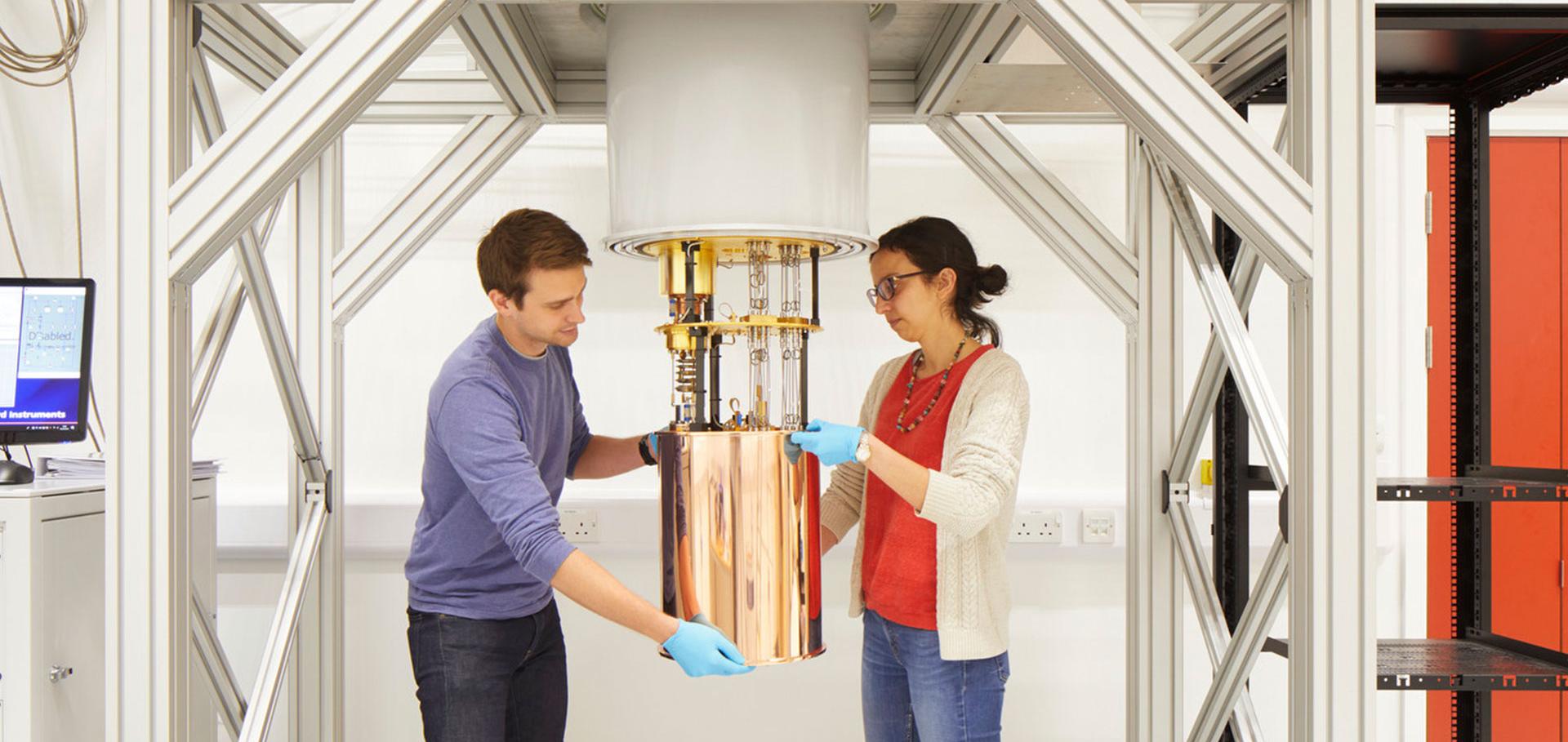

High coherence and low cross-talk in a tileable 3D integrated superconducting circuit architecture.
Science advances 8:16 (2022) eabl6698-eabl6698
Abstract:
We report high qubit coherence as well as low cross-talk and single-qubit gate errors in a superconducting circuit architecture that promises to be tileable to two-dimensional (2D) lattices of qubits. The architecture integrates an inductively shunted cavity enclosure into a design featuring nongalvanic out-of-plane control wiring and qubits and resonators fabricated on opposing sides of a substrate. The proof-of-principle device features four uncoupled transmon qubits and exhibits average energy relaxation times T1 = 149(38) μs, pure echoed dephasing times Tϕ,e = 189(34) μs, and single-qubit gate fidelities F = 99.982(4)% as measured by simultaneous randomized benchmarking. The 3D integrated nature of the control wiring means that qubits will remain addressable as the architecture is tiled to form larger qubit lattices. Band structure simulations are used to predict that the tiled enclosure will still provide a clean electromagnetic environment to enclosed qubits at arbitrary scale.Triple-Mode Microwave Filters With Arbitrary Prescribed Transmission Zeros
IEEE Access Institute of Electrical and Electronics Engineers 9 (2021) 22045-22052
Abstract:
This article presents a new filter design for arbitrary placement of real frequency transmission zeros in triple-mode filters, allowing for either asymmetric or symmetric responses. Triple-mode filters can be viewed, in general, as a series combination of coupled resonators with non-adjacent couplings, allowing for the realisation of transmission zeros. The strength and phase of couplings dictate the transmission zeros locations. The arbitrary placement of transmission zeros requires controlling all amplitude and phase rations, i.e., the ability to realise both negative and positive couplings. In general, this necessitates the use of capacitive and inductive probe structures complicating the construction and hence increasing the filter cost. The method presented in this article enables arbitrary placement of transmission zeros using only inductive or only capacitive couplings structures. In addition, broadband filtering characteristics can be realised using triple-mode filters. Examples of several narrow and broadband bandpass filters are given indicating that this method is valid for most triple-mode structures.A Survey of Differential-Fed Microstrip Bandpass Filters: Recent Techniques and Challenges
Sensors MDPI 20:8 (2020) 2356
Compact triple-mode microwave dielectric resonator filters
International Journal of Electronics Letters Taylor & Francis 8:2 (2020) 194-204
A Differential-Fed Dual-Polarized High-Gain Filtering Antenna Based on SIW Technology for 5G Applications
Institute of Electrical and Electronics Engineers (IEEE) 00 (2020) 1-5