Home
Department Of Physics text logo
  • Research
    • Our research
    • Our research groups
    • Our research in action
    • Research funding support
    • Summer internships for undergraduates
  • Study
    • Undergraduates
    • Postgraduates
  • Engage
    • For alumni
    • For business
    • For schools
    • For the public
  • Support
Menu
CMP
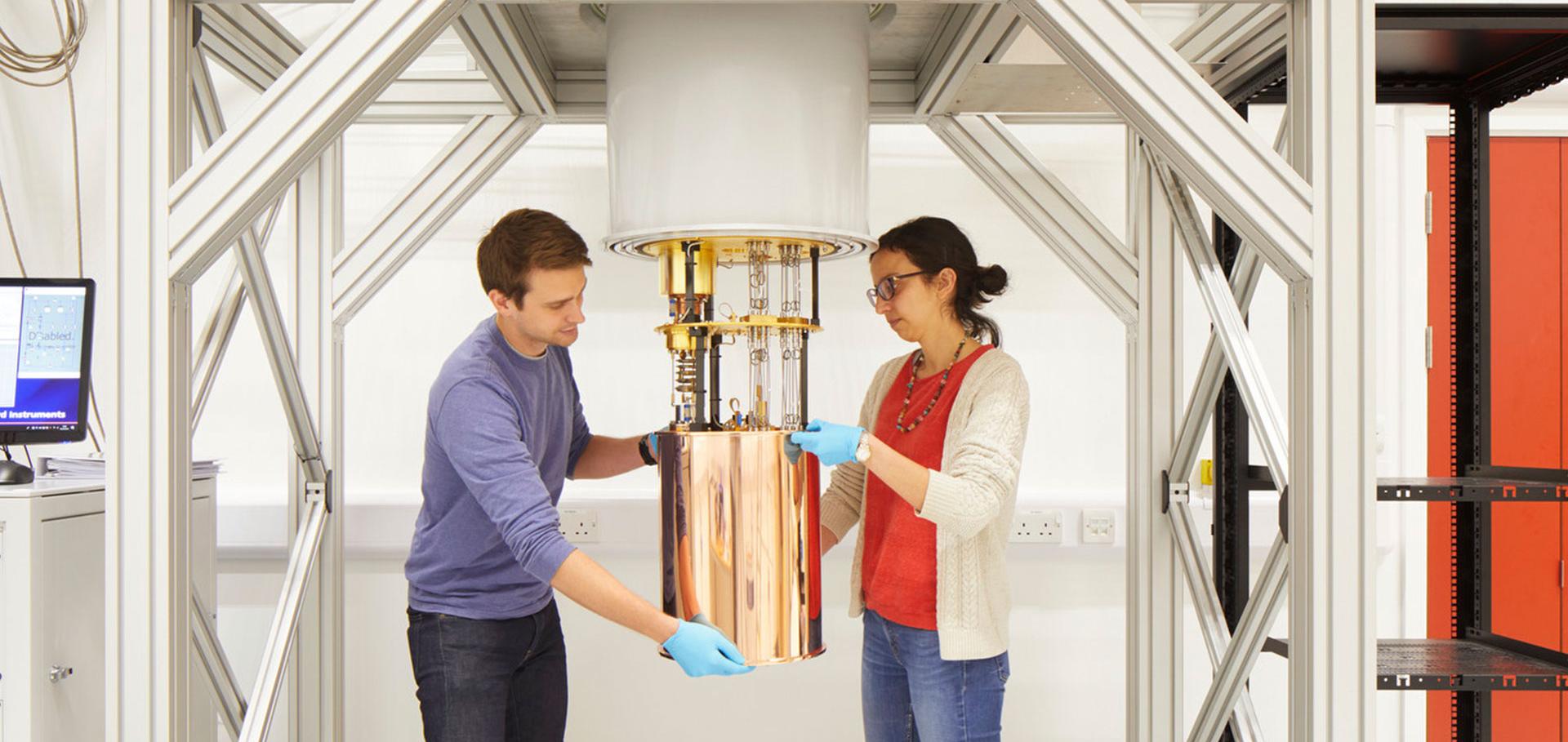
Credit: Jack Hobhouse

Dr Mustafa Bakr

Quantum Technology Research Fellow

Research theme

  • Quantum information and computation

Sub department

  • Condensed Matter Physics

Research groups

  • Superconducting quantum devices
mustafa.bakr@physics.ox.ac.uk
  • About
  • Publications

Emulating two qubits with a four-level transmon qudit for variational quantum algorithms

Quantum Science and Technology IOP Publishing 9:3 (2024) 035003

Authors:

Shuxiang Cao, Mustafa Bakr, Giulio Campanaro, Simone D Fasciati, James Wills, Deep Lall, Boris Shteynas, Vivek Chidambaram, Ivan Rungger, Peter Leek

Abstract:

Using quantum systems with more than two levels, or qudits, can scale the computational space of quantum processors more efficiently than using qubits, which may offer an easier physical implementation for larger Hilbert spaces. However, individual qudits may exhibit larger noise, and algorithms designed for qubits require to be recompiled to qudit algorithms for execution. In this work, we implemented a two-qubit emulator using a 4-level superconducting transmon qudit for variational quantum algorithm applications and analyzed its noise model. The major source of error for the variational algorithm was readout misclassification error and amplitude damping. To improve the accuracy of the results, we applied error-mitigation techniques to reduce the effects of the misclassification and qudit decay event. The final predicted energy value is within the range of chemical accuracy.
More details from the publisher
Details from ORA
More details

Encoding optimization for quantum machine learning demonstrated on a superconducting transmon qutrit

(2023)

Authors:

Shuxiang Cao, Weixi Zhang, Jules Tilly, Abhishek Agarwal, Mustafa Bakr, Giulio Campanaro, Simone D Fasciati, James Wills, Boris Shteynas, Vivek Chidambaram, Peter Leek, Ivan Rungger
More details from the publisher
Details from ArXiV

Technological Investigation of Metal 3-D Printed Microwave Cavity Filters Based on Different Topologies and Materials

IEEE Transactions on Components Packaging and Manufacturing Technology Institute of Electrical and Electronics Engineers (IEEE) 12:12 (2022) 2027-2037

Authors:

Povilas Vaitukaitis, Kenneth Nai, Jiayu Rao, Mustafa S Bakr, Jiasheng Hong
More details from the publisher
More details

High coherence and low cross-talk in a tileable 3D integrated superconducting circuit architecture

Science Advances American Association for the Advancement of Science (AAAS) 8:16 (2022) eabl6698

Authors:

Peter A Spring, Shuxiang Cao, Takahiro Tsunoda, Giulio Campanaro, Simone Fasciati, James Wills, Mustafa Bakr, Vivek Chidambaram, Boris Shteynas, Lewis Carpenter, Paul Gow, James Gates, Brian Vlastakis, Peter J Leek
More details from the publisher
More details
More details

Triple-Mode Microwave Filters With Arbitrary Prescribed Transmission Zeros

IEEE Access Institute of Electrical and Electronics Engineers 9 (2021) 22045-22052

Abstract:

This article presents a new filter design for arbitrary placement of real frequency transmission zeros in triple-mode filters, allowing for either asymmetric or symmetric responses. Triple-mode filters can be viewed, in general, as a series combination of coupled resonators with non-adjacent couplings, allowing for the realisation of transmission zeros. The strength and phase of couplings dictate the transmission zeros locations. The arbitrary placement of transmission zeros requires controlling all amplitude and phase rations, i.e., the ability to realise both negative and positive couplings. In general, this necessitates the use of capacitive and inductive probe structures complicating the construction and hence increasing the filter cost. The method presented in this article enables arbitrary placement of transmission zeros using only inductive or only capacitive couplings structures. In addition, broadband filtering characteristics can be realised using triple-mode filters. Examples of several narrow and broadband bandpass filters are given indicating that this method is valid for most triple-mode structures.
More details from the publisher
Details from ORA
More details

Pagination

  • First page First
  • Previous page Prev
  • …
  • Page 3
  • Page 4
  • Page 5
  • Page 6
  • Current page 7
  • Page 8
  • Page 9
  • Page 10
  • Page 11
  • …
  • Next page Next
  • Last page Last

Footer Menu

  • Contact us
  • Giving to the Dept of Physics
  • Work with us
  • Media

User account menu

  • Log in

Follow us

FIND US

Clarendon Laboratory,

Parks Road,

Oxford,

OX1 3PU

CONTACT US

Tel: +44(0)1865272200

University of Oxfrod logo Department Of Physics text logo
IOP Juno Champion logo Athena Swan Silver Award logo

© University of Oxford - Department of Physics

Cookies | Privacy policy | Accessibility statement

Built by: Versantus

  • Home
  • Research
  • Study
  • Engage
  • Our people
  • News & Comment
  • Events
  • Our facilities & services
  • About us
  • Giving to Physics
  • Current students
  • Staff intranet