Home
Department Of Physics text logo
  • Research
    • Our research
    • Our research groups
    • Our research in action
    • Research funding support
    • Summer internships for undergraduates
  • Study
    • Undergraduates
    • Postgraduates
  • Engage
    • For young people
    • For teachers
    • For the public
    • For alumni
    • For business
  • Support
Menu
Atomic and Laser Physics
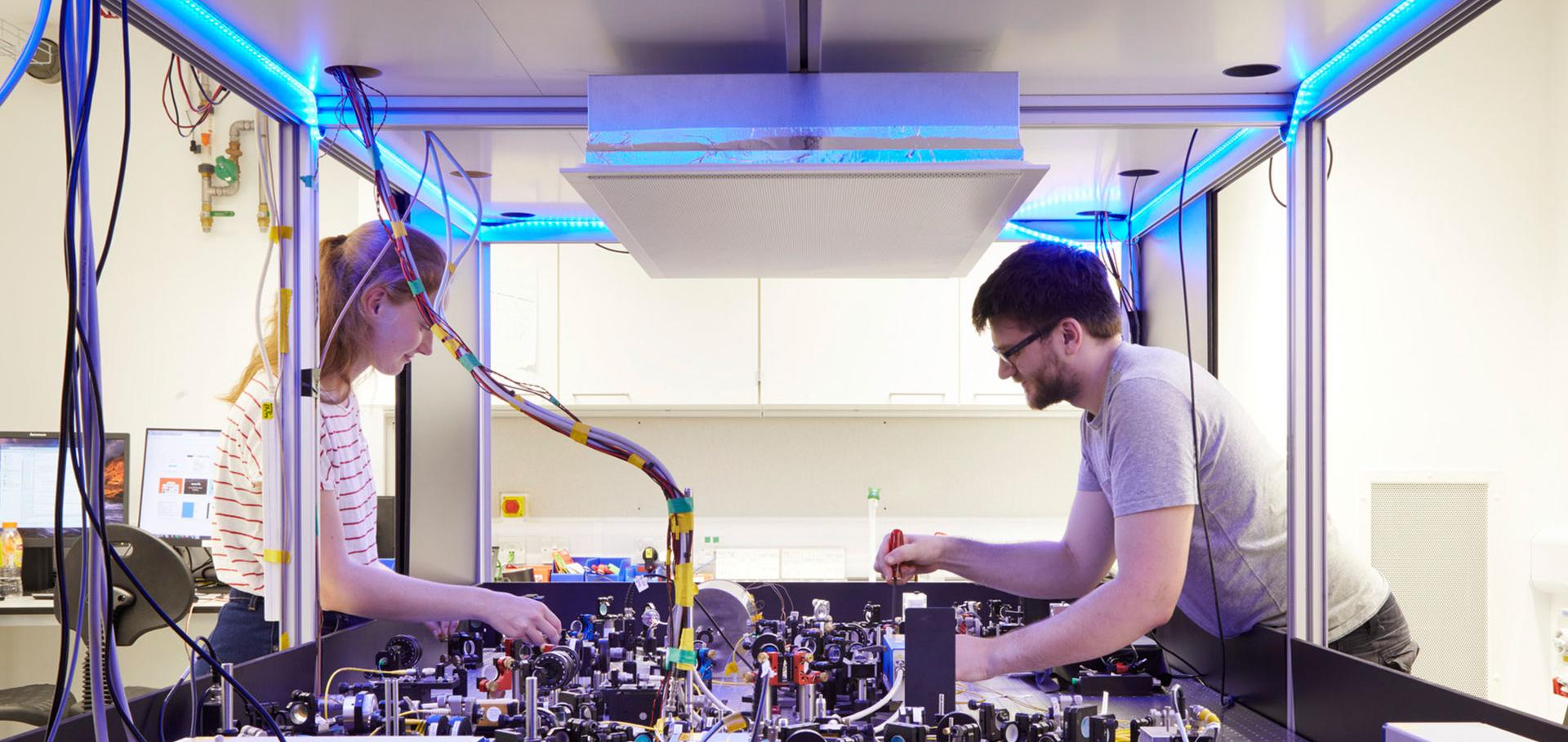
Credit: Jack Hobhouse

Dr Elliot Bentine

Royal Academy of Engineering Enterprise Fellowship

Research theme

  • Instrumentation
  • Quantum optics & ultra-cold matter

Sub department

  • Atomic and Laser Physics

Research groups

  • Ultracold quantum matter
elliot.bentine@physics.ox.ac.uk
Telephone: 01865 (2)72203
Clarendon Laboratory
  • About
  • Publications

Applying machine learning optimization methods to the production of a quantum gas

Machine Learning: Science and Technology

Authors:

Adam J Barker, Harry Style, Shinichi Sunami, Kathrin Luksch, David Garrick, Felix Hill, Elliot Bentine, Christopher J Foot

Abstract:

We apply three machine learning strategies to optimize the atomic cooling processes utilized in the production of a Bose-Einstein condensate (BEC). For the first time, we optimize both laser cooling and evaporative cooling mechanisms simultaneously. We present the results of an evolutionary optimization method (Differential Evolution), a method based on non-parametric inference (Gaussian Process regression) and a gradient-based function approximator (Artificial Neural Network). Online optimization is performed using no prior knowledge of the apparatus, and the learner succeeds in creating a BEC from completely randomized initial parameters. Optimizing these cooling processes results in a factor of four increase in BEC atom number compared to our manually-optimized parameters. This automated approach can maintain close-to-optimal performance in long-term operation. Furthermore, we show that machine learning techniques can be used to identify the main sources of instability within the apparatus.
More details from the publisher
Details from ORA
More details
Details from ArXiV

Inelastic collisions in radiofrequency-dressed mixtures of ultracold atoms

Authors:

Elliot Bentine, Adam J Barker, Kathrin Luksch, Shinichi Sunami, Tiffany L Harte, Ben Yuen, Christopher J Foot, Daniel J Owens, Jeremy M Hutson

Abstract:

Radiofrequency (RF)-dressed potentials are a promising technique for manipulating atomic mixtures, but so far little work has been undertaken to understand the collisions of atoms held within these traps. In this work, we dress a mixture of 85Rb and 87Rb with RF radiation, characterize the inelastic loss that occurs, and demonstrate species-selective manipulations. Our measurements show the loss is caused by two-body 87Rb+85Rb collisions, and we show the inelastic rate coefficient varies with detuning from the RF resonance. We explain our observations using quantum scattering calculations, which give reasonable agreement with the measurements. The calculations consider magnetic fields both perpendicular to the plane of RF polarization and tilted with respect to it. Our findings have important consequences for future experiments that dress mixtures with RF fields.
More details from the publisher
Details from ArXiV

Pagination

  • First page First
  • Previous page Prev
  • Page 1
  • Page 2
  • Page 3
  • Current page 4

Footer Menu

  • Contact us
  • Giving to the Dept of Physics
  • Work with us
  • Media

User account menu

  • Log in

Follow us

FIND US

Clarendon Laboratory,

Parks Road,

Oxford,

OX1 3PU

CONTACT US

Tel: +44(0)1865272200

University of Oxfrod logo Department Of Physics text logo
IOP Juno Champion logo Athena Swan Silver Award logo

© University of Oxford - Department of Physics

Cookies | Privacy policy | Accessibility statement

Built by: Versantus

  • Home
  • Research
  • Study
  • Engage
  • Our people
  • News & Comment
  • Events
  • Our facilities & services
  • About us
  • Giving to Physics
  • Current students
  • Staff intranet