Home
Department Of Physics text logo
  • Research
    • Our research
    • Our research groups
    • Our research in action
    • Research funding support
    • Summer internships for undergraduates
  • Study
    • Undergraduates
    • Postgraduates
  • Engage
    • For alumni
    • For business
    • For schools
    • For the public
Menu
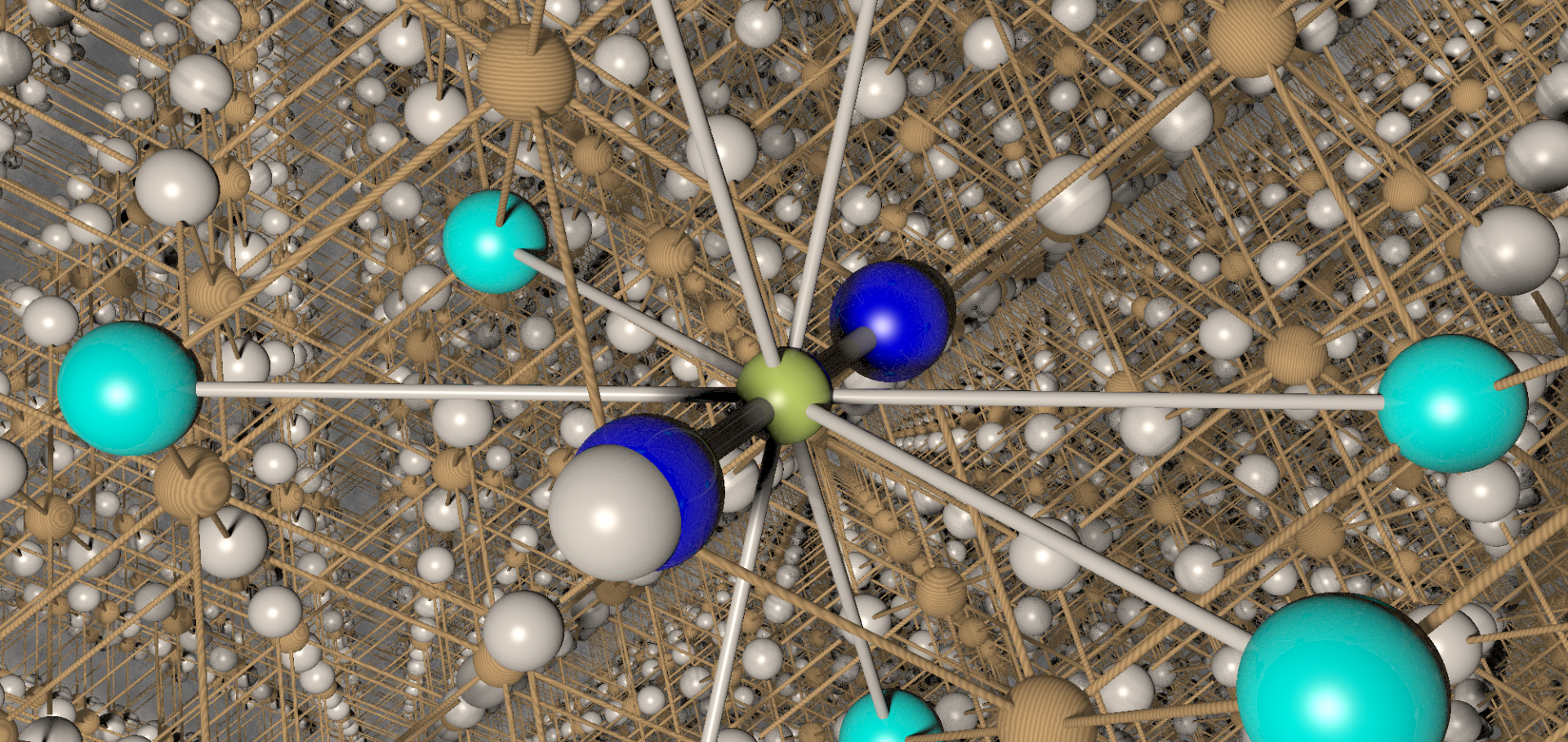
Crystal structure inside calcium fluoride with an implanted muon
Credit: SJB

Professor Stephen Blundell

Professor of Physics

Research theme

  • Quantum materials

Sub department

  • Condensed Matter Physics

Research groups

  • Muons and magnets
Stephen.Blundell@physics.ox.ac.uk
Telephone: 01865 (2)72347
Clarendon Laboratory, room 108
  • About
  • Books
  • Teaching
  • Research
  • Publications

Enhancement of superconducting transition temperature of FeSe by intercalation of a molecular spacer layer

(2012)

Authors:

Matthew Burrard-Lucas, David G Free, Stefan J Sedlmaier, Jack D Wright, Simon J Cassidy, Yoshiaki Hara, Alex J Corkett, Tom Lancaster, Peter J Baker, Stephen J Blundell, Simon J Clarke
More details from the publisher
Details from ArXiV

Persistent dynamics in the S=1/2 quasi-one-dimensional chain compound Rb4Cu(MoO4)3 probed with muon-spin relaxation

(2012)

Authors:

T Lancaster, PJ Baker, FL Pratt, SJ Blundell, W Hayes, D Prabhakaran
More details from the publisher

Chemical Engineering of Molecular Qubits

Phys. Rev. Lett. American Physical Society 108 (2012) 107204-107204

Authors:

CJ Wedge, GA Timco, ET Spielberg, RE George, F Tuna, S Rigby, EJL McInnes, REP Winpenny, SJ Blundell, A Ardavan
More details from the publisher
Details from ORA
More details
More details

Ag(nic)2 (nic = nicotinate): a spin-canted quasi-2D antiferromagnet composed of square-planar S = 1/2 Ag(II) ions.

Inorg Chem 51:4 (2012) 1989-1991

Authors:

Jamie L Manson, Toby J Woods, Saul H Lapidus, Peter W Stephens, Heather I Southerland, Vivien S Zapf, John Singleton, Paul A Goddard, Tom Lancaster, Andrew J Steele, Stephen J Blundell

Abstract:

Square-planar S = 1/2 Ag(II) ions in polymeric Ag(nic)(2) are linked by bridging nic monoanions to yield 2D corrugated sheets. Long-range magnetic order occurs below T(N) = 11.8(2) K due to interlayer couplings that are estimated to be about 30 times weaker than the intralayer exchange interaction.
More details from the publisher
More details

Importance of halogen···halogen contacts for the structural and magnetic properties of CuX2(pyrazine-N,N′-dioxide)(H2O)2 (X = Cl and Br).

Inorg Chem 51:4 (2012) 2121-2129

Authors:

John A Schlueter, Hyunsoo Park, Gregory J Halder, William R Armand, Cortney Dunmars, Karena W Chapman, Jamie L Manson, John Singleton, Ross McDonald, Alex Plonczak, Jinhee Kang, Chaghoon Lee, Myung-Hwan Whangbo, Tom Lancaster, Andrew J Steele, Isabel Franke, Jack D Wright, Stephen J Blundell, Francis L Pratt, Joseph deGeorge, Mark M Turnbull, Christopher P Landee

Abstract:

The structural and magnetic properties of the newly crystallized CuX(2)(pyzO)(H(2)O)(2) (X = Cl, Br; pyzO = pyrazine-N,N'-dioxide) coordination polymers are reported. These isostructural compounds crystallize in the monoclinic space group C2/c with, at 150 K, a = 17.0515(7) Å, b = 5.5560(2) Å, c = 10.4254(5) Å, β = 115.400(2)°, and V = 892.21(7) Å(3) for X = Cl and a = 17.3457(8) Å, b = 5.6766(3) Å, c = 10.6979(5) Å, β = 115.593(2)°, and V = 950.01(8) Å(3) for X = Br. Their crystal structure is characterized by one-dimensional chains of Cu(2+) ions linked through bidentate pyzO ligands. These chains are joined together through OH···O hydrogen bonds between the water ligands and pyzO oxygen atoms and Cu-X···X-Cu contacts. Bulk magnetic susceptibility measurements at ambient pressure show a broad maximum at 7 (Cl) and 28 K (Br) that is indicative of short-range magnetic correlations. The dominant spin exchange is the Cu-X···X-Cu supersuperexchange because the magnetic orbital of the Cu(2+) ion is contained in the CuX(2)(H(2)O)(2) plane and the X···X contact distances are short. The magnetic data were fitted to a Heisenberg 1D uniform antiferromagnetic chain model with J(1D)/k(B) = -11.1(1) (Cl) and -45.9(1) K (Br). Magnetization saturates at fields of 16.1(3) (Cl) and 66.7(5) T (Br), from which J(1D) is determined to be -11.5(2) (Cl) and -46.4(5) K (Br). For the Br analog the pressure dependence of the magnetic susceptibility indicates a gradual increase in the magnitude of J(1D)/k(B) up to -51.2 K at 0.84 GPa, suggesting a shortening of the Br···Br contact distance under pressure. At higher pressure X-ray powder diffraction data indicates a structural phase transition at ∼3.5 GPa. Muon-spin relaxation measurements indicate that CuCl(2)(pyzO)(H(2)O)(2) is magnetically ordered with T(N) = 1.06(1) K, while the signature for long-range magnetic order in CuBr(2)(pyzO)(H(2)O)(2) was much less definitive down to 0.26 K. The results for the CuX(2)(pyzO)(H(2)O)(2) complexes are compared to the related CuX(2)(pyrazine) materials.
More details from the publisher
More details

Pagination

  • First page First
  • Previous page Prev
  • …
  • Page 68
  • Page 69
  • Page 70
  • Page 71
  • Current page 72
  • Page 73
  • Page 74
  • Page 75
  • Page 76
  • …
  • Next page Next
  • Last page Last

Footer Menu

  • Contact us
  • Giving to the Dept of Physics
  • Work with us
  • Media

User account menu

  • Log in

Follow us

FIND US

Clarendon Laboratory,

Parks Road,

Oxford,

OX1 3PU

CONTACT US

Tel: +44(0)1865272200

University of Oxfrod logo Department Of Physics text logo
IOP Juno Champion logo Athena Swan Silver Award logo

© University of Oxford - Department of Physics

Cookies | Privacy policy | Accessibility statement

Built by: Versantus

  • Home
  • Research
  • Study
  • Engage
  • Our people
  • News & Comment
  • Events
  • Our facilities & services
  • About us
  • Giving to Physics
  • Current students
  • Staff intranet