Home
Department Of Physics text logo
  • Research
    • Our research
    • Our research groups
    • Our research in action
    • Research funding support
    • Summer internships for undergraduates
  • Study
    • Undergraduates
    • Postgraduates
  • Engage
    • For alumni
    • For business
    • For schools
    • For the public
  • Support
Menu
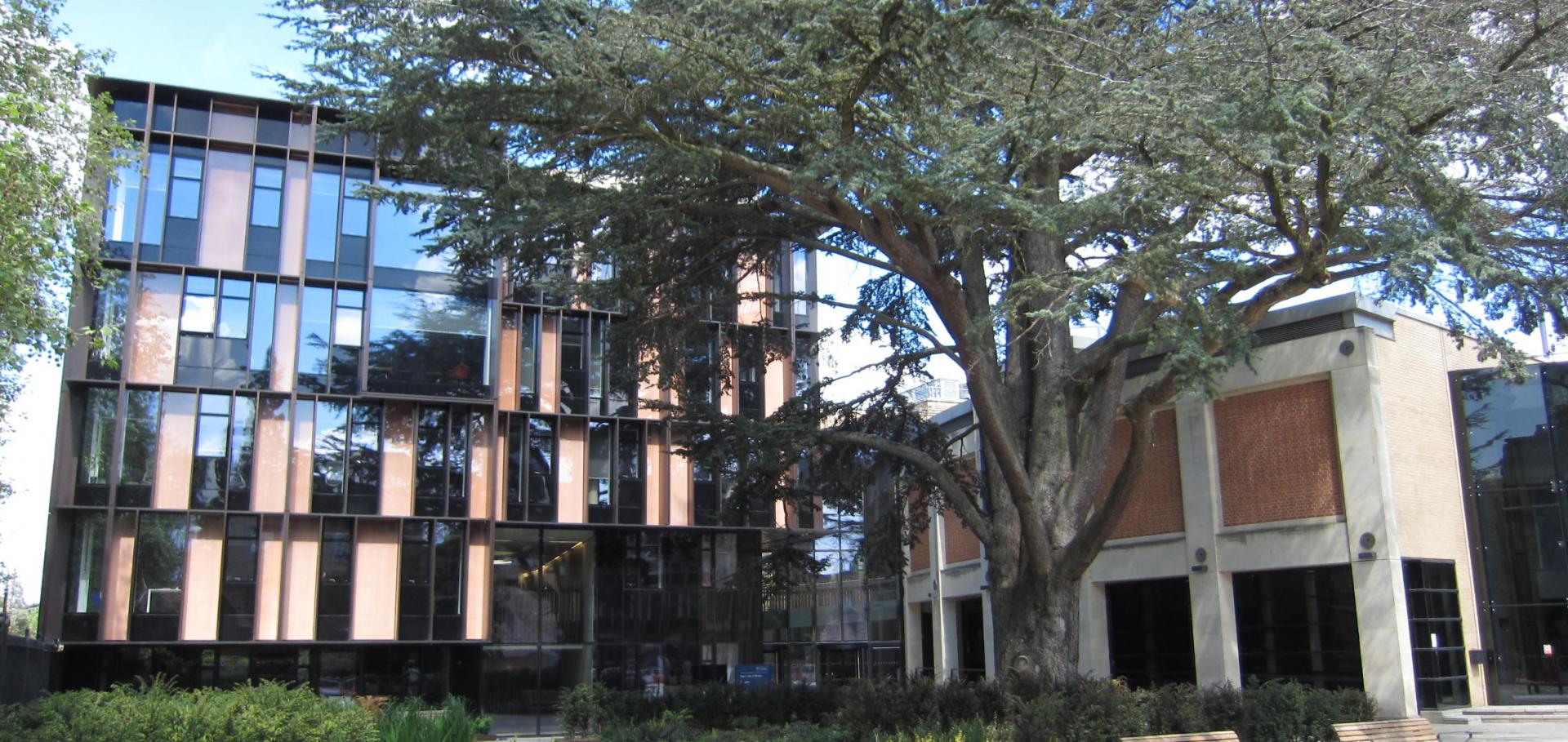
Clarendon Laboratory and Beecroft Building

Andrew Boothroyd

Head of Department

Research theme

  • Quantum materials

Sub department

  • Condensed Matter Physics

Research groups

  • X-ray and neutron scattering
Andrew.Boothroyd@physics.ox.ac.uk
Telephone: 01865 (2)72376
Clarendon Laboratory, room 311,172
ORCID ID 0000-0002-3575-7471
ResearcherID AAA-7883-2021
  • About
  • News
  • Research
  • Teaching
  • Prizes, awards and recognition
  • Software
  • Vacancies
  • Publications

Textbook

Principles of Neutron Scattering from Condensed Matter

Published by Oxford University Press in July 2020

Buy now

Coupling of magnetic order to planar Bi electrons in the anisotropic Dirac metals AMnBi2 (A = Sr, Ca)

(2013)

Authors:

YF Guo, AJ Princep, X Zhang, P Manuel, D Khalyavin, II Mazin, YG Shi, AT Boothroyd
More details from the publisher
Details from ArXiV

Suppression of thermal conductivity by rattling modes in thermoelectric sodium cobaltate

Nature Materials 12:11 (2013) 1028-1032

Authors:

DJ Voneshen, K Refson, E Borissenko, M Krisch, A Bosak, A Piovano, E Cemal, M Enderle, MJ Gutmann, M Hoesch, M Roger, L Gannon, AT Boothroyd, S Uthayakumar, DG Porter, JP Goff

Abstract:

The need for both high electrical conductivity and low thermal conductivity creates a design conflict for thermoelectric systems, leading to the consideration of materials with complicated crystal structures. Rattling of ions in cages results in low thermal conductivity, but understanding the mechanism through studies of the phonon dispersion using momentum-resolved spectroscopy is made difficult by the complexity of the unit cells. We have performed inelastic X-ray and neutron scattering experiments that are in remarkable agreement with our first-principles density-functional calculations of the phonon dispersion for thermoelectric Na 0.8 CoO2, which has a large-period superstructure. We have directly observed an Einstein-like rattling mode at low energy, involving large anharmonic displacements of the sodium ions inside multi-vacancy clusters. These rattling modes suppress the thermal conductivity by a factor of six compared with vacancy-free NaCoO2. Our results will guide the design of the next generation of materials for applications in solid-state refrigerators and power recovery. © 2013 Macmillan Publishers Limited. All rights reserved.
More details from the publisher

A ferroelectric-like structural transition in a metal.

Nat Mater 12:11 (2013) 1024-1027

Authors:

Youguo Shi, Yanfeng Guo, Xia Wang, Andrew J Princep, Dmitry Khalyavin, Pascal Manuel, Yuichi Michiue, Akira Sato, Kenji Tsuda, Shan Yu, Masao Arai, Yuichi Shirako, Masaki Akaogi, Nanlin Wang, Kazunari Yamaura, Andrew T Boothroyd

Abstract:

Metals cannot exhibit ferroelectricity because static internal electric fields are screened by conduction electrons, but in 1965, Anderson and Blount predicted the possibility of a ferroelectric metal, in which a ferroelectric-like structural transition occurs in the metallic state. Up to now, no clear example of such a material has been identified. Here we report on a centrosymmetric (R3c) to non-centrosymmetric (R3c) transition in metallic LiOsO3 that is structurally equivalent to the ferroelectric transition of LiNbO3 (ref. 3). The transition involves a continuous shift in the mean position of Li(+) ions on cooling below 140 K. Its discovery realizes the scenario described in ref. 2, and establishes a new class of materials whose properties may differ from those of normal metals.
More details from the publisher
More details

Suppression of thermal conductivity by rattling modes in thermoelectric sodium cobaltate.

Nat Mater 12:11 (2013) 1028-1032

Authors:

DJ Voneshen, K Refson, E Borissenko, M Krisch, A Bosak, A Piovano, E Cemal, M Enderle, MJ Gutmann, M Hoesch, M Roger, L Gannon, AT Boothroyd, S Uthayakumar, DG Porter, JP Goff

Abstract:

The need for both high electrical conductivity and low thermal conductivity creates a design conflict for thermoelectric systems, leading to the consideration of materials with complicated crystal structures. Rattling of ions in cages results in low thermal conductivity, but understanding the mechanism through studies of the phonon dispersion using momentum-resolved spectroscopy is made difficult by the complexity of the unit cells. We have performed inelastic X-ray and neutron scattering experiments that are in remarkable agreement with our first-principles density-functional calculations of the phonon dispersion for thermoelectric Na(0.8)CoO2, which has a large-period superstructure. We have directly observed an Einstein-like rattling mode at low energy, involving large anharmonic displacements of the sodium ions inside multi-vacancy clusters. These rattling modes suppress the thermal conductivity by a factor of six compared with vacancy-free NaCoO2. Our results will guide the design of the next generation of materials for applications in solid-state refrigerators and power recovery.
More details from the publisher
More details

Absence of strong magnetic fluctuations in FeP-based systems LaFePO and Sr₂ScO₃FeP.

J Phys Condens Matter 25:42 (2013) 425701

Authors:

AE Taylor, RA Ewings, TG Perring, DR Parker, J Ollivier, SJ Clarke, AT Boothroyd

Abstract:

We report neutron inelastic scattering measurements on polycrystalline LaFePO and Sr2ScO3FeP, two members of the iron phosphide families of superconductors. No evidence is found for any magnetic fluctuations in the spectrum of either material in the energy and wavevector ranges probed. Special attention is paid to the wavevector at which spin-density-wave-like fluctuations are seen in other iron-based superconductors. We estimate that the magnetic signal, if present, is at least a factor of four (Sr2ScO3FeP) or seven (LaFePO) smaller than in the related iron arsenide and chalcogenide superconductors. These results suggest that magnetic fluctuations are not as influential on the electronic properties of the iron phosphide systems as they are in other iron-based superconductors.
More details from the publisher
More details

Pagination

  • First page First
  • Previous page Prev
  • …
  • Page 27
  • Page 28
  • Page 29
  • Page 30
  • Current page 31
  • Page 32
  • Page 33
  • Page 34
  • Page 35
  • …
  • Next page Next
  • Last page Last

Footer Menu

  • Contact us
  • Giving to the Dept of Physics
  • Work with us
  • Media

User account menu

  • Log in

Follow us

FIND US

Clarendon Laboratory,

Parks Road,

Oxford,

OX1 3PU

CONTACT US

Tel: +44(0)1865272200

University of Oxfrod logo Department Of Physics text logo
IOP Juno Champion logo Athena Swan Silver Award logo

© University of Oxford - Department of Physics

Cookies | Privacy policy | Accessibility statement

Built by: Versantus

  • Home
  • Research
  • Study
  • Engage
  • Our people
  • News & Comment
  • Events
  • Our facilities & services
  • About us
  • Giving to Physics
  • Current students
  • Staff intranet