Home
Department Of Physics text logo
  • Research
    • Our research
    • Our research groups
    • Our research in action
    • Research funding support
    • Summer internships for undergraduates
  • Study
    • Undergraduates
    • Postgraduates
  • Engage
    • For alumni
    • For business
    • For schools
    • For the public
Menu
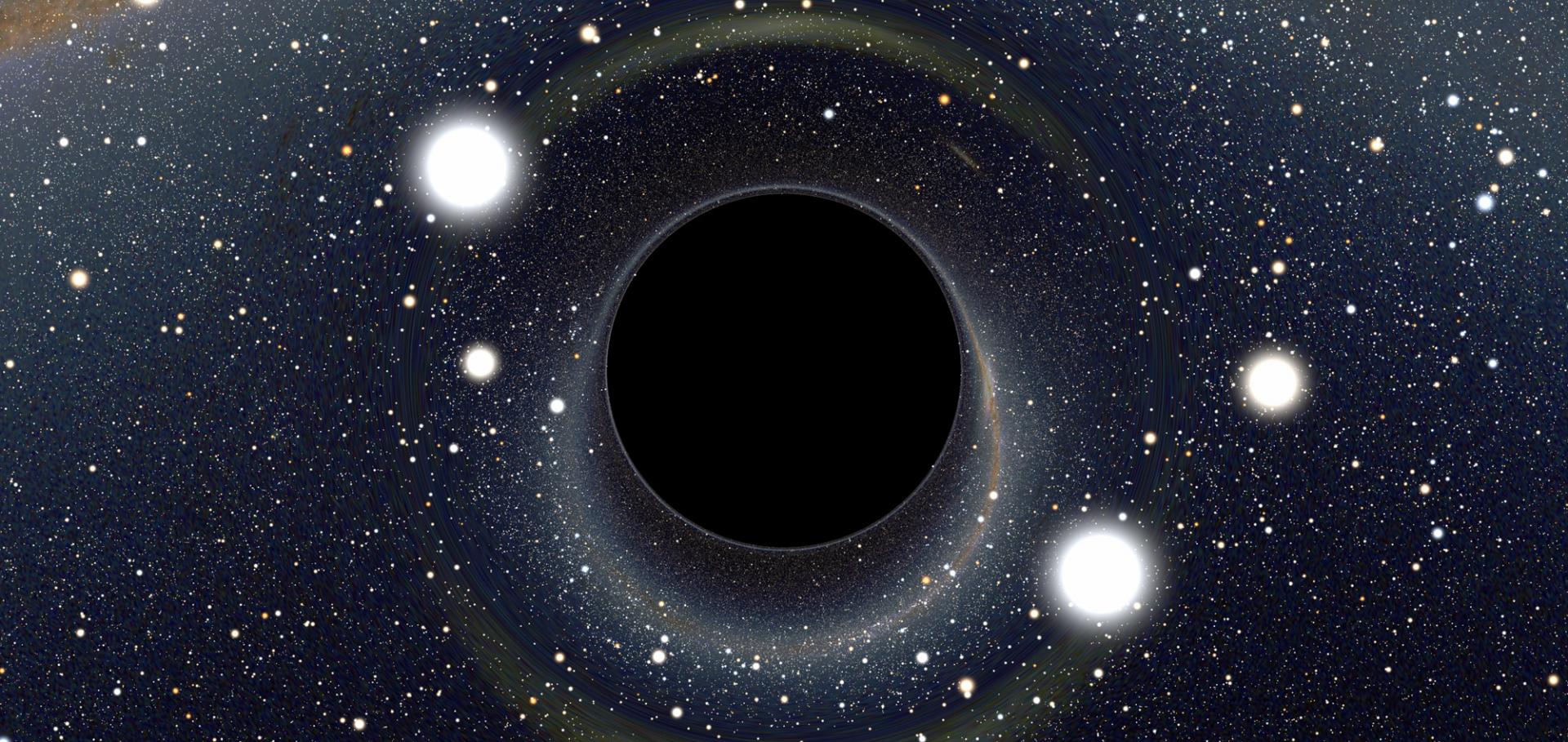
Black Hole

Lensing of space time around a black hole. At Oxford we study black holes observationally and theoretically on all size and time scales - it is some of our core work.

Credit: ALAIN RIAZUELO, IAP/UPMC/CNRS. CLICK HERE TO VIEW MORE IMAGES.

Martin Bureau

Professor of Astrophysics

Research theme

  • Astronomy and astrophysics

Sub department

  • Astrophysics

Research groups

  • Galaxy formation and evolution
  • Hintze Centre for Astrophysical Surveys
martin.bureau@physics.ox.ac.uk
Telephone: 01865 (2)73377
Denys Wilkinson Building, room 701
Home page
ORCID
  • About
  • Publications

WISDOM project - IV. A molecular gas dynamical measurement of the supermassive black hole mass in NGC 524

(2019)

Authors:

Mark D Smith, Martin Bureau, Timothy A Davis, Michele Cappellari, Lijie Liu, Eve V North, Kyoko Onishi, Satoru Iguchi, Marc Sarzi
More details from the publisher

WISDOM project – IV. A molecular gas dynamical measurement of the supermassive black hole mass in NGC 524

Monthly Notices of the Royal Astronomical Society Oxford University Press 485:3 (2019) 4359-4374

Authors:

Mark D Smith, Martin Bureau, TA Davis, Michele Cappellari, Lijie Liu, EV North, K Onishi, S Iguchi, M Sarzi

Abstract:

We present high angular resolution (0.3 arcsec or 37 pc) Atacama Large Millimeter/submillimeter Array observations of the CO(2–1) line emission from a central disc in the early-type galaxy NGC 524. This disc is shown to be dynamically relaxed, exhibiting ordered rotation about a compact 1.3 mm continuum source, which we identify as emission from an active supermassive black hole (SMBH). There is a hole at the centre of the disc slightly larger than the SMBH sphere of influence. An azimuthal distortion of the observed velocity field is found to be due to either a position angle warp or radial gas flow over the inner 2. 5. By forward-modelling the observations, we obtain an estimate of the SMBH mass of 4.0+3.5 −2.0 × 10⁸ M, where the uncertainties are at the 3σ level. The uncertainties are dominated by the poorly constrained inclination and the stellar mass-to-light ratio of this galaxy, and our measurement is consistent with the established correlation between SMBH mass and stellar velocity dispersion. Our result is roughly half that of the previous stellar dynamical measurement, but is consistent within the uncertainties of both. We also present and apply a new tool for modelling complex molecular gas distributions.
More details from the publisher
Details from ORA
More details

The MBHBM* Project -- I: Measurement of the Central Black Hole Mass in Dwarf Galaxy NGC 3504 Using Molecular Gas Kinematics

(2019)

Authors:

Dieu D Nguyen, Mark den Brok, Anil C Seth, Satoru Iguchi, Jenny E Greene, Timothy Davis, Masatoshi Imanishi, Takuma, Izumi, Michelle Cappellari, Nadine Neumayer, Kristina Nyland, Takafumi Tsukui, Kouichiro Nakanishi, Phuong M Nguyen, Quang L Nguyen, Sabine Thater, Martin Bureau, Kyoko Onishi, Karina T Voggel, Ngan M Le, Trung V Dinh
More details from the publisher

The AGN fuelling/feedback cycle in nearby radio galaxies I. ALMA observations and early results

Monthly Notices of the Royal Astronomical Society Oxford University Press 484:3 (2019) 4239-4259

Authors:

I Ruffa, I Prandoni, R Laing, R Paladino, P Parma, H de Ruiter, A Mignano, TA Davis, Martin Bureau, J Warren

Abstract:

This is the first paper of a series exploring the multi-frequency properties of a sample of eleven nearby low excitation radio galaxies (LERGs) in the southern sky. We are conducting an extensive study of different galaxy components (stars, warm and cold gas, radio jets) with the aim of improving our understanding of the AGN fuelling/feedback cycle in LERGs. We present ALMA Band 6 12CO(2-1) and continuum observations of nine sources. Continuum emission from the radio cores was detected in all objects. Six sources also show mm emission from jets on kpc/sub-kpc scales. The jet structures are very similar at mm and cm wavelengths. We conclude that synchrotron emission associated with the radio jets dominates the continuum spectra up to 230 GHz. The 12CO(2-1) line was detected in emission in six out of nine objects, with molecular gas masses ranging from 2 × 10⁷ to 2 × 10¹⁰ M⊙. The CO detections show disc-like structures on scales from ≈0.2 to ≈10 kpc. In one case (NGC 3100) the CO disc presents some asymmetries and is disrupted in the direction of the northern radio jet, indicating a possible jet/disc interaction. In IC 4296, CO is detected in absorption against the radio core as well as in emission. In four of the six galaxies with CO detections, the gas rotation axes are roughly parallel to the radio jets in projection; the remaining two cases show large misalignments. In those objects where optical imaging is available, dust and CO appear to be co-spatial.
More details from the publisher
Details from ORA
More details

The AGN fuelling/feedback cycle in nearby radio galaxies - I. ALMA observations and early results

(2019)

Authors:

Ilaria Ruffa, Isabella Prandoni, Robert A Laing, Rosita Paladino, Paola Parma, Hans de Ruiter, Arturo Mignano, Timothy A Davis, Martin Bureau, Joshua Warren
More details from the publisher

Pagination

  • First page First
  • Previous page Prev
  • …
  • Page 18
  • Page 19
  • Page 20
  • Page 21
  • Current page 22
  • Page 23
  • Page 24
  • Page 25
  • Page 26
  • …
  • Next page Next
  • Last page Last

Footer Menu

  • Contact us
  • Giving to the Dept of Physics
  • Work with us
  • Media

User account menu

  • Log in

Follow us

FIND US

Clarendon Laboratory,

Parks Road,

Oxford,

OX1 3PU

CONTACT US

Tel: +44(0)1865272200

University of Oxfrod logo Department Of Physics text logo
IOP Juno Champion logo Athena Swan Silver Award logo

© University of Oxford - Department of Physics

Cookies | Privacy policy | Accessibility statement

Built by: Versantus

  • Home
  • Research
  • Study
  • Engage
  • Our people
  • News & Comment
  • Events
  • Our facilities & services
  • About us
  • Giving to Physics
  • Current students
  • Staff intranet