Home
Department Of Physics text logo
  • Research
    • Our research
    • Our research groups
    • Our research in action
    • Research funding support
    • Summer internships for undergraduates
  • Study
    • Undergraduates
    • Postgraduates
  • Engage
    • For alumni
    • For business
    • For schools
    • For the public
  • Support
Menu
Atomic and Laser Physics
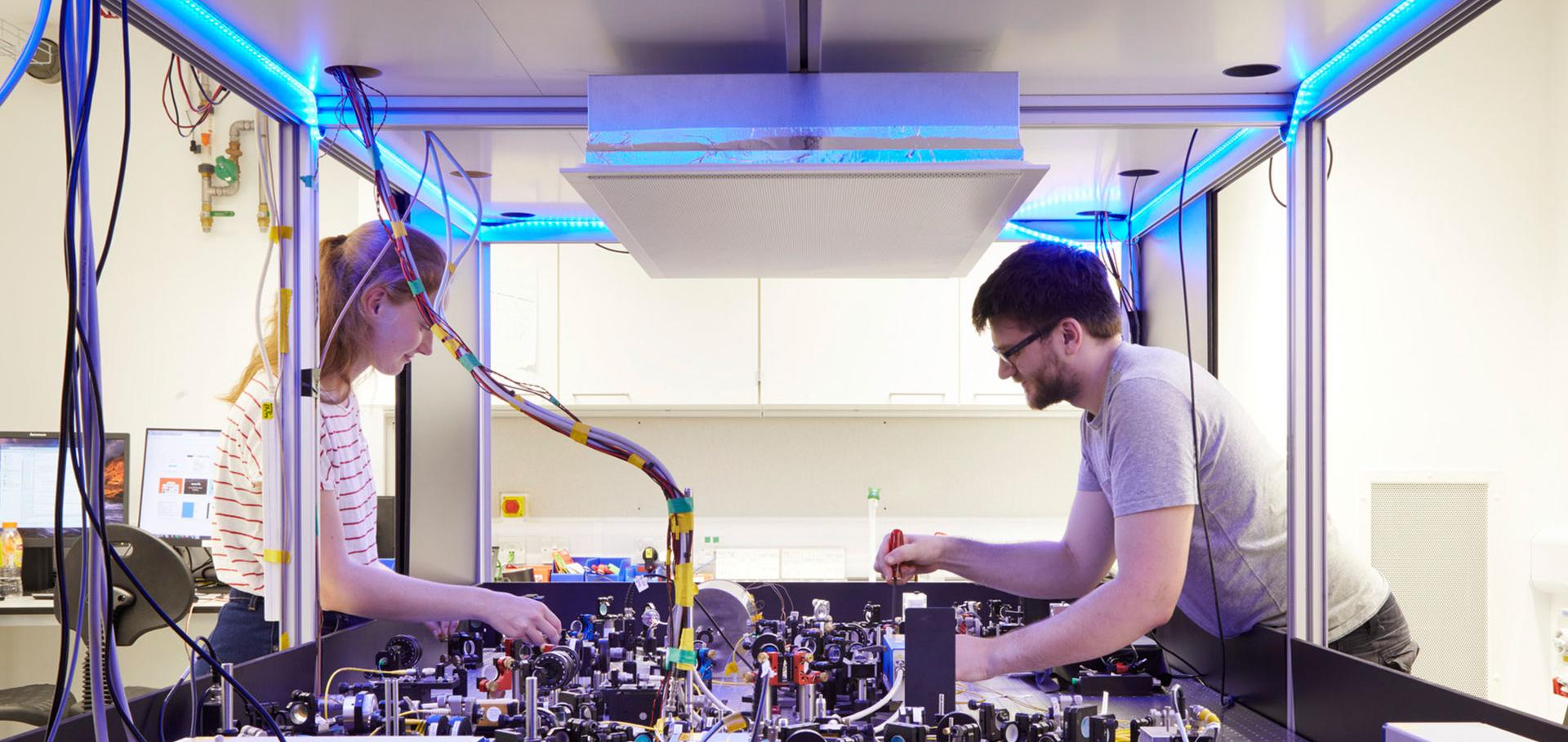
Credit: Jack Hobhouse

Shuying Chen

PDRA

Research theme

  • Quantum information and computation

Sub department

  • Atomic and Laser Physics

Research groups

  • Ion trap quantum computing
shuying.chen@physics.ox.ac.uk
Clarendon Laboratory, room Old Library
  • About
  • Publications

Terahertz electrometry via infrared spectroscopy of atomic vapor

Optica Optica Publishing Group 9:5 (2022) 485-485

Authors:

Shuying Chen, Dominic J Reed, Andrew R MacKellar, Lucy A Downes, Nourah FA Almuhawish, Matthew J Jamieson, Charles S Adams, Kevin J Weatherill

Abstract:

In recent years, the characterization of radiation falling within the so-called “terahertz (THz) gap” has become an ever more prominent issue due to the increasing use of THz systems in applications such as nondestructive testing, security screening, telecommunications, and medical diagnostics. THz detection technologies have advanced rapidly, yet traceable calibration of THz radiation remains challenging. In this paper, we demonstrate a system of electrometry in which a THz signal can be characterized using laser spectroscopy of highly excited (Rydberg) atomic states. We report on proof-of-principle measurements that reveal a minimum detectable THz electric field amplitude of 1.07 ± 0.06 V / m at 1.06 THz (3 ms detection), corresponding to a THz power at the atomic cell of approximately 3.4 nW. Due to the relative simplicity and cryogen-free nature of this system, it has the potential to provide a route to a SI traceable “atomic candle” for THz calibration across the THz frequency range, and provide an alternative to calorimetric methods.
More details from the publisher

Polarization spectroscopy of an excited state transition in Rubidium

OSA Continuum Optica Publishing Group 4:10 (2021) 2598-2598

Authors:

Nourah F Almuhawish, Shuying Chen, Lucy A Downes, Matthew J Jamieson, Andrew R MacKellar, Kevin J Weatherill

Abstract:

We investigate polarization spectroscopy of an excited state transition in room-temperature rubidium vapor. By applying a circularly polarized coupling beam, resonant with the 52S1/2 → 52P3/2 transition, we induce anisotropy in the atomic medium that is then probed by scanning a probe beam across the 52P3/2 → 62S1/2 transition. By performing polarimetry on the probe beam, a dispersive spectral feature is observed. We characterize the excited-state polarization spectrum as a function of coupling intensity for both isotopes and find that at high intensities, Autler-Townes splitting results in a sub-feature, which theoretical modelling shows is enhanced by Doppler averaging. This spectroscopic technique produces a narrow dispersive signal which is ideal for laser frequency stabilization to excited-state transitions.
More details from the publisher

Reducing the mode-mismatch noises in atom–light interactions via optimization of the temporal waveform

Photonics Research Optica Publishing Group 8:11 (2020) 1697-1697

Authors:

Xiaotian Feng, Zhifei Yu, Bing Chen, Shuying Chen, Yuan Wu, Donghui Fan, Chun-Hua Yuan, LQ Chen, ZY Ou, Weiping Zhang

Abstract:

Atom–light interface is at the core of quantum metrology and quantum information science. Associated noises during interaction processes are always inevitable and adverse. In this paper, we perform the stimulated Raman scattering (SRS) in a hot Rb 87 vapor cell and demonstrate the reduction of related noises originated from mode mismatch via optimizing the temporal waveform of the input seed. By using the seed with the optimized mode, the intensity fluctuation of the signal field generated in atom–light interaction is decreased by 4.3 dB. Furthermore, the fluctuation of the intensity difference between the signal and atomic spin wave is reduced by 3.1 dB. Such a temporal mode-cleaning method can be applied to improve the precision of atom interferometry using SRS and should be helpful for quantum information processing based on an atom–light correlated system.
More details from the publisher

Quality estimation of non-demolition measurement with lossy atom-light hybrid interferometers

Optics Express Optica Publishing Group 28:7 (2020) 9875-9875

Authors:

D-H Fan, S-Y Chen, Z-F Yu, Keye Zhang, LQ Chen

Abstract:

The atom-light hybrid interferometer recently attracted much attention in the research of precision metrology for its combination of light and atomic spin wave. With the AC Stark effect and proper design, it can be applied in the scheme of quantum non-demolition (QND) measurement of photon numbers. In this work, we apply the QND criteria to the scheme and theoretically derive its explicit formulas with various losses of the atomic-light hybrid interferometer. With the formulas and actual experiment parameters, we estimate and compare the performance of the vapor-atom-based and cold-atom-based hybrid interferometer in the QND measurement, analyze the influences of different kinds of losses, and provide optimized working parameter ranges of the interferometer.
More details from the publisher

Estimation of gravitational acceleration with quantum optical interferometers

Physical Review A American Physical Society (APS) 99:2 (2019) 023803

Authors:

SY Chen, TC Ralph
More details from the publisher

Pagination

  • First page First
  • Previous page Prev
  • Page 1
  • Current page 2
  • Page 3
  • Next page Next
  • Last page Last

Footer Menu

  • Contact us
  • Giving to the Dept of Physics
  • Work with us
  • Media

User account menu

  • Log in

Follow us

FIND US

Clarendon Laboratory,

Parks Road,

Oxford,

OX1 3PU

CONTACT US

Tel: +44(0)1865272200

University of Oxfrod logo Department Of Physics text logo
IOP Juno Champion logo Athena Swan Silver Award logo

© University of Oxford - Department of Physics

Cookies | Privacy policy | Accessibility statement

Built by: Versantus

  • Home
  • Research
  • Study
  • Engage
  • Our people
  • News & Comment
  • Events
  • Our facilities & services
  • About us
  • Giving to Physics
  • Current students
  • Staff intranet