Home
Department Of Physics text logo
  • Research
    • Our research
    • Our research groups
    • Our research in action
    • Research funding support
    • Summer internships for undergraduates
  • Study
    • Undergraduates
    • Postgraduates
  • Engage
    • For alumni
    • For business
    • For schools
    • For the public
  • Support
Menu
Atomic and Laser Physics
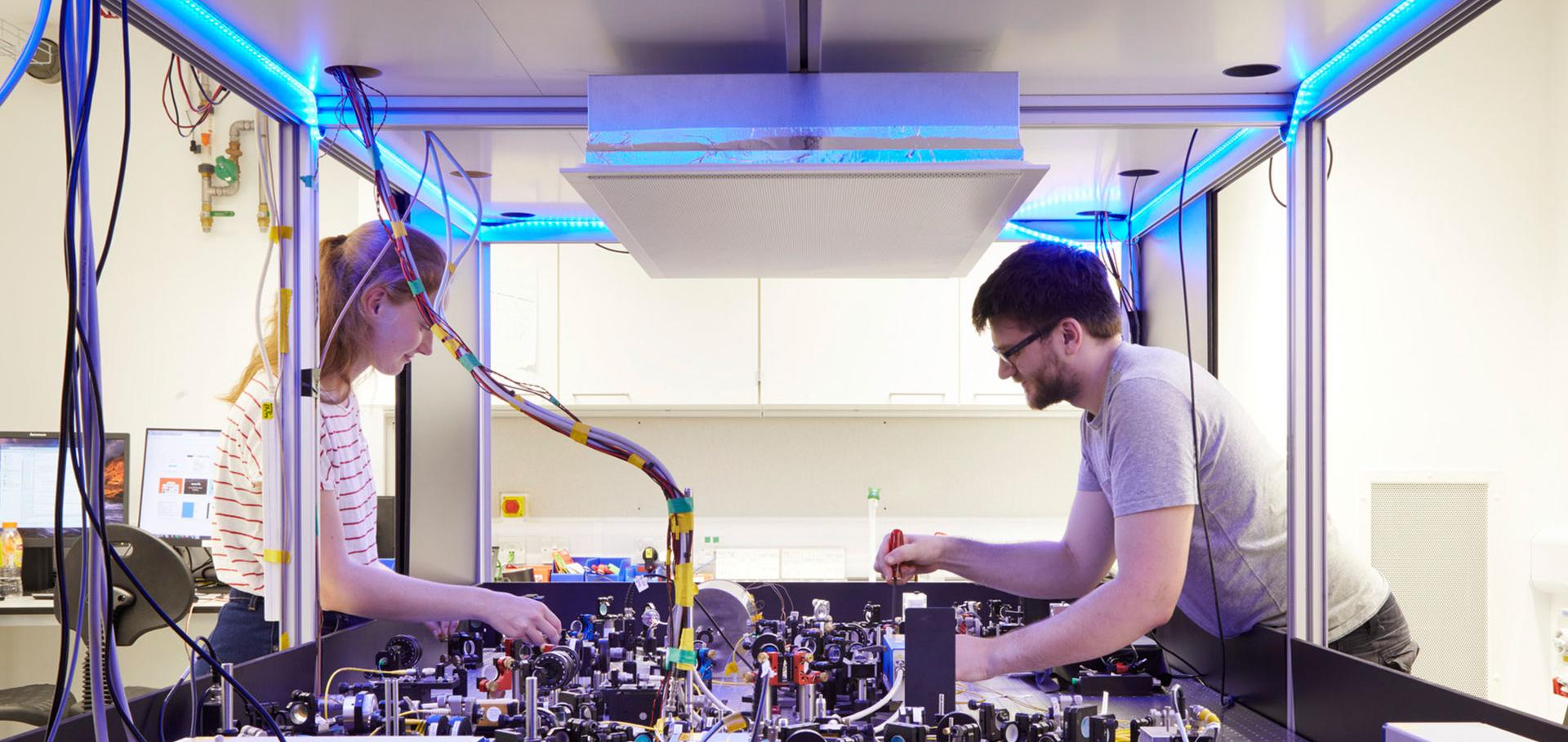
Credit: Jack Hobhouse

Professor Andrew Daley

Professor of Quantum Physics

Research theme

  • Quantum information and computation
  • Quantum optics & ultra-cold matter

Sub department

  • Atomic and Laser Physics

Research groups

  • Theory of quantum systems
andrew.daley@physics.ox.ac.uk
Clarendon Laboratory, room 316.3
  • About
  • Publications

Interspecies entanglement with impurity atoms in a lattice gas

(2018)

Authors:

Saubhik Sarkar, Suzanne McEndoo, Dominik Schneble, Andrew J Daley
More details from the publisher
Details from ArXiV

Particle statistics and lossy dynamics of ultracold atoms in optical lattices

Physical Review A American Physical Society (APS) 97:5 (2018) 053614

Authors:

J Yago Malo, EPL van Nieuwenburg, MH Fischer, AJ Daley
More details from the publisher
More details

Dynamical Disentangling and Cooling of Atoms in Bilayer Optical Lattices

Physical Review Letters American Physical Society (APS) 120:6 (2018) 060401

Authors:

A Kantian, S Langer, AJ Daley
More details from the publisher
More details
More details

Turbulent Mixing Simulation via a Quantum Algorithm

AIAA Journal American Institute of Aeronautics and Astronautics (AIAA) 56:2 (2018) 1-13

Authors:

Guanglei Xu, Andrew J Daley, Peyman Givi, Rolando D Somma
More details from the publisher

Theoretical aspects of analogue quantum simulation with cold atoms

Proceedings of the International School of Physics "Enrico Fermi" 198 (2018) 55-110

Abstract:

In these lectures, we discuss theoretical aspects of analogue quantum simulation, focussing on ultracold atoms in optical lattices as a specific example. We touch on the motivation for quantum simulation, before going into detail on the first-principles microscopic understanding of the system that allows us to use ultra-cold atoms as quantum simulators. This level of understanding and control crucially also exists for the dominant dissipative processes in experiments. We conclude by discussing the verification of quantum simulators, comparison with classical simulations, and the current role of many-body entanglement in this discussion.
More details from the publisher

Pagination

  • First page First
  • Previous page Prev
  • …
  • Page 22
  • Page 23
  • Page 24
  • Page 25
  • Current page 26
  • Page 27
  • Page 28
  • Page 29
  • Page 30
  • …
  • Next page Next
  • Last page Last

Footer Menu

  • Contact us
  • Giving to the Dept of Physics
  • Work with us
  • Media

User account menu

  • Log in

Follow us

FIND US

Clarendon Laboratory,

Parks Road,

Oxford,

OX1 3PU

CONTACT US

Tel: +44(0)1865272200

University of Oxfrod logo Department Of Physics text logo
IOP Juno Champion logo Athena Swan Silver Award logo

© University of Oxford - Department of Physics

Cookies | Privacy policy | Accessibility statement

Built by: Versantus

  • Home
  • Research
  • Study
  • Engage
  • Our people
  • News & Comment
  • Events
  • Our facilities & services
  • About us
  • Giving to Physics
  • Current students
  • Staff intranet