Home
Department Of Physics text logo
  • Research
    • Our research
    • Our research groups
    • Our research in action
    • Research funding support
    • Summer internships for undergraduates
  • Study
    • Undergraduates
    • Postgraduates
  • Engage
    • For alumni
    • For business
    • For schools
    • For the public
  • Support
Menu
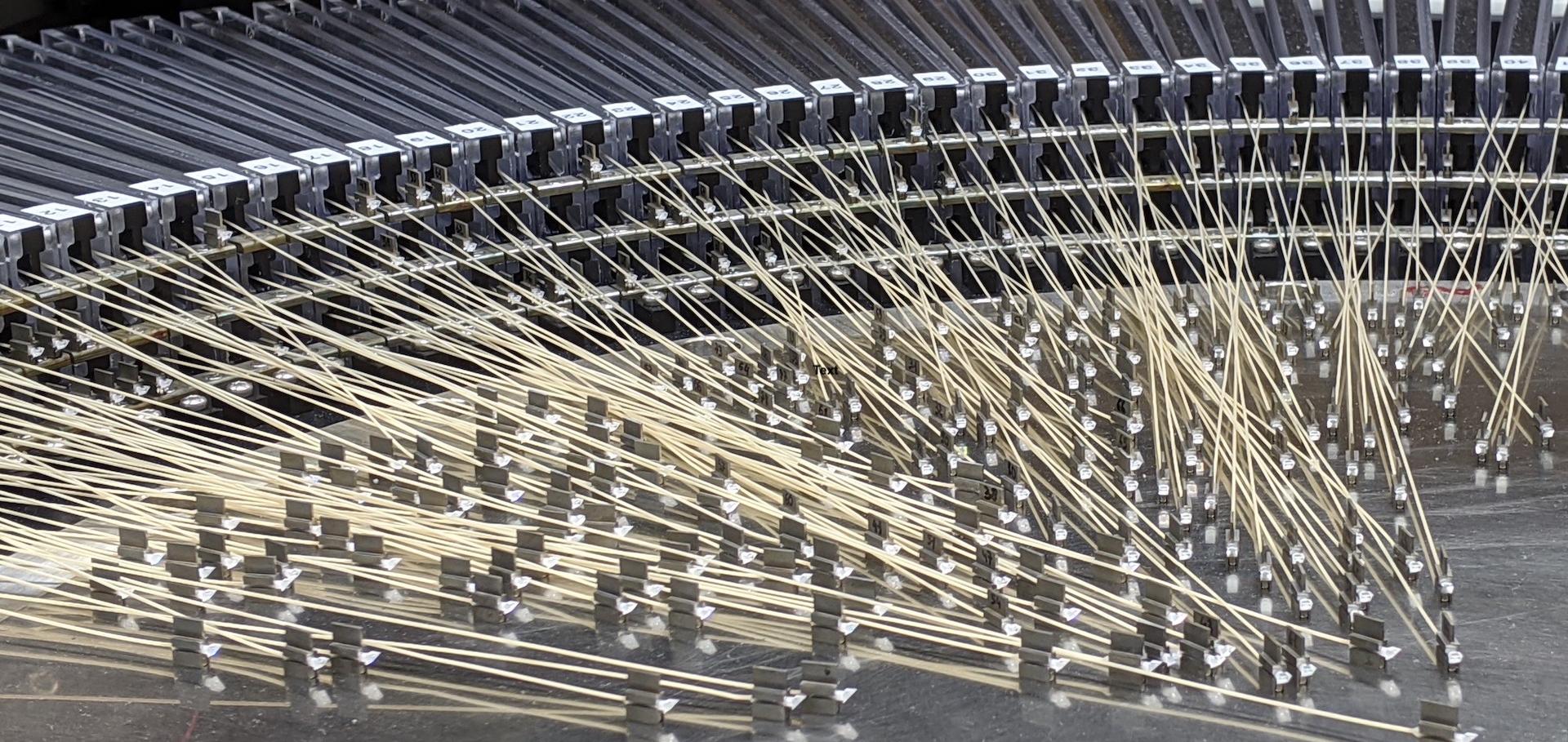
Part of a WEAVE fibre configuration

Part of the WEAVE focal plane showing optical fibres positioned on a set of targets in the telescope focal plane.

Prof Gavin Dalton

Professor of Astrophysics

Research theme

  • Astronomy and astrophysics

Sub department

  • Astrophysics

Research groups

  • Astronomical instrumentation
  • Extremely Large Telescope
Gavin.Dalton@physics.ox.ac.uk
  • About
  • Research
  • Publications

Cryogenic mounts for large fused silica lenses

Proceedings of SPIE - The International Society for Optical Engineering 6273 II (2006)

Authors:

TR Froud, IAJ Tosh, RL Edeson, GB Dalton

Abstract:

This paper describes the design and development of an accurate temperature compliant lens mounting technique being used on the camera of the UK-FMOS near infrared spectrograph for operation at the Subaru Telescope in Hawaii. A series of fused silica lenses of up to 4.4kg, 255mm in diameter and operating at temperatures as low as 70K are supported within flexures cut away from stainless steel outer rings. Intermediate low thermal expansion pads are attached to these flexures and in turn bonded to the glass during the alignment process. This mounting method lends itself to the domino chips type of assembly process which can be carried out on a rotary table to maintain accurate axial alignment. A detailed description of the overall design progression including the methods of manufacture, alignment process, adhesive selection, assembly methods and testing is included.
More details from the publisher
More details

The UK FMOS spectrograph

Proceedings of SPIE the International Society for Optical Engineering 6269 II (2006)

Authors:

GB Dalton, IJ Lewis, DG Bonfield, AR Holmes, CB Brooks, H Lee, IAJ Tosh, TR Froud, M Patel, NA Dipper, C Blackburn

Abstract:

We describe the build phase of the UK FMOS spectrograph, a 200 fibre cooled OH Suppression infrared spectrograph being constructed as part of Subaru's Fibre Multi Object Spectroscopy facility. Here we describe recent UK activities within the FMOS programme and the likely schedule for commissioning at Subaru.
More details from the publisher

The VISTA infrared camera

Proceedings of SPIE the International Society for Optical Engineering 6269 I (2006)

Authors:

GB Dalton, M Caldwell, AK Ward, MS Whalley, G Woodhouse, RL Edeson, P Clark, SM Beard, AM Gallie, SP Todd, JMD Strachan, NN Bezawada, WJ Sutherland, JP Emerson

Abstract:

We describe the integration and test phase of the construction of the VISTA Infrared Camera, a 64 Megapixel, 1.65 degree field of view 0.9-2.4 micron camera which will soon be operating at the cassegrain focus of the 4m VISTA telescope. The camera incorporates sixteen IR detectors and six CCD detectors which are used to provide autoguiding and wavefront sensing information to the VISTA telescope control system.
More details from the publisher
More details

Scientific requirements for a European ELT

Proceedings of SPIE - The International Society for Optical Engineering 6267 II (2006)

Authors:

I Hook, G Dalton, R Gilmozzi

Abstract:

The science case for the next generation of Extremely Large Telescopes (ELTs) covers a huge range of astronomical topics and requires a wide range of capabilities. Here we describe top-level requirements on an ELT, which were derived from some of the key science cases identified by European astronomers. After a brief summary of these science cases we discuss the requirements on the ELT system in terms of several parameters, including wavelength range, field of view, image quality etc. We discuss the science driver that sets the limits on each parameter. We also discuss specific requirements on instrumentation, site and adaptive optics. In several cases, detailed simulated observations will be required in order to set the requirements. While the example science cases provide a useful guide, we also note that an important goal is to develop a facility that covers a broad parameter space, and maintains flexibility in order to adapt to new scientific directions.
More details from the publisher

Galaxy clusters at 0.6 < z < 1.4 in the UKIDSS Ultra Deep Survey Early Data Release

(2006)

Authors:

C van Breukelen, L Clewley, DG Bonfield, S Rawlings, MJ Jarvis, JM Barr, S Foucaud, O Almaini, M Cirasuolo, G Dalton, JS Dunlop, AC Edge, P Hirst, RJ McLure, MJ Page, K Sekiguchi, C Simpson, I Smail, MG Watson
More details from the publisher

Pagination

  • First page First
  • Previous page Prev
  • …
  • Page 46
  • Page 47
  • Page 48
  • Page 49
  • Current page 50
  • Page 51
  • Page 52
  • Page 53
  • Page 54
  • …
  • Next page Next
  • Last page Last

Footer Menu

  • Contact us
  • Giving to the Dept of Physics
  • Work with us
  • Media

User account menu

  • Log in

Follow us

FIND US

Clarendon Laboratory,

Parks Road,

Oxford,

OX1 3PU

CONTACT US

Tel: +44(0)1865272200

University of Oxfrod logo Department Of Physics text logo
IOP Juno Champion logo Athena Swan Silver Award logo

© University of Oxford - Department of Physics

Cookies | Privacy policy | Accessibility statement

Built by: Versantus

  • Home
  • Research
  • Study
  • Engage
  • Our people
  • News & Comment
  • Events
  • Our facilities & services
  • About us
  • Giving to Physics
  • Current students
  • Staff intranet