
Home
Department Of Physics text logo
  • Research
    • Our research
    • Our research groups
    • Our research in action
    • Research funding support
    • Summer internships for undergraduates
  • Study
    • Undergraduates
    • Postgraduates
  • Engage
    • For alumni
    • For business
    • For schools
    • For the public
Menu
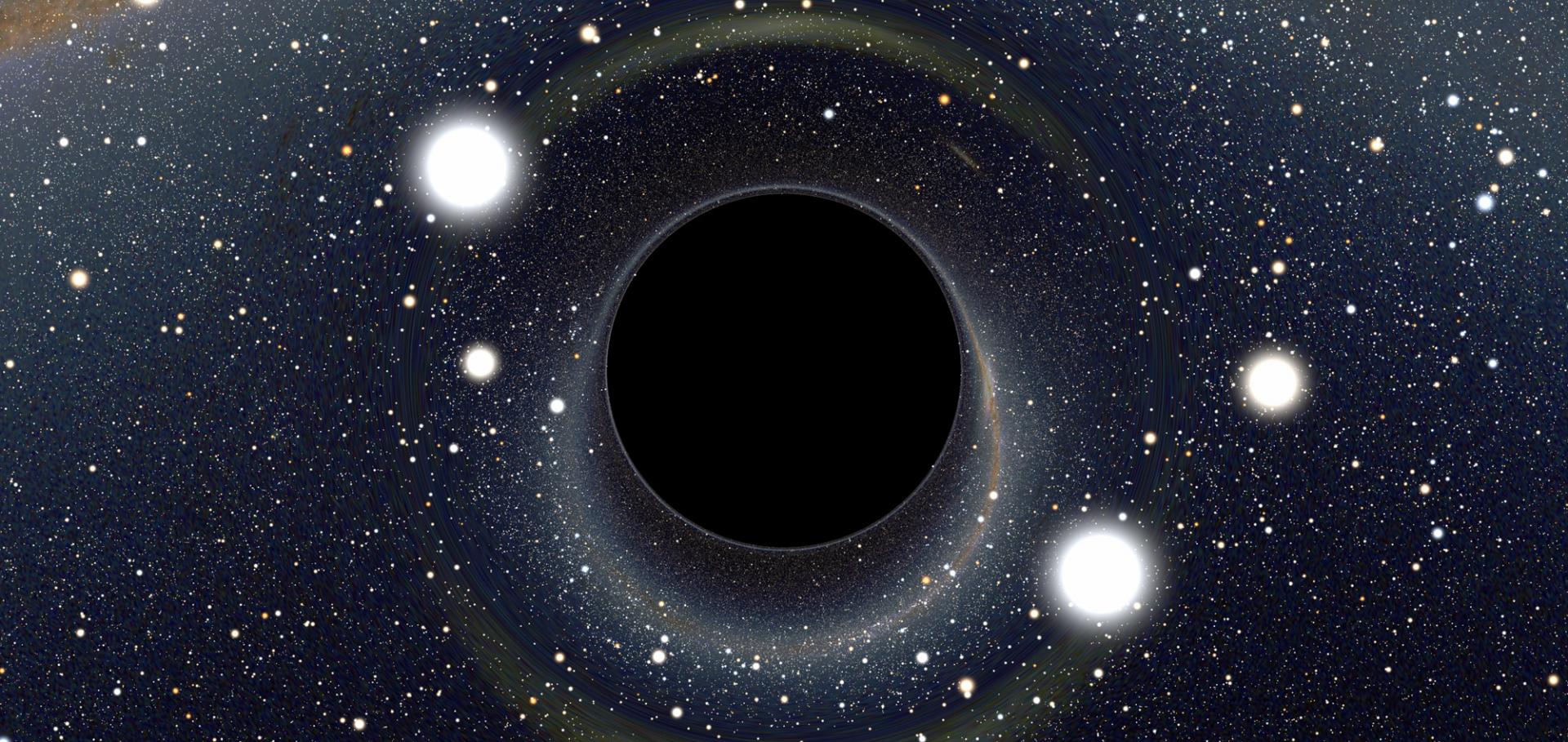
Black Hole

Lensing of space time around a black hole. At Oxford we study black holes observationally and theoretically on all size and time scales - it is some of our core work.

Credit: ALAIN RIAZUELO, IAP/UPMC/CNRS. CLICK HERE TO VIEW MORE IMAGES.

Julien Devriendt

Professor of Astrophysics

Research theme

  • Astronomy and astrophysics
  • Particle astrophysics & cosmology

Sub department

  • Astrophysics

Research groups

  • Beecroft Institute for Particle Astrophysics and Cosmology
  • Cosmology
  • Galaxy formation and evolution
julien.devriendt@physics.ox.ac.uk
Telephone: 01865 (2)73307
Denys Wilkinson Building, room 555D
  • About
  • Teaching
  • Publications

Galaxy orientation with the cosmic web across cosmic time

Monthly Notices of the Royal Astronomical Society Oxford University Press 481:4 (2018) 4753-4774

Authors:

S Codis, A Jindal, N Elisa Chisari, D Vibert, Y Dubois, C Pichon, Julien Devriendt

Abstract:

This work investigates the alignment of galactic spins with the cosmic web across cosmic time using the cosmological hydrodynamical simulation Horizon-AGN. The cosmic web structure is extracted via the persistent skeleton as implemented in the DISPERSE algorithm. It is found that the spin of low-mass galaxies is more likely to be aligned with the filaments of the cosmic web and to lie within the plane of the walls while more massive galaxies tend to have a spin perpendicular to the axis of the filaments and to the walls. The mass transition is detected with a significance of 9σ. This galactic alignment is consistent with the alignment of the spin of dark haloes found in pure dark matter simulations and with predictions from (anisotropic) tidal torque theory. However, unlike haloes, the alignment of low-mass galaxies is weak and disappears at low redshifts while the orthogonal spin orientation of massive galaxies is strong and increases with time, probably as a result of mergers. At fixed mass, alignments are correlated with galaxy morphology: the high-redshift alignment is dominated by spiral galaxies while elliptical centrals are mainly responsible for the perpendicular signal. The two regimes probed in this work induce competing galactic alignment signals for weak lensing, with opposite redshift and luminosity evolution. Understanding the details of these intrinsic alignments will be key to exploit future major cosmic shear surveys like Euclid or LSST.
More details from the publisher
Details from ORA
More details
Details from ArXiV

Probing Cosmic Dawn: Modelling the Assembly History, SEDs, and Dust Content of Selected $z\sim9$ Galaxies

(2018)

Authors:

Harley Katz, Nicolas Laporte, Richard S Ellis, Julien Devriendt, Adrianne Slyz
More details from the publisher

Galaxy orientation with the cosmic web across cosmic time

(2018)

Authors:

S Codis, A Jindal, NE Chisari, D Vibert, Y Dubois, C Pichon, J Devriendt
More details from the publisher

The role of mergers in driving morphological transformation over cosmic time

Monthly Notices of the Royal Astronomical Society Oxford University Press (OUP) (2018)

Authors:

G Martin, S Kaviraj, JEG Devriendt, Y Dubois, C Pichon

Abstract:

Understanding the processes that trigger morphological transformation is central to understanding how and why the Universe transitions from being disc-dominated at early epochs to having the morphological mix that is observed today. We use Horizon-AGN, a cosmological hydrodynamical simulation, to perform a comprehensive study of the processes that drive morphological change in massive (M > 10^10 MSun) galaxies over cosmic time. We show that (1) essentially all the morphological evolution in galaxies that are spheroids at z=0 is driven by mergers with mass ratios greater than 1:10, (2) major mergers alone cannot produce today's spheroid population -- minor mergers are responsible for a third of all morphological transformation over cosmic time and are its dominant driver after z~1, (3) prograde mergers trigger milder morphological transformation than retrograde mergers -- while both types of events produce similar morphological changes at z>2, the average change due to retrograde mergers is around twice that due to their prograde counterparts at z~0, (4) remnant morphology depends strongly on the gas fraction of a merger, with gas-rich mergers routinely re-growing discs, and (5) at a given stellar mass, discs do not exhibit drastically different merger histories from spheroids -- disc survival in mergers is driven by acquisition of cold gas (via cosmological accretion and gas-rich interactions) and a preponderance of prograde mergers in their merger histories.
More details from the publisher
Details from ORA
More details
Details from ArXiV

The role of mergers in driving morphological transformation over cosmic time

(2018)

Authors:

G Martin, S Kaviraj, JEG Devriendt, Y Dubois, C Pichon
More details from the publisher

Pagination

  • First page First
  • Previous page Prev
  • …
  • Page 33
  • Page 34
  • Page 35
  • Page 36
  • Current page 37
  • Page 38
  • Page 39
  • Page 40
  • Page 41
  • …
  • Next page Next
  • Last page Last

Footer Menu

  • Contact us
  • Giving to the Dept of Physics
  • Work with us
  • Media

User account menu

  • Log in

Follow us

FIND US

Clarendon Laboratory,

Parks Road,

Oxford,

OX1 3PU

CONTACT US

Tel: +44(0)1865272200

University of Oxfrod logo Department Of Physics text logo
IOP Juno Champion logo Athena Swan Silver Award logo

© University of Oxford - Department of Physics

Cookies | Privacy policy | Accessibility statement

Built by: Versantus

  • Home
  • Research
  • Study
  • Engage
  • Our people
  • News & Comment
  • Events
  • Our facilities & services
  • About us
  • Giving to Physics
  • Current students
  • Staff intranet