


A decelerating jet observed by the EVN and VLB A in the X-ray transient XTE J1752-223
Monthly Notices of the Royal Astronomical Society: Letters 409:1 (2010)
Abstract:
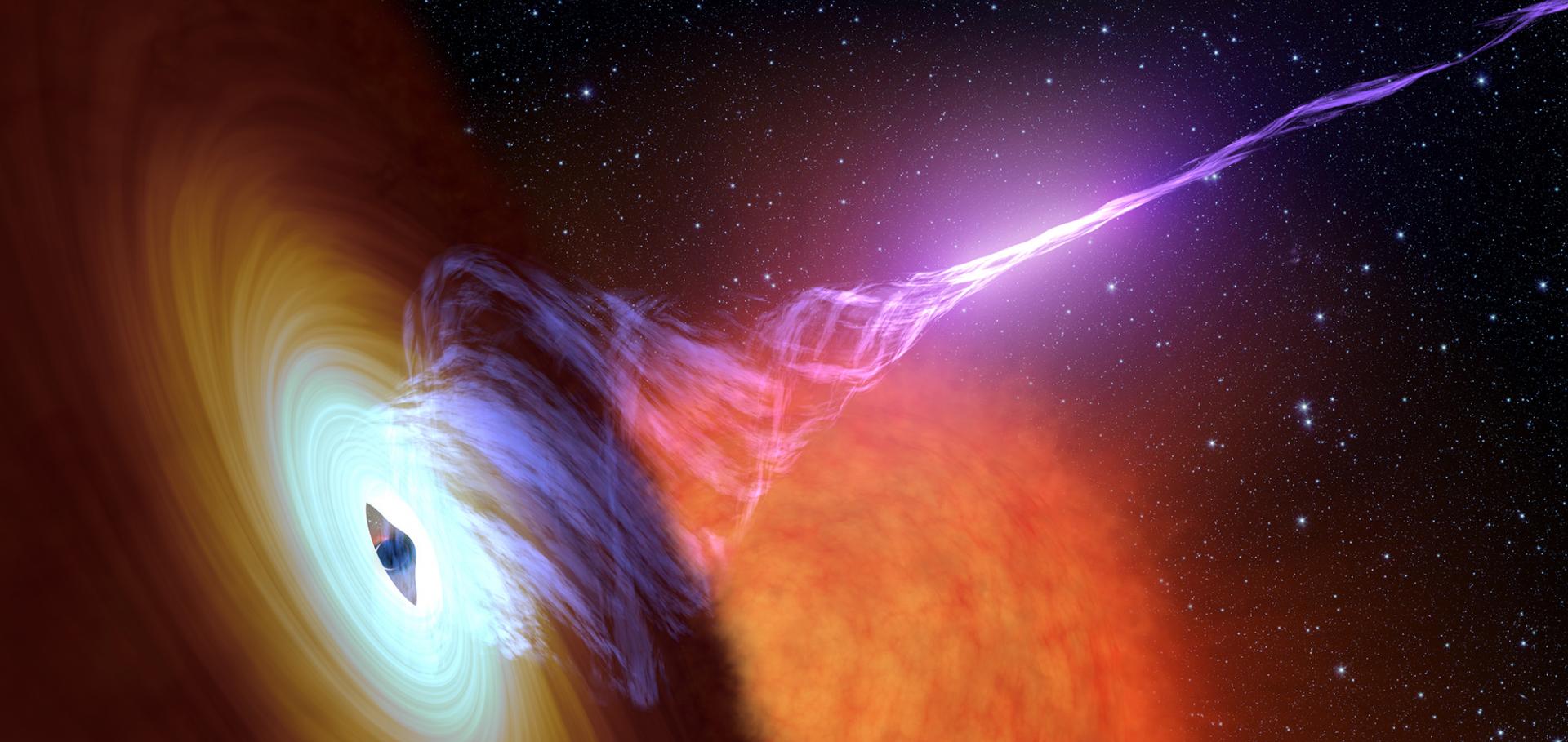
The recently discovered Galactic X-ray transient XTE J1752-223 entered its first known outburst in 2010, emitting from the X-ray to the radio regimes. Its general X-ray properties were consistent with those of a black hole candidate in various spectral states, when ejection of jet components is expected. To verify this, we carried out very long baseline interferometry (VLBI) observations. The measurements were carried out with the European VLBI Network (EVN) and the Very Long Baseline Array (VLBA) at four epochs in 2010 February. The images at the first three epochs show a moving jet component that is significantly decelerated by the last epoch, when a new jet component appears that is likely to be associated with the receding jet side. The overall picture is consistent with an initially mildly relativistic jet, interacting with the interstellar medium or with swept-up material along the jet. The brightening of the receding ejecta at the final epoch can be well explained by initial Doppler deboosting of the emission in the decelerating jet. © 2010 The Authors. Journal compilation © 2010 RAS.Investigating accretion disk - radio jet coupling across the stellar mass scale
(2010)
The commensal real-time ASKAP fast-transients (CRAFT) survey
Publications of the Astronomical Society of Australia 27:3 (2010) 272-282
Abstract:
We are developing a purely commensal survey experiment for fast (<5 s) transient radio sources. Short-timescale transients are associated with the most energetic and brightest single events in the Universe. Our objective is to cover the enormous volume of transients parameter space made available by ASKAP, with an unprecedented combination of sensitivity and field of view. Fast timescale transients open new vistas on the physics of high brightness temperature emission,extreme states of matter and the physics of strong gravitational fields. In addition, the detection of extragalactic objects affords us an entirely new and extremely sensitive probe on the huge reservoir of baryons present in the IGM. We outline here our approach to the considerable challenge involved in detecting fast transients, particularly the development of hardware fast enough to dedisperse and search the ASKAP data stream at or near real-time rates. Through CRAFT, ASKAP will provide the testbed of many of the key technologies and survey modes proposed for high time resolution science with the SKA. © Astronomical Society of Australia 2010.A Global Study of the Behaviour of Black Hole X-ray Binary Discs
(2010)
X-ray and radio variability in the low luminosity Active Galactic Nucleus NGC 7213
(2010)