Home
Department Of Physics text logo
  • Research
    • Our research
    • Our research groups
    • Our research in action
    • Research funding support
    • Summer internships for undergraduates
  • Study
    • Undergraduates
    • Postgraduates
  • Engage
    • For alumni
    • For business
    • For schools
    • For the public
  • Support
Menu
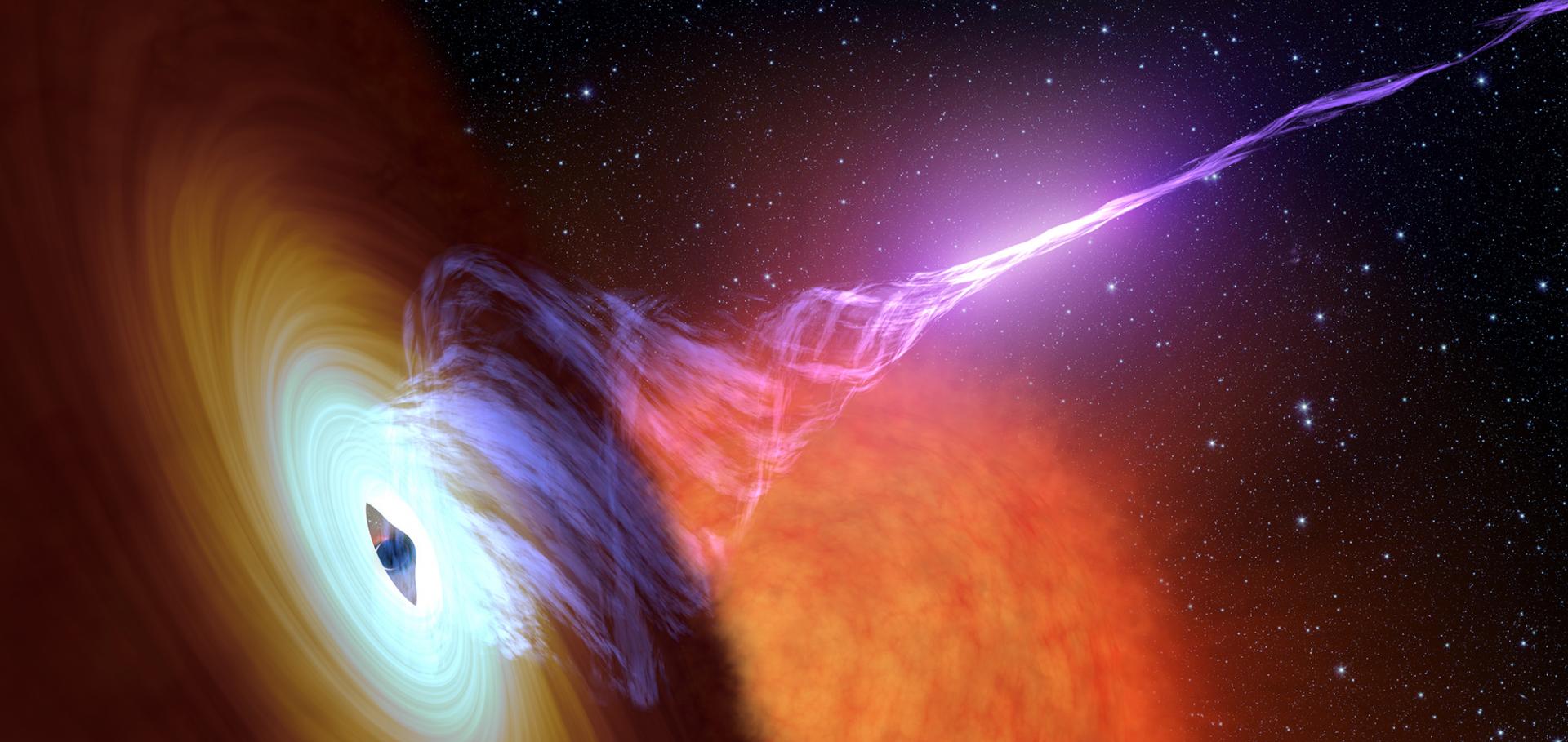
Relativistic Jet from Black Hole

An artist's impression of a relativistic jet propagating away from a black hole at close to the speed of light. Such jets are formed by the inner regions of the accretion flow: matter flowing inwards towards the black hole, via processes which are not yet fully understood. The accretion flow emits primarily in X-rays, the relativistic jet in the radio band: by combing observations in each band we can try and understand how such jets form and how much energy they carry away from the black hole.

Professor Rob Fender

Professor of Astrophysics

Research theme

  • Astronomy and astrophysics

Sub department

  • Astrophysics

Research groups

  • Hintze Centre for Astrophysical Surveys
  • MeerKAT
  • Pulsars, transients and relativistic astrophysics
  • Rubin-LSST
  • The Square Kilometre Array (SKA)
  • Gamma-ray astronomy
Rob.Fender@physics.ox.ac.uk
Telephone: 01865 (2)73435
Denys Wilkinson Building, room 712
  • About
  • Publications

'Disc-jet' coupling in black hole X-ray binaries and active galactic nuclei

(2009)
More details from the publisher

Following the 2008 outburst decay of the black hole candidate H1743-322 in X-ray and radio

(2009)

Authors:

PG Jonker, J Miller-Jones, J Homan, E Gallo, M Rupen, J Tomsick, RP Fender, P Kaaret, DTH Steeghs, MAP Torres, R Wijnands, S Markoff, WHG Lewin
More details from the publisher

The proper motion and changing jet morphology of Cygnus X-3

(2009)

Authors:

JCA Miller-Jones, CM Sakari, V Dhawan, V Tudose, RP Fender, Z Paragi, MA Garrett
More details from the publisher

Refined orbital solution and quiescent variability in the black hole transient GS 1354-64 (= BW Cir)

Astrophysical Journal, Supplement Series 181:1 (2009) 238-243

Authors:

J Casares, JA Orosz, C Zurita, T Shahbaz, JM Corral-Santana, JE Mcclintock, MR Garcia, IG Martínez-Pais, PA Charles, RP Fender, RA Remillard

Abstract:

In Casares et al. we presented the first radial velocity curve of the companion star to BW Cir which demonstrates the presence of a black hole in this historical X-ray transient. But these data were affected by aliasing and two possible periods at 2.5445 days and 2.5635 days were equally possible. Here we present new spectroscopic data that enable us to break the 1-year aliasing and confirm 2.5445 days as the correct orbital period. We also present R-band photometry over 14 years, which reveals the presence of important flaring activity dominating the light curves. © 2009. The American Astronomical Society. All rights reserved.
More details from the publisher
More details

iShocks: X-ray binary jets with an internal shocks model

(2009)

Authors:

O Jamil, R Fender, C Kaiser
More details from the publisher

Pagination

  • First page First
  • Previous page Prev
  • …
  • Page 133
  • Page 134
  • Page 135
  • Page 136
  • Current page 137
  • Page 138
  • Page 139
  • Page 140
  • Page 141
  • …
  • Next page Next
  • Last page Last

Footer Menu

  • Contact us
  • Giving to the Dept of Physics
  • Work with us
  • Media

User account menu

  • Log in

Follow us

FIND US

Clarendon Laboratory,

Parks Road,

Oxford,

OX1 3PU

CONTACT US

Tel: +44(0)1865272200

University of Oxfrod logo Department Of Physics text logo
IOP Juno Champion logo Athena Swan Silver Award logo

© University of Oxford - Department of Physics

Cookies | Privacy policy | Accessibility statement

Built by: Versantus

  • Home
  • Research
  • Study
  • Engage
  • Our people
  • News & Comment
  • Events
  • Our facilities & services
  • About us
  • Giving to Physics
  • Current students
  • Staff intranet