Home
Department Of Physics text logo
  • Research
    • Our research
    • Our research groups
    • Our research in action
    • Research funding support
    • Summer internships for undergraduates
  • Study
    • Undergraduates
    • Postgraduates
  • Engage
    • For alumni
    • For business
    • For schools
    • For the public
Menu
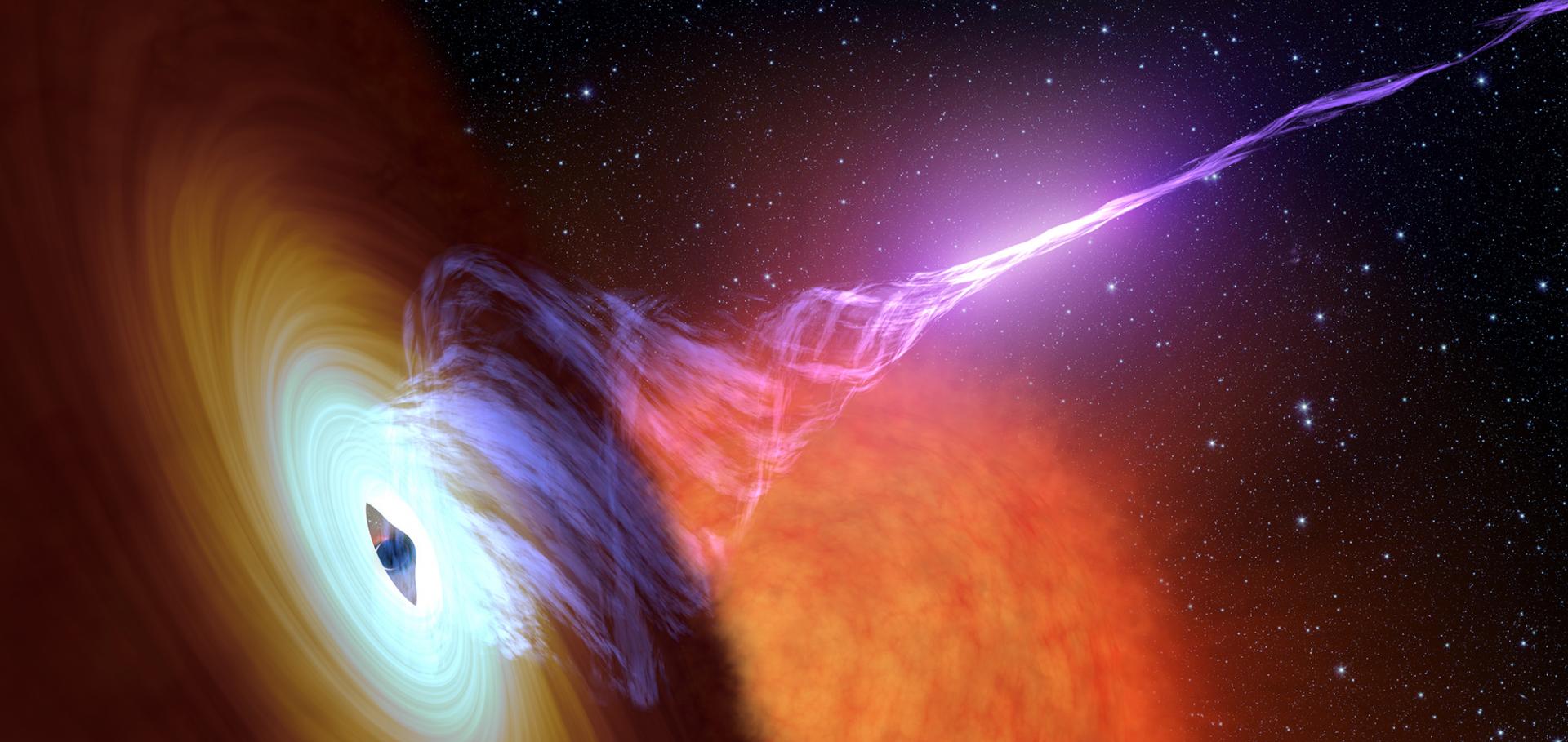
Relativistic Jet from Black Hole

An artist's impression of a relativistic jet propagating away from a black hole at close to the speed of light. Such jets are formed by the inner regions of the accretion flow: matter flowing inwards towards the black hole, via processes which are not yet fully understood. The accretion flow emits primarily in X-rays, the relativistic jet in the radio band: by combing observations in each band we can try and understand how such jets form and how much energy they carry away from the black hole.

Professor Rob Fender

Professor of Astrophysics

Research theme

  • Astronomy and astrophysics

Sub department

  • Astrophysics

Research groups

  • Hintze Centre for Astrophysical Surveys
  • MeerKAT
  • Pulsars, transients and relativistic astrophysics
  • Rubin-LSST
  • The Square Kilometre Array (SKA)
  • Gamma-ray astronomy
Rob.Fender@physics.ox.ac.uk
Telephone: 01865 (2)73435
Denys Wilkinson Building, room 712
  • About
  • Publications

The EUV transient RE J1255 + 266

Monthly Notices of the Royal Astronomical Society Oxford University Press (OUP) 281:3 (1996) 1016-1026

Authors:

MG Watson, TR Marsh, RP Fender, MA Barstow, M Still, M Page, VS Dhillon, AP Beardmore
More details from the publisher

A new deep infrared finder chart for the Cygnus X-3 field

Astronomy and Astrophysics 308:2 (1996) 497-498

Authors:

RP Fender, SJ Bell Burnell

Abstract:

We present a new deep K-band infrared finder chart for the Cygnus X-3 field, revealing the presence of at least ten previously undetected infrared objects within a few arc seconds of the source. Although these newly-discovered objects have in all likelihood not affected previous infrared spectroscopy or photometry of Cyg X-3, knowledge of their locations is an important consideration for future deep infrared spectroscopy of the source.

Simultaneous millimetre and radio observations of Cygnus X-3 in a quiescent radio state

Monthly Notices of the Royal Astronomical Society Oxford University Press (OUP) 274:2 (1995) 633-638

Authors:

RP Fender, SJ Bell Burnell, ST Garrington, RE Spencer, GG Pooley
More details from the publisher

Rapid Infrared Flares in Cygnus X-3

Chapter in Frontiers of Space And Ground-Based Astronomy, Springer Nature 187 (1994) 615-616

Authors:

RP Fender, SJ Bell Burnell
More details from the publisher

A persistent ultraviolet outflow from the accretion disc in a transient neutron star binary

Authors:

Noel Castro Segura, Christian Knigge, Knox Long, Diego Altamirano, Montserrat Armas Padilla, Charles Bailyn, David Buckley, Douglas Buisson, Jorge Casares, Phil Charles, Jorge Combi, Virginia A Cúneo, Nathalie Degenaar, Santiago del Palacio, Maria Diaz Trigo, Rob Fender, Poshak Gandhi, Claudia Gutíerrez, Juan Hernández Santisteban, Felipe Jiménez Ibarra, James Matthews, Mariano Mendez, Matthew Middleton, Teo Muñoz Darias, Mehtap Özbey Arabaci, Mayukh Pahari, Lauren Rhodes, Thomas Russell, Simone Scaringi, Jakob van den Eijden, Georgios Vasilopolulos, Federico Vincentelli, Phil Wiseman
More details from the publisher

Pagination

  • First page First
  • Previous page Prev
  • …
  • Page 228
  • Page 229
  • Page 230
  • Page 231
  • Page 232
  • Page 233
  • Page 234
  • Current page 235
  • Page 236
  • Next page Next
  • Last page Last

Footer Menu

  • Contact us
  • Giving to the Dept of Physics
  • Work with us
  • Media

User account menu

  • Log in

Follow us

FIND US

Clarendon Laboratory,

Parks Road,

Oxford,

OX1 3PU

CONTACT US

Tel: +44(0)1865272200

University of Oxfrod logo Department Of Physics text logo
IOP Juno Champion logo Athena Swan Silver Award logo

© University of Oxford - Department of Physics

Cookies | Privacy policy | Accessibility statement

Built by: Versantus

  • Home
  • Research
  • Study
  • Engage
  • Our people
  • News & Comment
  • Events
  • Our facilities & services
  • About us
  • Giving to Physics
  • Current students
  • Staff intranet