Home
Department Of Physics text logo
  • Research
    • Our research
    • Our research groups
    • Our research in action
    • Research funding support
    • Summer internships for undergraduates
  • Study
    • Undergraduates
    • Postgraduates
  • Engage
    • For alumni
    • For business
    • For schools
    • For the public
  • Support
Menu
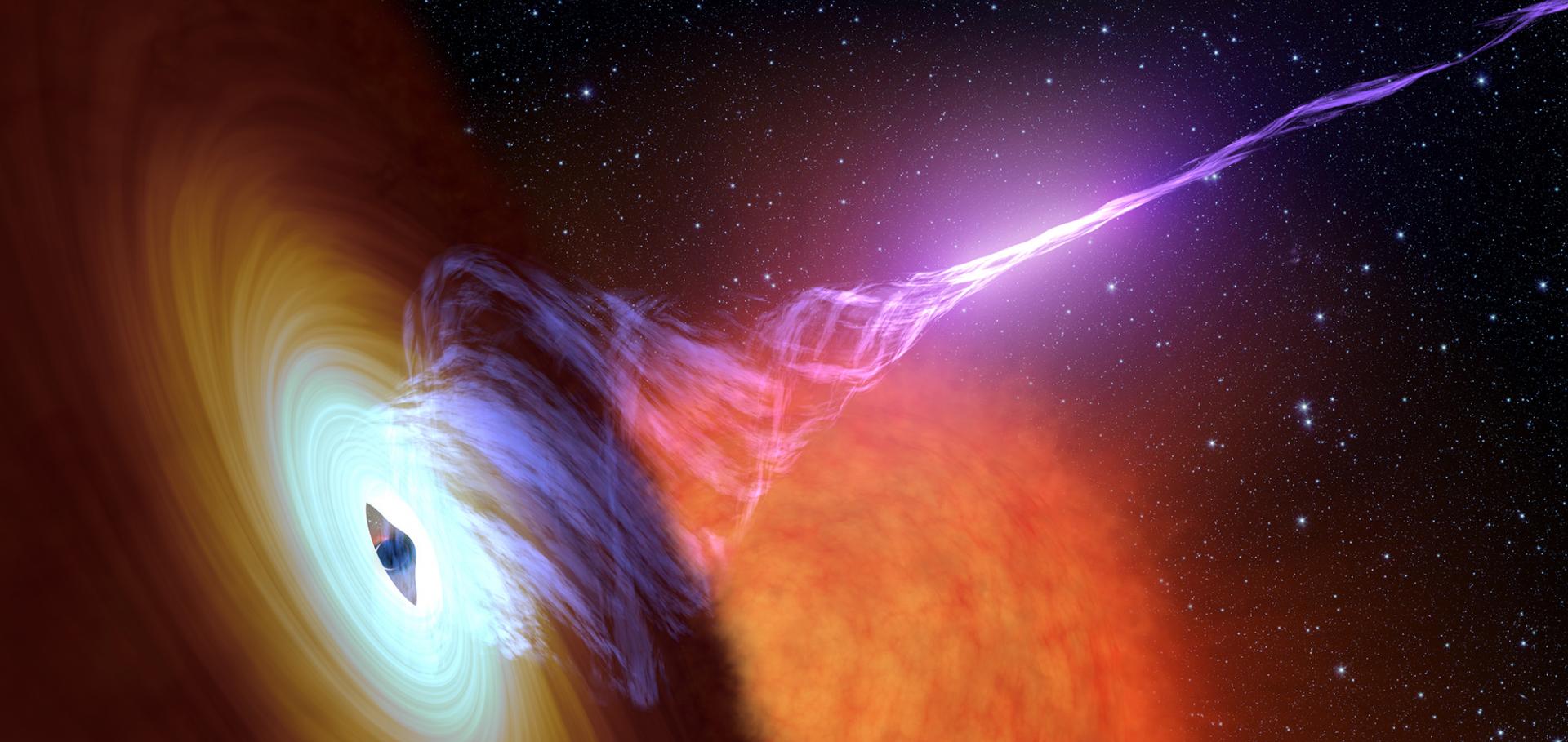
Relativistic Jet from Black Hole

An artist's impression of a relativistic jet propagating away from a black hole at close to the speed of light. Such jets are formed by the inner regions of the accretion flow: matter flowing inwards towards the black hole, via processes which are not yet fully understood. The accretion flow emits primarily in X-rays, the relativistic jet in the radio band: by combing observations in each band we can try and understand how such jets form and how much energy they carry away from the black hole.

Professor Rob Fender

Professor of Astrophysics

Research theme

  • Astronomy and astrophysics

Sub department

  • Astrophysics

Research groups

  • Hintze Centre for Astrophysical Surveys
  • MeerKAT
  • Pulsars, transients and relativistic astrophysics
  • Rubin-LSST
  • The Square Kilometre Array (SKA)
  • Gamma-ray astronomy
Rob.Fender@physics.ox.ac.uk
Telephone: 01865 (2)73435
Denys Wilkinson Building, room 712
  • About
  • Publications

Low-radio-frequency eclipses of the redback pulsar J2215+5135 observed in the image plane with LOFAR

(2016)

Authors:

JW Broderick, RP Fender, RP Breton, AJ Stewart, A Rowlinson, JD Swinbank, JWT Hessels, TD Staley, AJ van der Horst, ME Bell, D Carbone, Y Cendes, S Corbel, J Eislöffel, H Falcke, J-M Grießmeier, TE Hassall, P Jonker, M Kramer, M Kuniyoshi, CJ Law, S Markoff, GJ Molenaar, M Pietka, LHA Scheers, M Serylak, BW Stappers, S ter Veen, J van Leeuwen, RAMJ Wijers, R Wijnands, MW Wise, P Zarka
More details from the publisher

Furiously Fast and Red: Sub-second Optical Flaring in V404 Cyg during the 2015 Outburst Peak

(2016)

Authors:

P Gandhi, SP Littlefair, LK Hardy, VS Dhillon, TR Marsh, AW Shaw, D Altamirano, MD Caballero-Garcia, J Casares, P Casella, AJ Castro-Tirado, PA Charles, Y Dallilar, S Eikenberry, RP Fender, RI Hynes, C Knigge, E Kuulkers, K Mooley, T Muñoz-Darias, M Pahari, F Rahoui, DM Russell, JV Hernández Santisteban, T Shahbaz, DM Terndrup, J Tomsick, DJ Walton
More details from the publisher

A large light-mass component of cosmic rays at 10^{17} - 10^{17.5} eV from radio observations

(2016)

Authors:

S Buitink, A Corstanje, H Falcke, JR Hörandel, T Huege, A Nelles, JP Rachen, L Rossetto, P Schellart, O Scholten, S ter Veen, S Thoudam, TNG Trinh, J Anderson, A Asgekar, IM Avruch, ME Bell, MJ Bentum, G Bernardi, P Best, A Bonafede, F Breitling, JW Broderick, WN Brouw, M Brüggen, HR Butcher, D Carbone, B Ciardi, JE Conway, F de Gasperin, E de Geus, A Deller, R-J Dettmar, G van Diepen, S Duscha, J Eislöffel, D Engels, JE Enriquez, RA Fallows, R Fender, C Ferrari, W Frieswijk, MA Garrett, JM Griessmeier, AW Gunst, MP van Haarlem, TE Hassall, G Heald, JWT Hessels, M Hoeft, A Horneffer, M Iacobelli, H Intema, E Juette, A Karastergiou, VI Kondratiev, M Kramer, M Kuniyoshi, G Kuper, J van Leeuwen, GM Loose, P Maat, G Mann, S Markoff, R McFadden, D McKay-Bukowski, JP McKean, M Mevius, DD Mulcahy, H Munk, MJ Norden, E Orru, H Paas, M Pandey-Pommier, VN Pandey, M Pietka, R Pizzo, AG Polatidis, W Reich, HJA Röttgering, AMM Scaife, DJ Schwarz, M Serylak, J Sluman, O Smirnov, BW Stappers, M Steinmetz, A Stewart, J Swinbank, M Tagger, Y Tang, C Tasse, MC Toribio, R Vermeulen, C Vocks, C Vogt, RJ van Weeren, RAMJ Wijers, SJ Wijnholds, MW Wise, O Wucknitz, S Yatawatta, P Zarka, JA Zensus
More details from the publisher

A clean sightline to quiescence: multiwavelength observations of the high Galactic latitude black hole X-ray binary Swift J1357.2−0933

Monthly Notices of the Royal Astronomical Society Oxford University Press (OUP) 456:3 (2016) 2707-2716

Authors:

Richard M Plotkin, Elena Gallo, Peter G Jonker, James CA Miller-Jones, Jeroen Homan, Teo Muñoz-Darias, Sera Markoff, Montserrat Armas Padilla, Rob Fender, Anthony P Rushton, David M Russell, Manuel AP Torres
More details from the publisher
More details

A large light-mass component of cosmic rays at 10(17)-10(17.5) electronvolts from radio observations

Nature Springer Nature (2016)

Authors:

S Buitink, A Corstanje, H Falcke, Hörandel, T Huege, A Nelles, JP Rachen, L Rossetto, P Schellart, O Scholten, S Ter Ter Veen, S Thoudam, TNG Trinh, J Anderson, A Asgekar, IM Avruch, ME Bell, MJ Bentum, G Bernardi, P Best, A Bonafede, F Breitling, JW Broderick, WN Brouw, M Brüggen, HR Butcher, D Carbone, B Ciardi, JE Conway, F De Gasperin, E De Geus, A Deller, R-J Dettmar, G Van Diepen, S Duscha, J Eislöffel, D Engels, JE Enriquez, RA Fallows, Robert Fender, C Ferrari, W Frieswijk, MA Garrett, JM Grießmeier, AW Gunst, MP Van Haarlem, TE Hassall, G Heald, JWT Hessels, M Hoeft

Abstract:

Cosmic rays are the highest-energy particles found in nature. Measurements of the mass composition of cosmic rays with energies of 10(17)-10(18) electronvolts are essential to understanding whether they have galactic or extragalactic sources. It has also been proposed that the astrophysical neutrino signal comes from accelerators capable of producing cosmic rays of these energies. Cosmic rays initiate air showers--cascades of secondary particles in the atmosphere-and their masses can be inferred from measurements of the atmospheric depth of the shower maximum (Xmax; the depth of the air shower when it contains the most particles) or of the composition of shower particles reaching the ground. Current measurements have either high uncertainty, or a low duty cycle and a high energy threshold. Radio detection of cosmic rays is a rapidly developing technique for determining Xmax (refs 10, 11) with a duty cycle of, in principle, nearly 100 per cent. The radiation is generated by the separation of relativistic electrons and positrons in the geomagnetic field and a negative charge excess in the shower front. Here we report radio measurements of Xmax with a mean uncertainty of 16 grams per square centimetre for air showers initiated by cosmic rays with energies of 10(17)-10(17.5) electronvolts. This high resolution in Xmax enables us to determine the mass spectrum of the cosmic rays: we find a mixed composition, with a light-mass fraction (protons and helium nuclei) of about 80 per cent. Unless, contrary to current expectations, the extragalactic component of cosmic rays contributes substantially to the total flux below 10(17.5) electronvolts, our measurements indicate the existence of an additional galactic component, to account for the light composition that we measured in the 10(17)-10(17.5) electronvolt range.
More details from the publisher
Details from ORA
More details
More details
Details from ArXiV

Pagination

  • First page First
  • Previous page Prev
  • …
  • Page 74
  • Page 75
  • Page 76
  • Page 77
  • Current page 78
  • Page 79
  • Page 80
  • Page 81
  • Page 82
  • …
  • Next page Next
  • Last page Last

Footer Menu

  • Contact us
  • Giving to the Dept of Physics
  • Work with us
  • Media

User account menu

  • Log in

Follow us

FIND US

Clarendon Laboratory,

Parks Road,

Oxford,

OX1 3PU

CONTACT US

Tel: +44(0)1865272200

University of Oxfrod logo Department Of Physics text logo
IOP Juno Champion logo Athena Swan Silver Award logo

© University of Oxford - Department of Physics

Cookies | Privacy policy | Accessibility statement

Built by: Versantus

  • Home
  • Research
  • Study
  • Engage
  • Our people
  • News & Comment
  • Events
  • Our facilities & services
  • About us
  • Giving to Physics
  • Current students
  • Staff intranet