Home
Department Of Physics text logo
  • Research
    • Our research
    • Our research groups
    • Our research in action
    • Research funding support
    • Summer internships for undergraduates
  • Study
    • Undergraduates
    • Postgraduates
  • Engage
    • For alumni
    • For business
    • For schools
    • For the public
  • Support
Menu
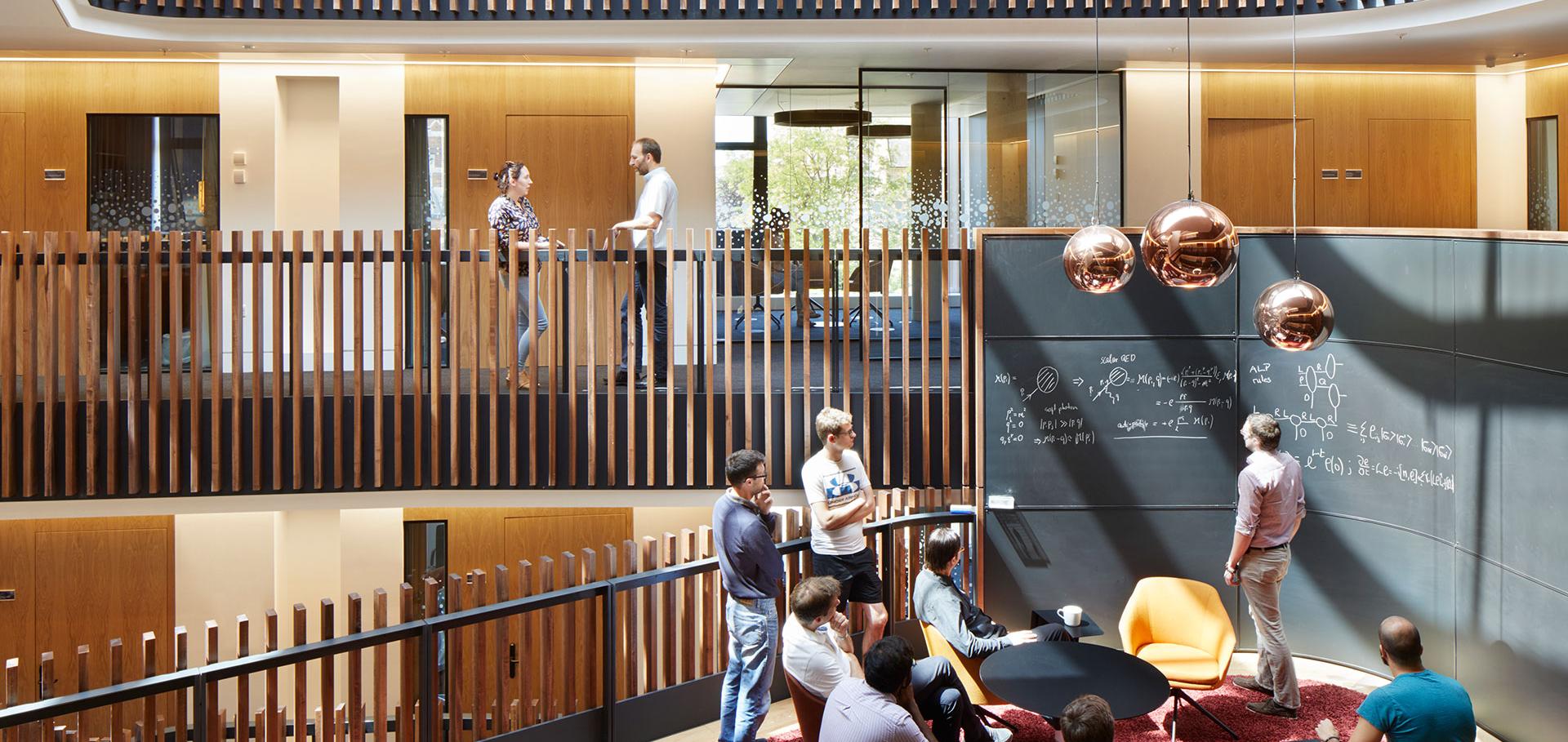
Theoretical physicists working at a blackboard collaboration pod in the Beecroft building.
Credit: Jack Hobhouse

Yonadav Barry Ginat

Leverhulme-Peierls Fellow

Research theme

  • Astronomy and astrophysics
  • Particle astrophysics & cosmology
  • Plasma physics

Sub department

  • Rudolf Peierls Centre for Theoretical Physics

Research groups

  • Cosmology
  • Theoretical astrophysics and plasma physics at RPC
yb.ginat@physics.ox.ac.uk
Telephone: 01865 273946
Rudolf Peierls Centre for Theoretical Physics, room 50.05
Personal website
  • About
  • Publications

Gravitational waves reveal the pair-instability mass gap and constrain nuclear burning in massive stars

Nature Astronomy Springer Nature

Authors:

Fabio Antonini, Isobel M Romero-Shaw, Thomas Callister, Fani Dosopoulou, Debatri Chattopadhyay, Barry Ginat, Mark Gieles, Michela Mapelli

Abstract:

Pair-instability should prevent the direct formation of black holes above about 50M⊙ creating a “pair-instability” mass gap. Yet gravitational-wave obser vations have detected black holes in this mass range. These systems can be explained with uncertainties in massive-star evolution, or hierarchical mergers in stellar clusters, which are expected to produce large spins with isotropic orien tations. Here we present evidence for the pair-instability mass gap in the LIGO–Virgo–KAGRA fourth transient catalog, with a lower edge at 44.3 +5.9 −3.5 M⊙. We also obtain a measurement of the 12C(α, γ) 35 16O reaction rate, yielding an Sfactor of 268+195 −116 keV b, a parameter critical for modeling helium burning and stellar evolution. The data reveal two populations: a low-spin group with no black holes above the gap, and a high-spin, isotropic group that extends across the full mass range and occupies the gap, consistent with hierarchical mergers. These findings are consistent with pair-instability playing a role in shaping the black hole mass spectrum, point to a connection between gravitational wave astronomy and nuclear astrophysics, and highlight dense stellar clusters as key environments in the growth of black holes.
Details from ORA

Pagination

  • First page First
  • Previous page Prev
  • Page 1
  • Page 2
  • Page 3
  • Page 4
  • Page 5
  • Current page 6

Footer Menu

  • Contact us
  • Giving to the Dept of Physics
  • Work with us
  • Media

User account menu

  • Log in

Follow us

FIND US

Clarendon Laboratory,

Parks Road,

Oxford,

OX1 3PU

CONTACT US

Tel: +44(0)1865272200

University of Oxfrod logo Department Of Physics text logo
IOP Juno Champion logo Athena Swan Silver Award logo

© University of Oxford - Department of Physics

Cookies | Privacy policy | Accessibility statement

Built by: Versantus

  • Home
  • How to edit
  • Research
  • Study
  • Engage
  • Our people
  • News & Comment
  • Events
  • Our facilities & services
  • About us
  • Giving to Physics
  • Current students
  • Staff intranet