

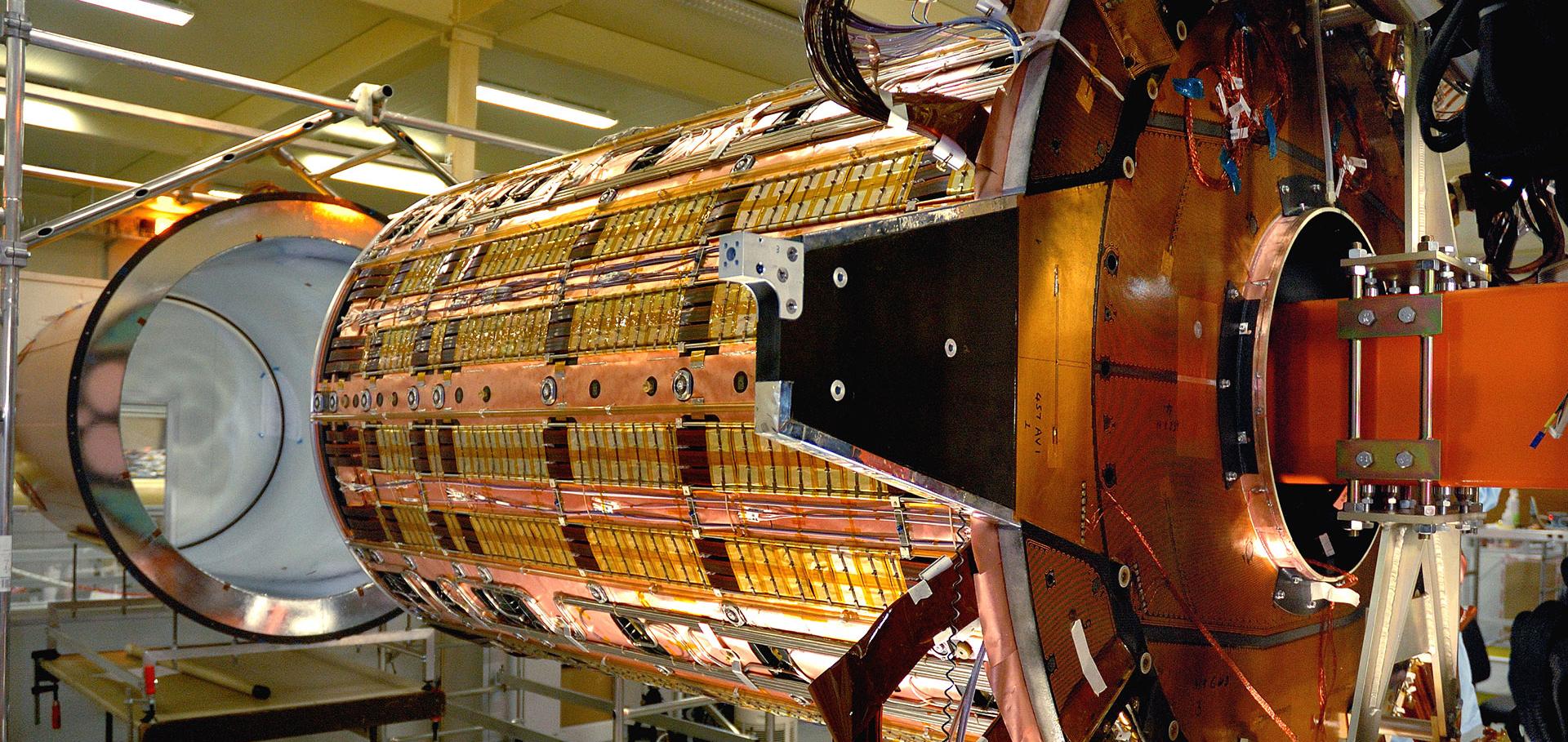

An overview of the status of the LHCb RICH detectors
Nuclear Instruments and Methods in Physics Research, Section A: Accelerators, Spectrometers, Detectors and Associated Equipment 595:1 (2008) 31-35
Abstract:
The LHCb experiment will make precision measurements of CP violation and rare b-hadron decays. Efficient particle identification with high purity over a wide momentum range is vital to these aims. The experiment employs two ring-imaging Cherenkov (RICH) detectors with three radiators, silica aerogel, C4F10 and CF4, to cover the momentum range from around 1-100 GeV/c. The RICH system employs a number of innovative techniques, both in hardware and software. A total of 484 custom-built pixel Hybrid Photon Detectors (HPDs) will be used to measure the spatial positions of Cherenkov photons with wavelengths in the range 200-600 nm, covering an active area of around 3.3 m2. The production of the HPDs has now been completed and the tube quality, including the photo-cathode quantum efficiency, far exceeds expectations. The installation of RICH 1 is almost complete; RICH 2 has been installed and aligned, and commissioning is almost complete. Reconstruction studies incorporating realistic backgrounds indicate excellent kaon efficiencies of around 97% and pion misidentification probabilities of around 6%, averaged over the full momentum range. This paper provides a general overview of the status of the LHCb RICH project, with emphasis on the readiness for LHC start-up and for physics. © 2008 Elsevier B.V. All rights reserved.The physics prospects and status of the LHCb experiment
International Journal of Modern Physics A 23:21 (2008) 3329-3333
Abstract:
This paper summarises the B-physics prospects of the LHCb experiment. The focus is on the uniqueness of LHCb over and above the B-factories and the Tevatron experiments: the measurement of the unitarity angle γ using a number of complementary methods, the measurement of the Bs0 mixing phase φs in tree and penguin decay modes, and the expected observation of the rare decay mode Bs0 → μ+ μ- below Standard Model predictions. © 2008 World Scientific Publishing Company.Development of lightweight carbon-fiber mirrors for the RICH 1 detector of LHCb
Nuclear Instruments and Methods in Physics Research, Section A: Accelerators, Spectrometers, Detectors and Associated Equipment 593:3 (2008) 624-637
Abstract:
The design, manufacture and characterization of lightweight carbon-fiber spherical converging mirrors for the RICH 1 Cherenkov detector of the LHCb experiment at CERN are described. The mirrors need to be lightweight to minimize the material for traversing particles and fluorocarbon-compatible to avoid degradation in the C4F10 gas radiator of RICH 1. Four large-sized carbon-fiber mirrors covering a total surface area of ∼ 2 m2 were installed in RICH 1 in July 2007. The mirrors have a radius of curvature of ∼ 2700 mm, a high reflectivity of ∼ 90 % in the 200-600 nm wavelength band, a low areal density of ∼ 5 kg / m2 equivalent to ∼ 1.2 % of a radiation length. Results of the radiation and fluorocarbon testing of the mirror prototypes are also reported. © 2008 Elsevier B.V. All rights reserved.B-physics prospects with the LHCb experiment
Physics of Atomic Nuclei 71:4 (2008) 588-604
Abstract:
This paper summarizes the B-physics prospects of the LHCb experiment. Firstly, a brief introduction to the CKM matrix and the mechanism of CP violation in the Standard Model is given. The advantages of the LHCb experiment for B-physics exploitation will then be described, together with a short description of the detector components. Finally, the LHCb physics aims and prospects will be summarized, focusing on the measurements of sin(2β) in tree and gluonic penguin diagrams, sin(2α) in B d0 → π + π - and π + π - π 0, neutral B-meson oscillations and the B s0 mixing phase, and the measurement of γ using a variety of complementary methods. © 2008 Pleiades Publishing, Ltd.Deeper UK funding cuts
PHYSICS WORLD 21:11 (2008) 22-22