Home
Department Of Physics text logo
  • Research
    • Our research
    • Our research groups
    • Our research in action
    • Research funding support
    • Summer internships for undergraduates
  • Study
    • Undergraduates
    • Postgraduates
  • Engage
    • For alumni
    • For business
    • For schools
    • For the public
  • Support
Menu
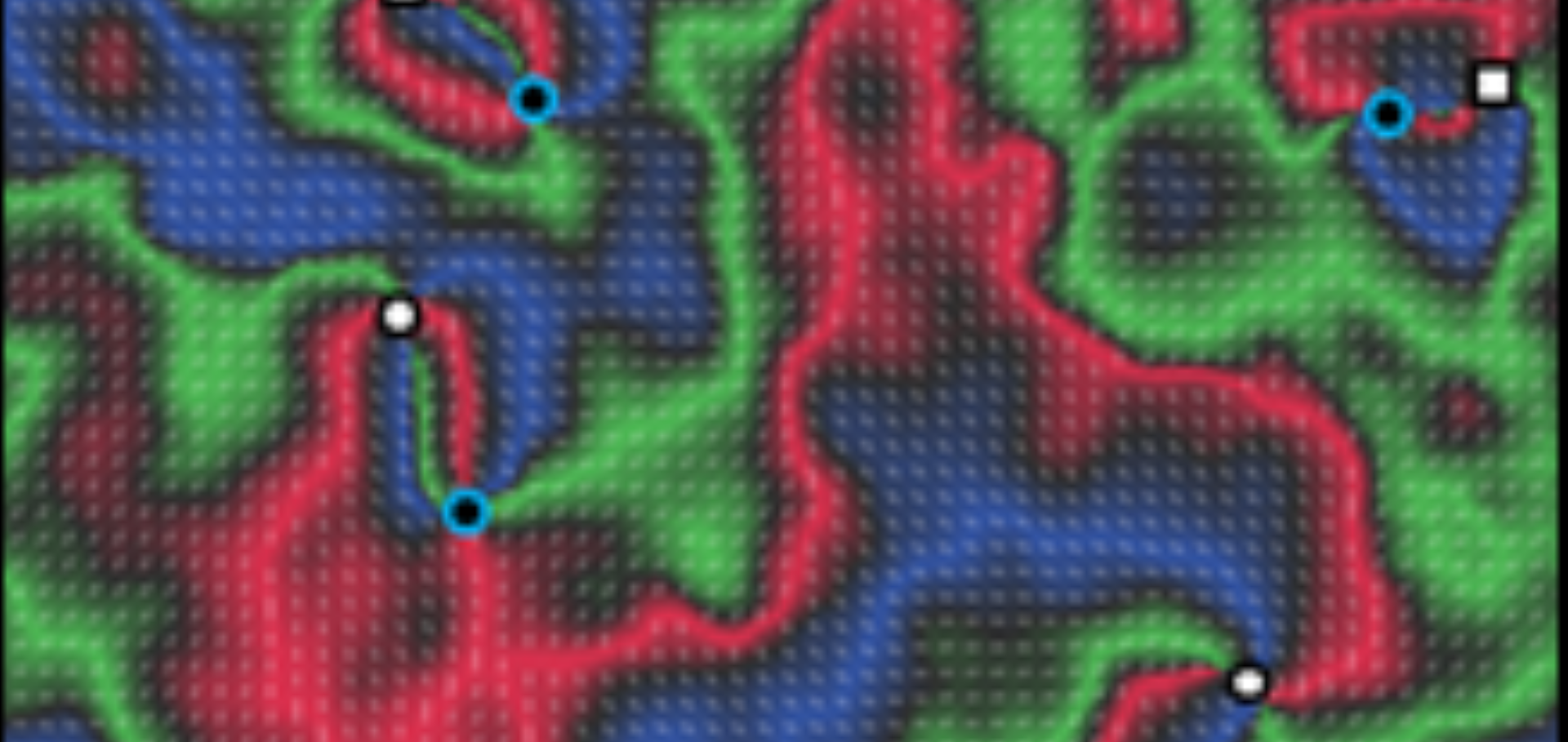
Image of domain walls and topological textures in Fe2O3

Antiferromagnetic domains (red-green-blue) in Fe2O3 observed via x-ray photoemission electron microscopy at Diamond light source (UK). The white and black circles identify the locations of topological textures (called merons) observed at room temperature.

Credit: DOI: 10.1038/s41586-021-03219-6

Jack Harrison

Visitor - Long Term

Research theme

  • Quantum materials

Sub department

  • Condensed Matter Physics

Research groups

  • Oxide electronics
jack.harrison@physics.ox.ac.uk
Clarendon Laboratory, room 103.1
  • About
  • Posters and presentations
  • Publications

Antiferromagnetic half-skyrmions and bimerons at room temperature

Nature Springer Nature 590:7844 (2021) 74-79

Authors:

Hariom Jani, Jheng-Cyuan Lin, Jiahao Chen, Jack Harrison, Francesco Maccherozzi, Jonathan Schad, Saurav Prakash, Chang-Beom Eom, A Ariando, T Venkatesan, Paolo G Radaelli

Abstract:

In the quest for post-CMOS (complementary metal–oxide–semiconductor) technologies, driven by the need for improved efficiency and performance, topologically protected ferromagnetic ‘whirls’ such as skyrmions1,2,3,4,5,6,7,8 and their anti-particles have shown great promise as solitonic information carriers in racetrack memory-in-logic or neuromorphic devices1,9,10,11. However, the presence of dipolar fields in ferromagnets, which restricts the formation of ultrasmall topological textures3,6,8,9,12, and the deleterious skyrmion Hall effect, when skyrmions are driven by spin torques9,10,12, have thus far inhibited their practical implementation. Antiferromagnetic analogues, which are predicted to demonstrate relativistic dynamics, fast deflection-free motion and size scaling, have recently become the subject of intense focus9,13,14,15,16,17,18,19, but they have yet to be experimentally demonstrated in natural antiferromagnetic systems. Here we realize a family of topological antiferromagnetic spin textures in α-Fe2O3—an Earth-abundant oxide insulator—capped with a platinum overlayer. By exploiting a first-order analogue of the Kibble–Zurek mechanism20,21, we stabilize exotic merons and antimerons (half-skyrmions)8 and their pairs (bimerons)16,22, which can be erased by magnetic fields and regenerated by temperature cycling. These structures have characteristic sizes of the order of 100 nanometres and can be chemically controlled via precise tuning of the exchange and anisotropy, with pathways through which further scaling may be achieved. Driven by current-based spin torques from the heavy-metal overlayer, some of these antiferromagnetic textures could emerge as prime candidates for low-energy antiferromagnetic spintronics at room temperature1,9,10,11,23.
More details from the publisher
Details from ORA
More details
More details
Details from ArXiV

Route towards stable homochrial topological textures in A-type antiferromagnets

Physical Review B American Physical Society 105 (2022) 224424

Authors:

Jack Harrison, Hariom Jani, Paolo G Radaelli

Abstract:

Topologically protected whirling magnetic textures could emerge as data carriers in next-generation post-Moore computing. Such textures are abundantly observed in ferromagnets (FMs); however, their antiferromagnetic (AFM) counterparts are expected to be even more relevant for device applications, as they promise ultrafast, deflection-free dynamics while being robust against external fields. Unfortunately, such textures have remained elusive; hence identifying materials hosting them is key to developing this technology. Here, we present comprehensive micromagnetic and analytical models investigating topological textures in the broad material class of A-type antiferromagnets, specifically focusing on the prototypical case of α-Fe2O3—an emerging candidate for AFM spintronics. By exploiting a symmetry-breaking interfacial Dzyaloshinskii-Moriya interaction (iDMI), it is possible to stabilize a wide topological family, including AFM (anti)merons, bimerons, and the hitherto undiscovered AFM skyrmions. While iDMI enforces homochirality and improves the stability of these textures, the widely tunable anisotropy and exchange interactions enable precise control of their core dimensions. We then present a unifying framework to model the scaling of texture sizes based on a simple dimensional analysis. As the parameters required to host and tune homochiral AFM textures may be obtained by rational materials design of α-Fe2O3, it could emerge as a promising platform to initiate AFM topological spintronics.

More details from the publisher
Details from ORA
More details

Room Temperature Control of Axial and Basal Antiferromagnetic Anisotropies Using Strain

ACS Nano American Chemical Society 19:50 (2025) 42118-42127

Authors:

Jack Harrison, Junxiong Hu, Charles Godfrey, Jheng-Cyuan Lin, Tim A Butcher, Jörg Raabe, Simone Finizio, Hariom Jani, Paolo G Radaelli

Abstract:

Antiferromagnetic materials are promising platforms for the development of ultrafast spintronics and magnonics due to their robust magnetism, high-frequency relativistic dynamics, low-loss transport, and the ability to support topological textures. However, achieving deterministic control over antiferromagnetic order in thin films is a major challenge due to the formation of multidomain states stabilized by competing magnetic and destressing interactions. Thus, the successful implementation of antiferromagnetic materials necessitates careful engineering of their anisotropy. Here, we demonstrate strain-based, robust control over multiple antiferromagnetic anisotropies and nanoscale domains in the promising spintronic candidate α-Fe2O3 at room temperature. By applying isotropic and anisotropic in-plane strains across a broad temperature–strain phase space, we systematically tune the interplay between magneto-crystalline and magneto-elastic interactions. We observe that strain-driven control steers the system toward an aligned antiferromagnetic state, while preserving topological spin textures, such as merons, antimerons, and bimerons. We directly map the nanoscale antiferromagnetic order using linear dichroic scanning transmission X-ray microscopy integrated with in situ strain and temperature control. A Landau model and micromagnetic simulations reveal how strain reshapes the magnetic energy landscape. These findings suggest that strain could serve as a versatile control mechanism to reconfigure equilibrium or dynamic antiferromagnetic states on demand in α-Fe2O3 for implementation in next-generation spintronic and magnonic devices.
More details from the publisher
Details from ORA
More details
More details

A preliminary study of using greener materials including deep eutectic solvents (DESs) for the cleaning of silver tarnish

Journal of Cultural Heritage Elsevier BV 76 (2025) 126-135

Authors:

Qing Wu, Jack Harrison, Patrycja Janina Petrasz, Lidia Mathys, Edith Joseph
More details from the publisher

MULTIXS: A new scanning multi-analyzer x-ray emission spectrometer at the GALAXIES beamline at synchrotron SOLEIL.

Rev Sci Instrum 96:5 (2025)

Authors:

James M Ablett, Anthony Berlioux, Dominique Prieur, Jack Harrison, Lars Heller, Sebastian Gliga, Jean-Pascal Rueff

Abstract:

We present the design and performance of a new multi-crystal x-ray emission spectrometer installed at the GALAXIES beamline at Synchrotron SOLEIL. The new instrument, which we name "MULTIXS," can host up to five analyzer crystals and supersedes our previous XES spectrometer design, providing a compact, simple design with all the analyzer crystals contained in the horizontal sample plane. This feature provides a direct view of the sample area and avoids the potential masking of the sample for constrained sample environments. This new design allows for the use of both 0.5 m and 1 m radius spherical analyzer crystals. In addition, the ability to continuously scan the spectrometer energy provides relatively fast scanning with high quality emission data and minimum dead-time overhead.
More details from the publisher

Pagination

  • Current page 1
  • Page 2
  • Page 3
  • Next page Next
  • Last page Last

Footer Menu

  • Contact us
  • Giving to the Dept of Physics
  • Work with us
  • Media

User account menu

  • Log in

Follow us

FIND US

Clarendon Laboratory,

Parks Road,

Oxford,

OX1 3PU

CONTACT US

Tel: +44(0)1865272200

University of Oxfrod logo Department Of Physics text logo
IOP Juno Champion logo Athena Swan Silver Award logo

© University of Oxford - Department of Physics

Cookies | Privacy policy | Accessibility statement

Built by: Versantus

  • Home
  • Research
  • Study
  • Engage
  • Our people
  • News & Comment
  • Events
  • Our facilities & services
  • About us
  • Giving to Physics
  • Current students
  • Staff intranet