

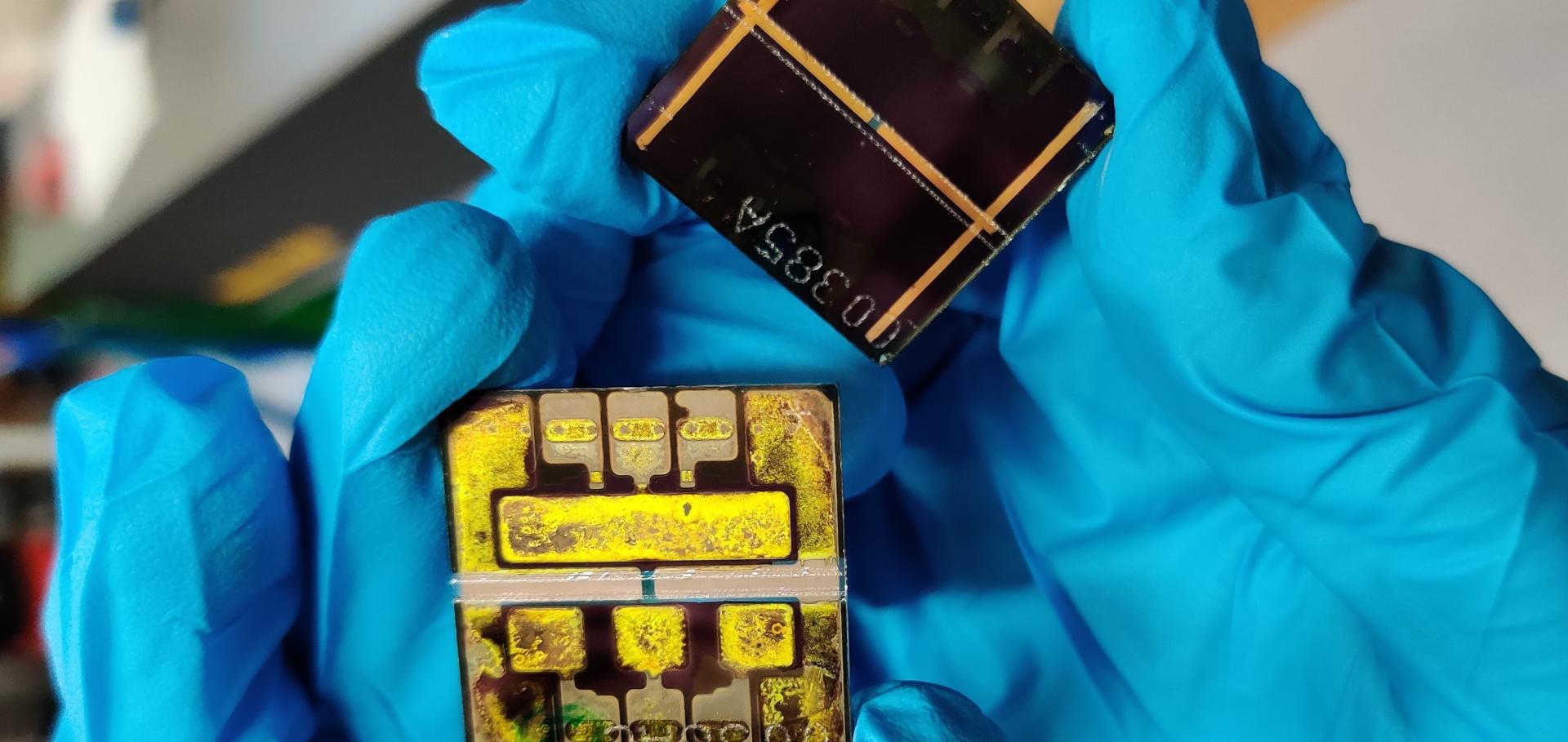

Beyond the Gold Standard: Towards Industrially Viable Electrodes for Durable Perovskite Solar Cells
Advanced Energy Materials Wiley (2026)
Abstract:
ABSTRACT Perovskite solar cells have achieved high efficiencies but remain limited by instabilities. For the opaque metal rear electrode, Au is commonly used to achieve stable operation but is impractical for scalable photovoltaics due to cost. We investigate the effect of a 5 nm chromium (Cr) interlayer beneath low‐cost metals (Al, Ag, Cu) to inhibit metal interdiffusion. Cr/Al electrodes yield devices with high efficiencies (up to 24.7%) and operational stability comparable to reference devices using Au rear electrodes under heat and light stress, with raw material costs reduced by five orders of magnitude. At the front semi‐transparent electrode, through which sunlight will be incident, we identify indium diffusion from indium tin oxide (ITO) as a key degradation mechanism, revealed via depth‐resolved mass spectrometry. We demonstrate that replacing ITO with fluorine‐doped tin oxide (FTO) substantially improves stability. Combining both improvements, FTO with Cr/Al contacts, produces devices retaining >66% of the initial efficiency after >1000 h ageing at 75 °C under simulated sunlight. These results highlight the critical role of electrode selection on perovskite solar cell durability and provide a practical route toward stable and cost‐effective perovskite photovoltaics.CsCl seed layer homogenizes co-evaporated perovskite growth for high-efficiency, fully textured perovskite-silicon tandem solar cells
Joule Elsevier (2026) 102645
Abstract:
Rapid efficiency improvement made monolithic perovskite-silicon tandem solar cells viable for industrial application, with co-evaporation emerging as a scalable deposition technique capable of conformally coating textured silicon bottom cells. Solution-processed [2-(3,6-dimethoxy-9H-carbazol-9-yl)ethyl]phosphonic acid (MeO-2PACz) is widely used as a hole-transporting material for co-evaporated perovskites. However, we show that its uneven coverage of textured silicon surfaces affects perovskite growth, resulting in residual PbI2 at the buried interface. We demonstrate that a CsCl seed layer promotes organic precursor incorporation across the MeO-2PACz/perovskite interface, including regions with thin MeO-2PACz coverage, thereby suppressing interfacial PbI2 formation and increasing the apparent grain size. The improved interfacial and bulk perovskite film quality enabled perovskite-silicon tandem solar cells with a power conversion efficiency of 30.3% (29.7% certified). These findings highlight the importance of a seed layer for robust growth of co-evaporated perovskites and represent an important step toward the industrialization of perovskite-silicon tandem solar cells.Enhanced carrier mobility and diffusion length in formamidinium-rich hybrid perovskites: effects of grain-size and electron–phonon coupling
Journal of Physical Chemistry Letters American Chemical Society 17:18 (2026) 5197-5206
Abstract:
Carrier mobility, recombination rates and diffusion length directly govern the efficiency of hybrid lead-halide perovskites. Yet, their behavior across different carrier concentrations and the effects of microstructure remain poorly understood. Using time-resolved photoluminescence and optical pump-THz probe spectroscopy, we quantify mobility, carrier recombination rates and diffusion length for polycrystalline films of methylammonium (MA)- and formamidinium (FA)-rich lead-halide perovskites, across carrier concentrations ranging from ∼1015 to ∼1019 cm-3. For example, at a carrier concentration of ∼1018 cm-3, FA0.95MA0.05Pb(I0.95Br0.05)3 exhibits a mobility of 127 ± 9 cm2 V-1 s-1 and a diffusion length of 392 ± 85 nm, compared to 69 ± 1 cm2 V-1 s-1 and 139 ± 1 nm for MAPbI3. These differences in mobility and diffusion length persist across different fluences, and are captured by a fluence-dependent rate model that accounts for both carrier generation and recombination at different material depths. From scanning electron microscopy and THz time-domain spectroscopy measurements, we attribute the increased mobility and diffusion length for the FA-rich perovskite mainly to a larger average grain size, after considering possible Fröhlich-type interactions between carriers and THz-active phonon modes. Our work establishes a mechanistic link between material microstructure and ultrafast carrier dynamics, informing crucial design principles for perovskite-based photovoltaic and optoelectronic applications.Crystal-facet-directed all vacuum-deposited perovskite solar cells
Nature Materials Springer Nature 25:6 (2026) 999-1010
Abstract:
Vacuum-based deposition is a scalable, solvent-free industrial method ideal for uniform coatings on complex substrates. However, all vacuum-deposited perovskite solar cells fabricated by thermal evaporation trail solution-processed counterparts in efficiency and stability due to film quality challenges, necessitating advancement and improved understanding. Here, we report a co-evaporation route for 1.67-eV wide-bandgap perovskites by introducing a PbCl2 co-source to optimize film quality. We promote perovskite formation with pronounced (100) “face-up” orientation and deliver a certified all vacuum-deposited solar cell with 18.35% efficiency (19.3% in the lab) for 0.25-cm2 devices (18.5% for 1-cm2 cells). These cells retain 80% of peak efficiency after 1,080 hours under the ISOS-L-2 protocol. Leveraging operando hyperspectral imaging, we provide spatiotemporal spectral insight into halide segregation and trap-mediated recombination, correlating microscopic luminescence features with macroscopic device performance while distinguishing radiative from non-ideal recombination channels. We further demonstrate 27.2%-efficient 1-cm2 evaporated perovskite-on-silicon tandems and outdoor stability of all vacuum-deposited tandems in Italy, retaining ~80% initial performance after 8 months.Photodegradation of 2D Ruddlesden‐Popper Perovskites: Consequences and Design Principles for Photoelectrochemical Applications
Advanced Science Wiley (2025) e07300