Home
Department Of Physics text logo
  • Research
    • Our research
    • Our research groups
    • Our research in action
    • Research funding support
    • Summer internships for undergraduates
  • Study
    • Undergraduates
    • Postgraduates
  • Engage
    • For alumni
    • For business
    • For schools
    • For the public
Menu
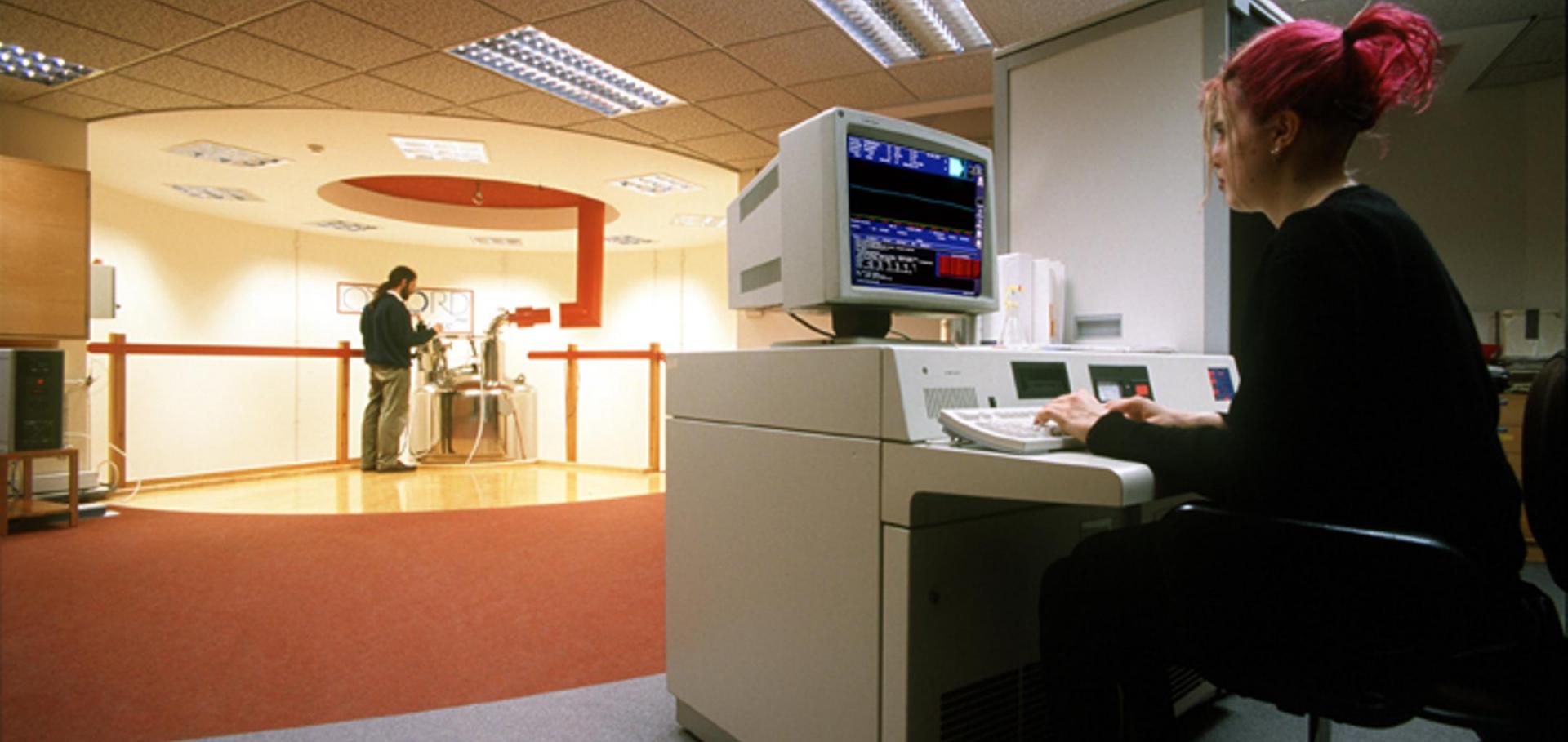
The Oxford 750MHz NMR Spectrometer

The Oxford 750MHz NMR Spectrometer

Prof Jonathan Jones

Professor of Physics

Research theme

  • Quantum information and computation

Sub department

  • Atomic and Laser Physics

Research groups

  • NMR quantum computing
jonathan.jones@physics.ox.ac.uk
  • About
  • Publications

Efficient refocusing of one-spin and two-spin interactions for NMR quantum computation.

J Magn Reson 141:2 (1999) 322-325

Authors:

JA Jones, E Knill

Abstract:

The use of spin echoes to refocus one-spin interactions (chemical shifts) and two-spin interactions (spin-spin couplings) plays a central role in both conventional NMR experiments and NMR quantum computation. Here we describe schemes for efficient refocusing of such interactions in both fully and partially coupled spin systems.
More details from the publisher
More details
Details from ArXiV

Use of composite rotations to correct systematic errors in NMR quantum computation

(1999)

Authors:

HK Cummins, JA Jones
More details from the publisher

Geometric quantum computation with NMR

(1999)

Authors:

JA Jones, V Vedral, A Ekert, G Castagnoli
More details from the publisher

Two-dimensional 15N-1H photo-CIDNP as a surface probe of native and partially structured proteins [5]

Journal of the American Chemical Society 121:27 (1999) 6505-6506

Authors:

CE Lyon, JA Jones, C Redfield, CM Dobson, PJ Hore
More details from the publisher
More details

Independent nucleation and heterogeneous assembly of structure during folding of equine lysozyme.

J Mol Biol 289:4 (1999) 1055-1073

Authors:

LA Morozova-Roche, JA Jones, W Noppe, CM Dobson

Abstract:

The refolding of equine lysozyme from guanidinium chloride has been studied using hydrogen exchange pulse labelling in conjunction with NMR spectroscopy and stopped flow optical methods. The stopped flow optical experiments indicate that extensive hydrophobic collapse occurs rapidly after the initiation of refolding. Pulse labelling experiments monitoring nearly 50 sites within the protein have enabled the subsequent formation of native-like structure to be followed in considerable detail. They reveal that an intermediate having persistent structure within three of the four helices of the alpha-domain of the protein is formed for the whole population of molecules within 4 ms. Subsequent to this event, however, the hydrogen exchange protection kinetics are complex and highly heterogeneous. Analysis of the results by fitting to stretched exponential functions shows that a series of other intermediates is formed as a consequence of the stepwise assembly of independently nucleated local regions of structure. In some molecules the next step in folding involves the stabilisation of the remaining helix in the alpha-domain, whilst in others persistent structure begins to form in the beta-domain. The formation of native-like structure throughout the beta-domain is itself heterogeneous, involving at least three kinetically distinguishable steps. Residues in loop regions throughout the protein attain persistent structure more slowly than regions of secondary structure. There is in addition evidence for locally misfolded regions of structure that reorganise on much longer timescales. The results reveal that the native state of the protein is generated by the heterogeneous assembly of a series of locally cooperative regions of structure. This observation has many features in common with the findings of recent theoretical simulations of protein folding.
More details from the publisher
More details

Pagination

  • First page First
  • Previous page Prev
  • …
  • Page 27
  • Page 28
  • Page 29
  • Page 30
  • Current page 31
  • Page 32
  • Page 33
  • Page 34
  • Page 35
  • …
  • Next page Next
  • Last page Last

Footer Menu

  • Contact us
  • Giving to the Dept of Physics
  • Work with us
  • Media

User account menu

  • Log in

Follow us

FIND US

Clarendon Laboratory,

Parks Road,

Oxford,

OX1 3PU

CONTACT US

Tel: +44(0)1865272200

University of Oxfrod logo Department Of Physics text logo
IOP Juno Champion logo Athena Swan Silver Award logo

© University of Oxford - Department of Physics

Cookies | Privacy policy | Accessibility statement

Built by: Versantus

  • Home
  • Research
  • Study
  • Engage
  • Our people
  • News & Comment
  • Events
  • Our facilities & services
  • About us
  • Giving to Physics
  • Current students
  • Staff intranet