Home
Department Of Physics text logo
  • Research
    • Our research
    • Our research groups
    • Our research in action
    • Research funding support
    • Summer internships for undergraduates
  • Study
    • Undergraduates
    • Postgraduates
  • Engage
    • For young people
    • For teachers
    • For the public
    • For alumni
    • For business
  • Support
Menu
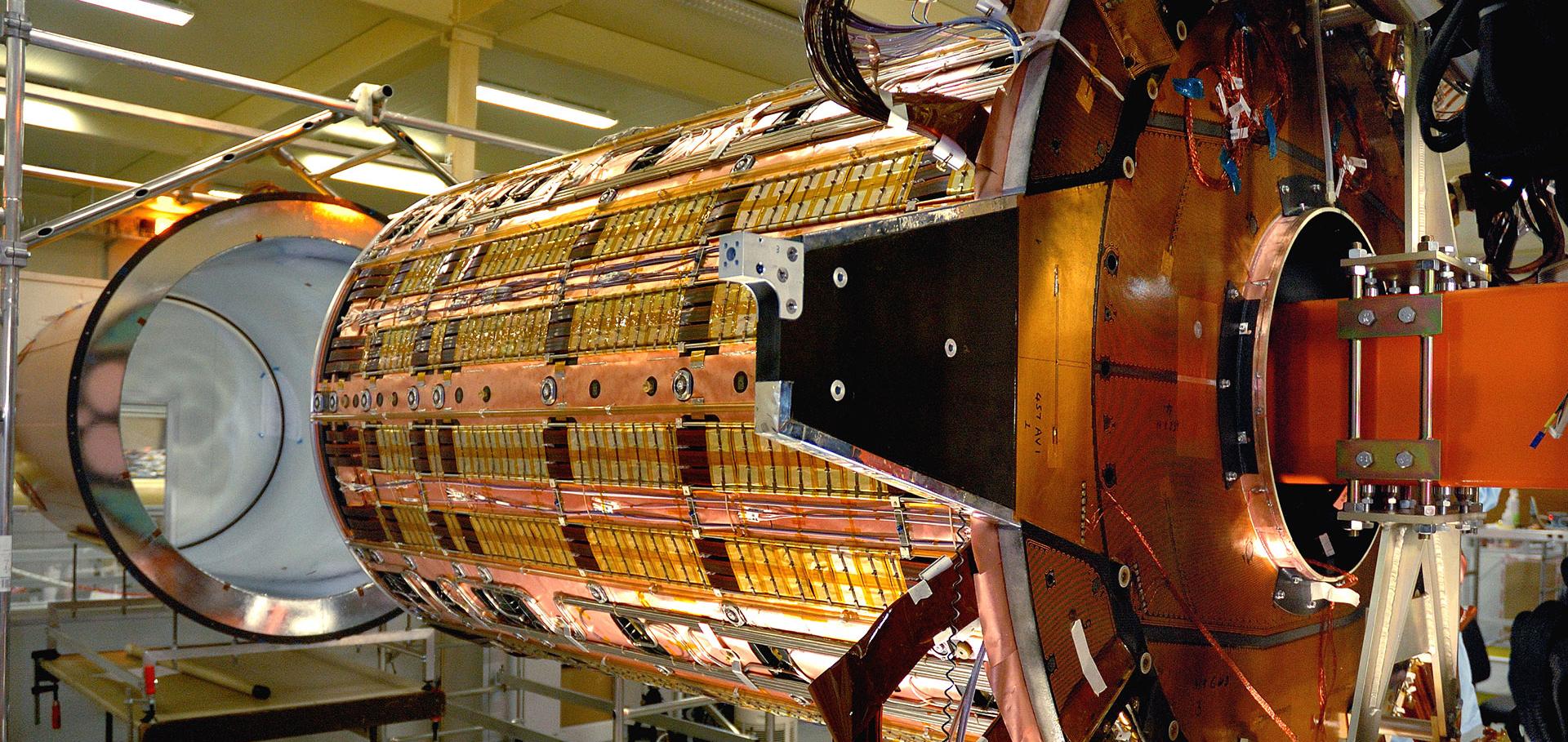
Insertion of STC into TRT at the Department of Physics, Oxford
Credit: CERN

Hans Kraus

Professor of Physics

Research theme

  • Particle astrophysics & cosmology

Sub department

  • Particle Physics

Research groups

  • LUX-ZEPLIN
Hans.Kraus@physics.ox.ac.uk
Telephone: 01865 (2)73361
Denys Wilkinson Building, room 623
  • About
  • Publications

Low temperature scintillation properties of Ga2O3

Applied Physics Letters AIP Publishing 115:8 (2019) 081103

Authors:

VB Mykhaylyk, Hans Kraus, V Kapustianyk, M Rudko

Abstract:

Gallium oxide has recently been identified as a promising scintillator. To assess its potential as a detector material for ionizing radiation at low temperatures, we measured the luminescence and scintillation properties of an undoped Ga2O3 crystal over the 7–295 K temperature range. The emission of the crystal is due to the radiative decay of self-trapped excitons and donor-acceptor pairs and peaks at a wavelength of 380 nm. The scintillation light output of the undoped Ga2O3 increases with a decrease in temperature, reaching a maximum value of 19 300 ± 2200 ph/MeV at 50 K. The measured luminescence kinetics has a recombination character with specific decay time (τ0.1) increasing from 1 to 1.8 μs at cooling. Since radiative decay in the crystal competes with nonradiative processes, material optimization could lead to the scintillator achieving a yield of 40800 ph/MeV, a figure considered to be an upper limit.
More details from the publisher
Details from ORA
More details

First results on sub-GeV spin-dependent dark matter interactions with 7Li

European Physical Journal C Springer Nature 79:7 (2019) 630

Authors:

AH Abdelhameed, G Angloher, P Bauer, A Bento, E Bertoldo, C Bucci, L Canonica, A D’Addabbo, X Defay, S Di Lorenzo, A Erb, FV Feilitzsch, N Ferreiro Iachellini, S Fichtinger, A Fuss, P Gorla, D Hauff, J Jochum, A Kinast, H Kluck, H Kraus, A Langenkämper, M Mancuso, V Mokina, E Mondragon, A Münster, M Olmi, T Ortmann, C Pagliarone, L Pattavina, F Petricca, W Potzel, F Pröbst, F Reindl, J Rothe, K Schäffner, J Schieck, V Schipperges, D Schmiedmayer, S Schönert, C Schwertner, M Stahlberg, L Stodolsky, C Strandhagen, R Strauss, C Türkoğlu, I Usherov, M Willers, V Zema, M Chapellier, A Giuliani, C Nones, DV Poda, VN Shlegel, M Velázquez, AS Zolotarova
More details from the publisher
More details

Bright and fast scintillation of organolead perovskite MAPbBr₃ at low temperatures

Materials Horizons Royal Society of Chemistry (2019)

Authors:

V Mykhaylyk, Hans Kraus, M Saliba

Abstract:

We report the excellent scintillation properties of MAPbBr3, an organic–inorganic trihalide perovskite (OTP). The characteristic scintillation time constants were determined using pulsed monochromatic 14 keV X-rays from a synchrotron. We find that between 50 and 130 K the MAPbBr3 crystal exhibits a very fast and intense scintillation response, with the fast (τf) and slow (τs) decay components reaching 0.1 and 1 ns, respectively. The light yield of MAPbBr3 is estimated to be 90 000 ± 18 000 ph MeV−1 at 77 K and 116 000 ± 23 000 ph MeV−1 at 8 K.
More details from the publisher
Details from ORA
More details

Measurement of the Gamma Ray Background in the Davis Cavern at the Sanford Underground Research Facility

(2019)

Authors:

DS Akerib, CW Akerlof, SK Alsum, N Angelides, HM Araújo, JE Armstrong, M Arthurs, X Bai, J Balajthy, S Balashov, A Baxter, EP Bernard, A Biekert, TP Biesiadzinski, KE Boast, B Boxer, P Brás, JH Buckley, VV Bugaev, S Burdin, JK Busenitz, C Carels, DL Carlsmith, MC Carmona-Benitez, M Cascella, C Chan, A Cole, A Cottle, JE Cutter, CE Dahl, L de Viveiros, JEY Dobson, E Druszkiewicz, TK Edberg, A Fan, S Fiorucci, H Flaecher, T Fruth, RJ Gaitskell, J Genovesi, C Ghag, MGD Gilchriese, S Gokhale, MGD van der Grinten, CR Hall, S Hans, J Harrison, SJ Haselschwardt, SA Hertel, JY-K Hor, M Horn, DQ Huang, CM Ignarra, O Jahangir, W Ji, J Johnson, AC Kaboth, K Kamdin, D Khaitan, A Khazov, WT Kim, CD Kocher, L Korley, EV Korolkova, J Kras, H Kraus, SW Kravitz, L Kreczko, B Krikler, VA Kudryavtsev, EA Leason, J Lee, DS Leonard, KT Lesko, C Levy, J Li, J Liao, F-T Liao, J Lin, A Lindote, R Linehan, WH Lippincott, R Liu, X Liu, C Loniewski, MI Lopes, B López Paredes, W Lorenzon, S Luitz, JM Lyle, PA Majewski, A Manalaysay, L Manenti, RL Mannino, N Marangou, MF Marzioni, DN McKinsey, J McLaughlin, Y Meng, EH Miller, ME Monzani, JA Morad, E Morrison, BJ Mount, A St J Murphy, D Naim, A Naylor, C Nedlik, C Nehrkorn, HN Nelson, F Neves, J Nikoleyczik, A Nilima, I Olcina, KC Oliver-Mallory, S Pal, KJ Palladino, EK Pease, BP Penning, G Pereira, A Piepke, K Pushkin, J Reichenbacher, CA Rhyne, Q Riffard, GRC Rischbieter, JP Rodrigues, R Rosero, P Rossiter, G Rutherford, ABMR Sazzad, RW Schnee, M Schubnell, PR Scovell, D Seymour, S Shaw, TA Shutt, JJ Silk, C Silva, M Solmaz, VN Solovov, P Sorensen, I Stancu, A Stevens, TM Stiegler, K Stifter, M Szydagis, WC Taylor, R Taylor, D Temples, PA Terman, DR Tiedt, M Timalsina, A Tomás, M Tripathi, L Tvrznikova, U Utku, S Uvarov, A Vacheret, JJ Wang, JR Watson, RC Webb, RG White, TJ Whitis, FLH Wolfs, D Woodward, J Yin
More details from the publisher

Megahertz non-contact luminescence decay time cryothermometry by means of ultrafast PbI2 scintillator

Scientific Reports Springer Nature Publishing Group 9 (2019) 5274

Authors:

VB Mykhaylyk, Hans Kraus, L Bobb, R Gamernyk, K Koronski

Abstract:

Realtime in situ temperature monitoring in difficult experimental conditions or inaccessible environments is critical for many applications. Non-contact luminescence decay time thermometry is often the method of choice for such applications due to a favorable combination of sensitivity, accuracy and robustness. In this work, we demonstrate the feasibility of an ultrafast PbI2 scintillator for temperature determination, using the time structure of X-ray radiation, produced by a synchrotron. The decay kinetics of the scintillations was measured over the 8–107 K temperature range using monochromatic pulsed X-ray excitation. It is found that lead iodide exhibits a very fast and intense scintillation response due to excitons and donor-acceptor pairs, with the fast decay component varying between 0.08 and 0.5 ns – a feature that can be readily exploited for temperature monitoring. The observed temperature dependence of the decay time is discussed in terms of two possible mechanisms of thermal quenching – transition over activation barrier and phonon-assisted escape. It is concluded that the latter provides a better fit to the experimental results and is consistent with the model of luminescence processes in PbI2. We evaluated the sensitivity and estimated the accuracy of the temperature determination as ca. ±6 K at 107 K, improving to ±1.4 K at 8 K. The results of this study prove the feasibility of temperature monitoring, using ultrafast scintillation of PbI2 excited by X-ray pulses from a synchrotron, thus enabling non-contact in-situ cryothermometry with megahertz sampling rate.
More details from the publisher
Details from ORA
More details
More details

Pagination

  • First page First
  • Previous page Prev
  • …
  • Page 17
  • Page 18
  • Page 19
  • Page 20
  • Current page 21
  • Page 22
  • Page 23
  • Page 24
  • Page 25
  • …
  • Next page Next
  • Last page Last

Footer Menu

  • Contact us
  • Giving to the Dept of Physics
  • Work with us
  • Media

User account menu

  • Log in

Follow us

FIND US

Clarendon Laboratory,

Parks Road,

Oxford,

OX1 3PU

CONTACT US

Tel: +44(0)1865272200

University of Oxfrod logo Department Of Physics text logo
IOP Juno Champion logo Athena Swan Silver Award logo

© University of Oxford - Department of Physics

Cookies | Privacy policy | Accessibility statement

Built by: Versantus

  • Home
  • Research
  • Study
  • Engage
  • Our people
  • News & Comment
  • Events
  • Our facilities & services
  • About us
  • Giving to Physics
  • Current students
  • Staff intranet