Home
Department Of Physics text logo
  • Research
    • Our research
    • Our research groups
    • Our research in action
    • Research funding support
    • Summer internships for undergraduates
  • Study
    • Undergraduates
    • Postgraduates
  • Engage
    • For alumni
    • For business
    • For schools
    • For the public
  • Support
Menu
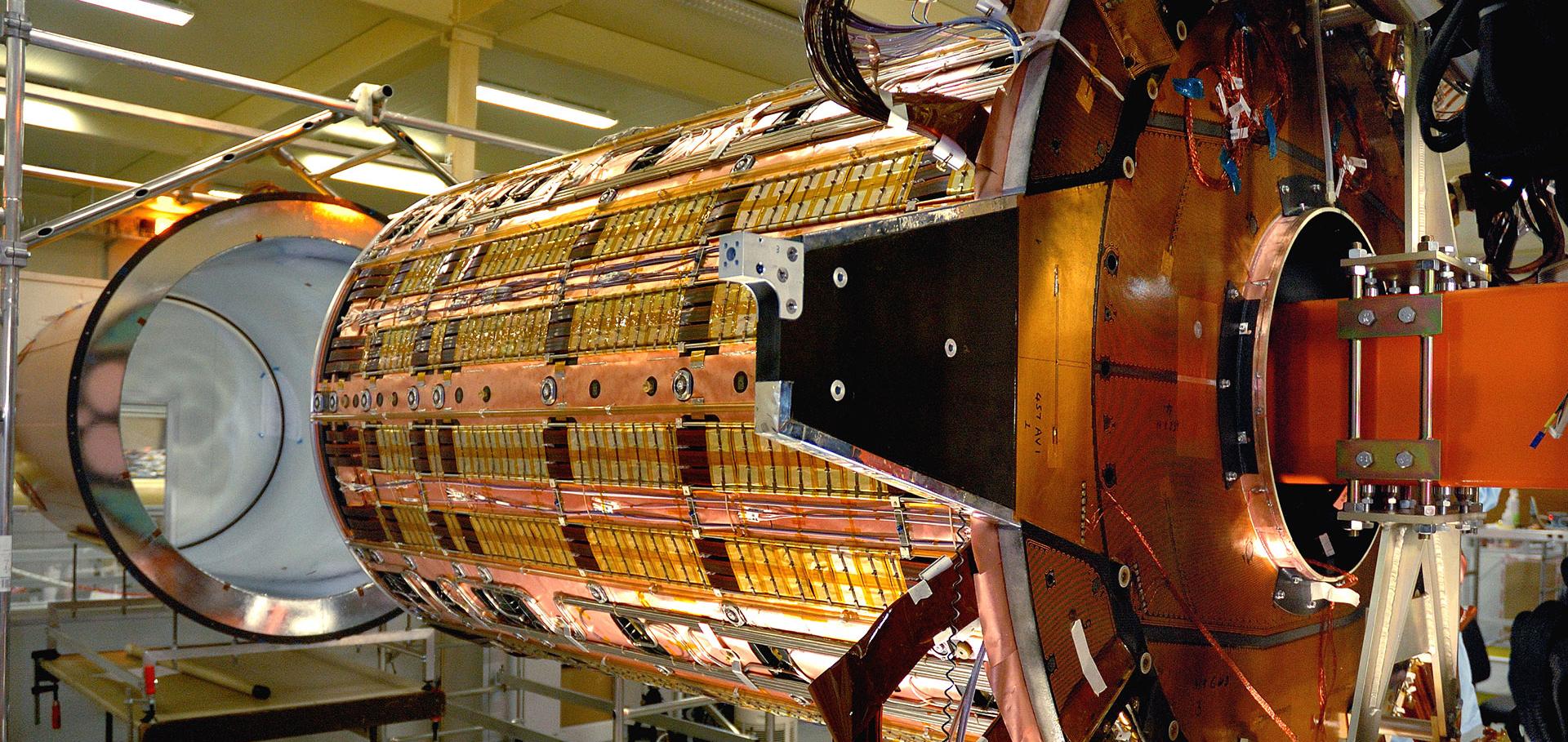
Insertion of STC into TRT at the Department of Physics, Oxford
Credit: CERN

Hans Kraus

Professor of Physics

Research theme

  • Particle astrophysics & cosmology

Sub department

  • Particle Physics

Research groups

  • LUX-ZEPLIN
Hans.Kraus@physics.ox.ac.uk
Telephone: 01865 (2)73361
Denys Wilkinson Building, room 623
  • About
  • Publications

A Low Nuclear Recoil Energy Threshold for Dark Matter Search with CRESST-III Detectors

Journal of Low Temperature Physics (2018) 1-8

Authors:

M Mancuso, G Angloher, P Bauer, A Bento, C Bucci, L Canonica, A D Addabbo, X Defay, A Erb, F von Feilitzsch, N Ferreiro Iachellini, P Gorla, A Gütlein, D Hauff, J Jochum, M Kiefer, H Kluck, H Kraus, JC Lanfranchi, A Langenkämper, J Loebell, E Mondragon, A Münster, C Pagliarone, F Petricca, W Potzel, F Pröbst, R Puig, F Reindl, J Rothe, K Schäffner, J Schieck, V Schipperges, S Schönert, W Seidel, M Stahlberg, L Stodolsky, C Strandhagen, R Strauss, A Tanzke, HHT Thi, C Türkoglu, M Uffinger, A Ulrich, I Usherov, S Wawoczny, M Willers, M Wüstrich

Abstract:

© 2018 The Author(s) The CRESST-III experiment (Cryogenic Rare Events Search with Superconducting Thermometers), located at the underground facility Laboratori Nazionali del Gran Sasso in Italy, uses scintillating CaWO(Formula presented.) crystals as cryogenic calorimeters to search for direct dark matter interactions in detectors. A large part of the parameter space for spin-independent scattering off nuclei remains untested for dark matter particles with masses below a few GeV/c(Formula presented.), despite many naturally motivated theoretical models for light dark matter particles. The CRESST-III detectors are designed to achieve the performance required to probe the low-mass region of the parameter space with a sensitivity never reached before. In this paper, new results on the performance and an overview of the CRESST-III detectors will be presented, emphasizing the results about the low-energy threshold for nuclear recoil of CRESST-III Phase 1 which started collecting data in August 2016.
More details from the publisher
More details

TES-Based Light Detectors for the CRESST Direct Dark Matter Search

Journal of Low Temperature Physics (2018) 1-7

Authors:

J Rothe, G Angloher, P Bauer, A Bento, C Bucci, L Canonica, A D Addabbo, X Defay, A Erb, FV Feilitzsch, N Ferreiro Iachellini, P Gorla, A Gütlein, D Hauff, J Jochum, M Kiefer, H Kluck, H Kraus, JC Lanfranchi, A Langenkämper, J Loebell, M Mancuso, E Mondragon, A Münster, C Pagliarone, F Petricca, W Potzel, F Pröbst, R Puig, F Reindl, K Schäffner, J Schieck, V Schipperges, S Schönert, W Seidel, M Stahlberg, L Stodolsky, C Strandhagen, R Strauss, A Tanzke, HH Trinh Thi, C Türkoğlu, A Ulrich, I Usherov, S Wawoczny, M Willers, M Wüstrich

Abstract:

© 2018 The Author(s) The CRESST experiment uses cryogenic detectors based on transition-edge sensors to search for dark matter interactions. Each detector module consists of a scintillating CaWO(Formula presented.) crystal and a silicon-on-sapphire (SOS) light detector which operate in coincidence (phonon-light technique). The 40-mm-diameter SOS disks (2 g mass) used in the data taking campaign of CRESST-II Phase 2 (2014–2016) reached absolute baseline resolutions of (Formula presented.) 4–7 eV. This is the best performance reported for cryogenic light detectors of this size. Newly developed silicon beaker light detectors (4 cm height, 4 cm diameter, 6 g mass), which cover a large fraction of the target crystal surface, have achieved a baseline resolution of (Formula presented.)eV. First results of further improved light detectors developed for the ongoing low-threshold CRESST-III experiment are presented.
More details from the publisher
More details

Complete event-by-event alpha/gamma (beta) separation in a full-size TeO2 CUORE bolometer by Neganov-Luke-magnified light detection

PHYSICAL REVIEW C 97:3 (2018) ARTN 032501

Authors:

L Berge, M Chapellier, M de Combarieu, L Dumoulin, A Giuliani, M Gros, P de Marcillac, S Marnieros, C Nones, V Novati, E Olivieri, B Paul, DV Poda, T Redon, B Siebenborn, AS Zolotarova, E Armengaud, C Augier, A Benoit, J Billard, A Broniatowski, P Camus, A Cazes, F Charlieux, M De Jesus, K Eitel, N Foerster, J Gascon, Y Jin, A Juillard, M Kleifges, V Kozlov, H Kraus, VA Kudryavtsev, H Le Sueur, R Maisonobe, X-F Navick, P Pari, E Queguiner, S Rozov, V Sanglard, L Vagneron, M Weber, E Yakushev
More details from the publisher
More details

Projected WIMP sensitivity of the LUX-ZEPLIN (LZ) dark matter experiment

(2018)

Authors:

DS Akerib, CW Akerlof, SK Alsum, HM Araújo, M Arthurs, X Bai, AJ Bailey, J Balajthy, S Balashov, D Bauer, J Belle, P Beltrame, T Benson, EP Bernard, TP Biesiadzinski, KE Boast, B Boxer, P Brás, JH Buckley, VV Bugaev, S Burdin, JK Busenitz, C Carels, DL Carlsmith, B Carlson, MC Carmona-Benitez, C Chan, JJ Cherwinka, A Cole, A Cottle, WW Craddock, A Currie, JE Cutter, CE Dahl, L de Viveiros, A Dobi, JEY Dobson, E Druszkiewicz, TK Edberg, WR Edwards, A Fan, S Fayer, S Fiorucci, T Fruth, RJ Gaitskell, J Genovesi, C Ghag, MGD Gilchriese, MGD van der Grinten, CR Hall, S Hans, K Hanzel, SJ Haselschwardt, SA Hertel, S Hillbrand, C Hjemfelt, MD Hoff, JY-K Hor, DQ Huang, CM Ignarra, W Ji, AC Kaboth, K Kamdin, J Keefner, D Khaitan, A Khazov, YD Kim, CD Kocher, EV Korolkova, H Kraus, HJ Krebs, L Kreczko, B Krikler, VA Kudryavtsev, S Kyre, J Lee, BG Lenardo, DS Leonard, KT Lesko, C Levy, J Li, J Liao, F-T Liao, J Lin, A Lindote, R Linehan, WH Lippincott, X Liu, MI Lopes, B López Paredes, W Lorenzon, S Luitz, JM Lyle, P Majewski, A Manalaysay, RL Mannino, C Maupin, DN McKinsey, Y Meng, EH Miller, J Mock, ME Monzani, JA Morad, E Morrison, BJ Mount, A St J Murphy, HN Nelson, F Neves, J Nikoleyczik, K O'Sullivan, I Olcina, MA Olevitch, KC Oliver-Mallory, KJ Palladino, SJ Patton, EK Pease, B Penning, A Piepke, S Powell, RM Preece, K Pushkin, BN Ratcliff, J Reichenbacher, CA Rhyne, A Richards, JP Rodrigues, R Rosero, P Rossiter, JS Saba, M Sarychev, RW Schnee, M Schubnell, PR Scovell, S Shaw, TA Shutt, JJ Silk, C Silva, K Skarpaas, W Skulski, M Solmaz, VN Solovov, P Sorensen, I Stancu, MR Stark, TM Stiegler, K Stifter, M Szydagis, WC Taylor, R Taylor, DJ Taylor, D Temples, PA Terman, KJ Thomas, M Timalsina, WH To, A Tomás, TE Tope, M Tripathi, CE Tull, L Tvrznikova, U Utku, J Va'vra, A Vacheret, JR Verbus, E Voirin, WL Waldron, JR Watson, RC Webb, DT White, TJ Whitis, WJ Wisniewski, MS Witherell, FLH Wolfs, D Woodward, SD Worm, M Yeh, J Yin, I Young
More details from the publisher

Optimizing EDELWEISS detectors for low-mass WIMP searches

PHYSICAL REVIEW D 97:2 (2018) ARTN 022003

Authors:

Q Arnaud, E Armengaud, C Augier, A Benoit, L Berge, J Billard, A Broniatowski, P Camus, A Cazes, M Chapellier, F Charlieux, M De Jesus, L Dumoulin, K Eitel, N Foerster, J Gascon, A Giuliani, M Gros, L Hehn, Y Jin, A Juillard, M Kleifges, V Kozlov, H Kraus, VA Kudryavtsev, H Le-Sueur, R Maisonobe, S Marnieros, X-F Navick, C Nones, E Olivieri, P Pari, B Paul, D Poda, E Queguiner, S Rozov, V Sanglard, S Scorza, B Siebenborn, L Vagneron, M Weber, E Yakushev, EDELWEISS Collaboration
More details from the publisher
More details

Pagination

  • First page First
  • Previous page Prev
  • …
  • Page 18
  • Page 19
  • Page 20
  • Page 21
  • Current page 22
  • Page 23
  • Page 24
  • Page 25
  • Page 26
  • …
  • Next page Next
  • Last page Last

Footer Menu

  • Contact us
  • Giving to the Dept of Physics
  • Work with us
  • Media

User account menu

  • Log in

Follow us

FIND US

Clarendon Laboratory,

Parks Road,

Oxford,

OX1 3PU

CONTACT US

Tel: +44(0)1865272200

University of Oxfrod logo Department Of Physics text logo
IOP Juno Champion logo Athena Swan Silver Award logo

© University of Oxford - Department of Physics

Cookies | Privacy policy | Accessibility statement

Built by: Versantus

  • Home
  • Research
  • Study
  • Engage
  • Our people
  • News & Comment
  • Events
  • Our facilities & services
  • About us
  • Giving to Physics
  • Current students
  • Staff intranet