Home
Department Of Physics text logo
  • Research
    • Our research
    • Our research groups
    • Our research in action
    • Research funding support
    • Summer internships for undergraduates
  • Study
    • Undergraduates
    • Postgraduates
  • Engage
    • For alumni
    • For business
    • For schools
    • For the public
  • Support
Menu
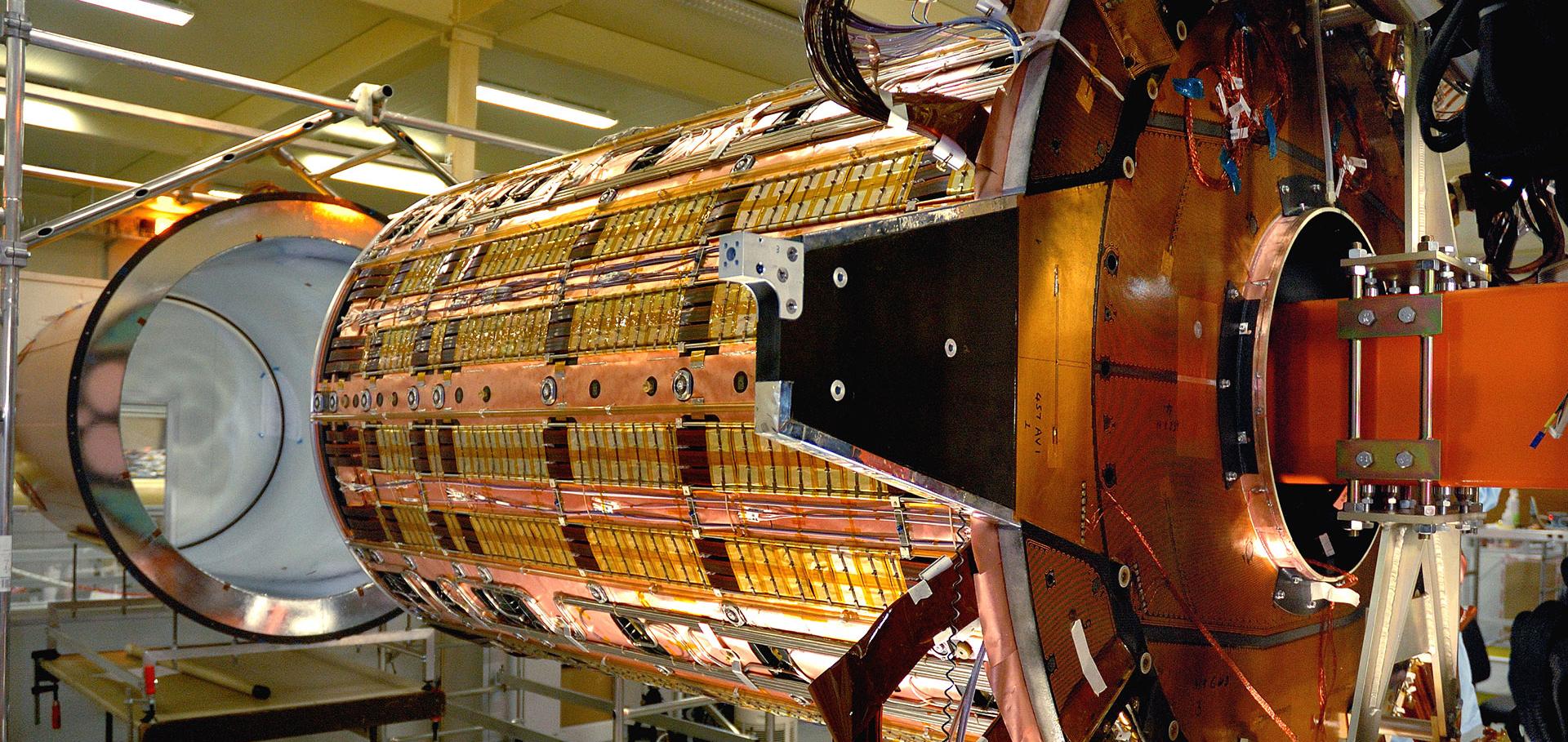
Insertion of STC into TRT at the Department of Physics, Oxford
Credit: CERN

Hans Kraus

Professor of Physics

Research theme

  • Particle astrophysics & cosmology

Sub department

  • Particle Physics

Research groups

  • LUX-ZEPLIN
Hans.Kraus@physics.ox.ac.uk
Telephone: 01865 (2)73361
Denys Wilkinson Building, room 623
  • About
  • Publications

CRESST cryogenic dark matter search

NEW ASTRON REV 49:2-6 (2005) 255-258

Authors:

C Cozzini, G Angloher, C Bucci, F von Feilitzsch, T Frank, D Hauff, S Henry, T Jagemann, J Jochum, H Kraus, B Majorovits, J Ninkovic, F Petricca, F Probst, Y Ramachers, W Rau, M Razeti, W Seidel, M Stark, L Stodolsky, S Uchaikin, H Wulandari

Abstract:

The CRESST Phase II experiment at Gran Sasso is using 300 g scintillating CaWO4 crystals as absorbers for direct WIMP (weakly interactive massive particles) detection. The phonon signal in the CaWO4 crystal is registered in coincidence with the light signal, which is measured with a separate cryogenic light detector. The absorber crystal and the silicon light detector are read out by tungsten superconducting phase transition thermometers (W-SPTs). As a result an active discrimination of the electron recoils against nuclear recoils is achieved. Results on the properties of the detector modules and on the WIMP sensitivity are presented. (C) 2005 Published by Elsevier B.V.
More details from the publisher

Luminescence of CaW O4, CaMo O4, and ZnW O4 scintillating crystals under different excitations

Journal of Applied Physics 97:8 (2005)

Authors:

VB Mikhailik, H Kraus, G Miller, MS Mykhaylyk, D Wahl

Abstract:

The luminescence spectra of CaW O4, CaMo O4, and ZnW O4 scintillating crystals were investigated in the temperature range 8-400 K. The excitation photon energy was varied from the ultraviolet (4.5 eV) to the hard x-ray region (35 keV). It is found that as the excitation energy decreases the relative intensity of the low-energy luminescence band, attributed to the extrinsic emission of defect centers in CaW O4 and CaMo O4 crystals, increases. This observation is interpreted in terms of the total absorption of incident radiation, i.e., the variation of the mean penetration depth of the photons with their energy. It indicates that the centers responsible for the extrinsic emission in the crystals with scheelite structure are mainly localized in a thin (∼100 nm) surface layer. On the other hand no noticeable changes with the excitation energy were found in the emission spectra of ZnW O4 crystals with wolframite structure. The possible implication of this finding is discussed. The light yield of the crystals is compared at low temperature using monochromatic x-ray excitation and it is shown that ZnW O4 has ∼10% higher light yield than CaW O4, while this parameter has a factor of 4 lower in CaMo O4. © 2005 American Institute of Physics.
More details from the publisher
More details

Fracture Processes Observed with A Cryogenic Detector

(2005)

Authors:

J Astrom, PCF Di Stefano, F Proebst, L Stodolsky, J Timonen, C Bucci, S Cooper, C Cozzini, FV Feilitzsch, H Kraus, J Marchese, O Meier, U Nagel, Y Ramachers, W Seidel, M Sisti, S Uchaikin, L Zerle
More details from the publisher

Limits on WIMP dark matter using scintillating CaWO4 cryogenic detectors with active background suppression

Astroparticle Physics 23 (2005) 325-339

Authors:

H Kraus, G Angloher, F Proebst, S Henry
More details from the publisher
More details

Luminescence studies of Ti-doped Al2 O3 using vacuum ultraviolet synchrotron radiation

Applied Physics Letters 86:10 (2005) 1-3

Authors:

VB Mikhailik, H Kraus, D Wahl, MS Mykhaylyk

Abstract:

In this study, we examined the luminescence response of Ti-doped Al2 O3 crystals to high-energy vacuum ultraviolet (UV) excitation. In addition to the thoroughly studied emission band of Ti3+ in the near-infrared region and blue emission at 420 nm, we detected a UV emission band at 290 nm. The excitation spectra of all emission bands were measured over the 4-20 eV spectral range. Our results indicate that intrinsic anion defects are involved in the process of the excitation of the 420 nm emission assigned to the charge transfer transitions 2p O2- →3d Ti4+. Analysis of the spectral and decay characteristics of the UV emission enables us to suggest that this band is associated with radiative decay of excitons localized at Ti ions. © 2005 American Institute of Physics.
More details from the publisher
More details

Pagination

  • First page First
  • Previous page Prev
  • …
  • Page 56
  • Page 57
  • Page 58
  • Page 59
  • Current page 60
  • Page 61
  • Page 62
  • Page 63
  • Page 64
  • …
  • Next page Next
  • Last page Last

Footer Menu

  • Contact us
  • Giving to the Dept of Physics
  • Work with us
  • Media

User account menu

  • Log in

Follow us

FIND US

Clarendon Laboratory,

Parks Road,

Oxford,

OX1 3PU

CONTACT US

Tel: +44(0)1865272200

University of Oxfrod logo Department Of Physics text logo
IOP Juno Champion logo Athena Swan Silver Award logo

© University of Oxford - Department of Physics

Cookies | Privacy policy | Accessibility statement

Built by: Versantus

  • Home
  • Research
  • Study
  • Engage
  • Our people
  • News & Comment
  • Events
  • Our facilities & services
  • About us
  • Giving to Physics
  • Current students
  • Staff intranet