Home
Department Of Physics text logo
  • Research
    • Our research
    • Our research groups
    • Our research in action
    • Research funding support
    • Summer internships for undergraduates
  • Study
    • Undergraduates
    • Postgraduates
  • Engage
    • For alumni
    • For business
    • For schools
    • For the public
  • Support
Menu
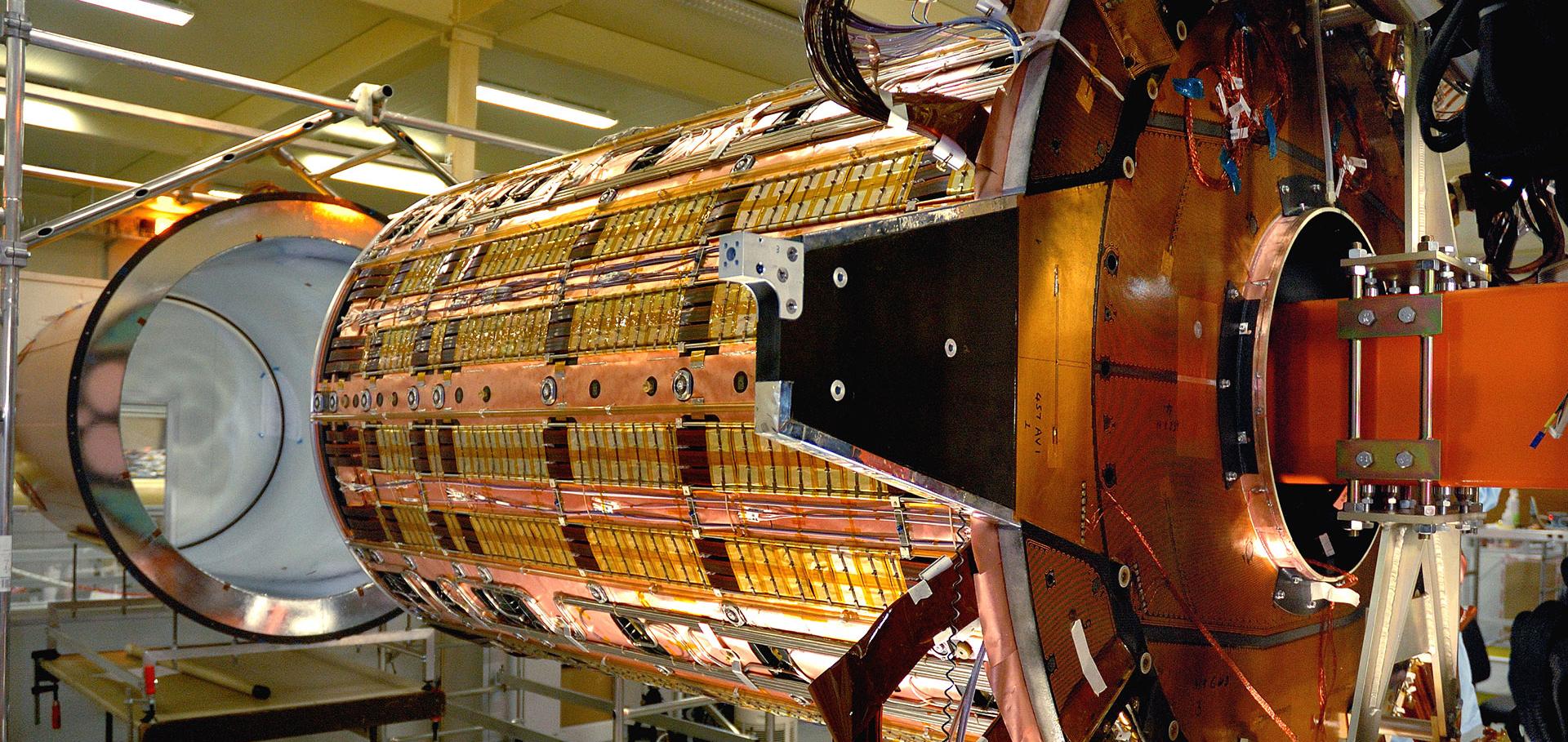
Insertion of STC into TRT at the Department of Physics, Oxford
Credit: CERN

Hans Kraus

Professor of Physics

Research theme

  • Particle astrophysics & cosmology

Sub department

  • Particle Physics

Research groups

  • LUX-ZEPLIN
Hans.Kraus@physics.ox.ac.uk
Telephone: 01865 (2)73361
Denys Wilkinson Building, room 623
  • About
  • Publications

One- and two-photon excited luminescence and band-gap assignment in CaWO4

Physical Review B - Condensed Matter and Materials Physics 69:20 (2004)

Authors:

VB Mikhailik, H Kraus, D Wahl, M Itoh, M Koike, IK Bailiff

Abstract:

Luminescence properties of CaWO4 have been investigated using complementary one- and two-photon excitation techniques. Analysis of the thermal changes in the luminescence spectra indicates that the observed high-energy shift of the CaWO4 emission maximum is mainly caused by a change of position of the intrinsic blue band. The thermal broadening and shift of this band can be interpreted satisfactorily in terms of a model of the luminescence center interacting with the vibrating crystalline environment. The characteristic parameters of the phonon system obtained from the experiment agree with those from earlier independent studies. Intense laser stimulation of CaWO4 in the spectral region <505 nm (>2.45 eV) results in emission with spectral and kinetics features that are characteristic of the radiative decay of a WO42- oxyanion complex in this crystal. The kinetics of luminescence decay under two-photon excitation changes with increasing excitation density due to exchange interaction of the elementary excitations. From a comparative analysis of the optical properties of CaWO 4 obtained in the course of two-photon and one-photon spectroscopic studies (absorption, reflection, one- and two-photon excitation spectra) it is concluded that the energy gap of the crystal is 5.2 ± 0.3 eV.
More details from the publisher
More details

Cresst-II: dark matter search with scintillating absorbers

NUCL INSTRUM METH A 520:1-3 (2004) 108-111

Authors:

G Angloher, C Bucci, C Cozzini, F von Feilitzsch, T Frank, D Hauff, S Henry, T Jagemann, J Jochum, H Kraus, B Majorovits, J Ninkovic, F Petricca, F Probst, Y Ramachers, W Rau, W Seidel, M Stark, S Uchaikin, L Stodolsky, H Wulandari

Abstract:

In the CRESST-II experiment, scintillating CaWO4 crystals are used as absorbers for direct weakly interacting massive particles (WIMP) detection. Nuclear recoils can be discriminated against electron recoils by measuring phonons and scintillation light simultaneously. The absorber crystal and the silicon light detector are read out by tungsten superconducting phase transition thermometers. Results on the sensitivity of the phonon and the light channel, radiopurity, the scintillation properties of CaWO4, and on the WIMP sensitivity are presented. (C) 2003 Elsevier B.V. All rights reserved.
More details from the publisher

Multichannel SQUID readout for CRESST II

NUCL INSTRUM METH A 520:1-3 (2004) 588-591

Authors:

S Henry, H Kraus, B Majorovits, Y Ramachers

Abstract:

We have developed a 66-channel SQUID system to read out the detectors for the second phase of the CRESST dark matter search using SQUID sensors, electronics and cryocables supplied by different manufacturers. The system has been extensively tested at Oxford to characterise the sensitivity, bandwidth, slew rate, noise, thermal drift, and crosstalk. By using the SQUID sensors as magnetometers we can confirm the input circuit for the detectors is superconducting, thus ensuring there will be no noise from parasitic resistance. Multichannel SQUID systems have further applications in particle physics experiments, such as precision magnetometry in the search for the neutron electric dipole moment. (C) 2003 Elsevier B.V. All rights reserved.
More details from the publisher
More details

Direct WIMP detection with cryogenic detectors

PHILOS T ROY SOC A 361:1812 (2003) 2581-2590

Abstract:

Cryogenic detectors have been developed since the mid 1980s and have been applied successfully to dark-matter searches since the mid 1990s. Among the advantages of cryogenic detectors are their high sensitivity to nuclear recoil, their low detection thresholds, the wide choice of target materials and the possibility of implementing event type recognition on an event-by-event basis. I explain the basics of cryogenic detectors, review various implementations, discuss advantages and drawbacks and give an overview of current dark-matter-search experiments based upon cryogenic detectors.
More details from the publisher

Direct WIMP detection with cryogenic detectors.

Philos Trans A Math Phys Eng Sci 361:1812 (2003) 2581-2590

Abstract:

Cryogenic detectors have been developed since the mid 1980s and have been applied successfully to dark-matter searches since the mid 1990s. Among the advantages of cryogenic detectors are their high sensitivity to nuclear recoil, their low detection thresholds, the wide choice of target materials and the possibility of implementing event type recognition on an event-by-event basis. I explain the basics of cryogenic detectors, review various implementations, discuss advantages and drawbacks and give an overview of current dark-matter-search experiments based upon cryogenic detectors.
More details from the publisher

Pagination

  • First page First
  • Previous page Prev
  • …
  • Page 60
  • Page 61
  • Page 62
  • Page 63
  • Current page 64
  • Page 65
  • Page 66
  • Page 67
  • Page 68
  • …
  • Next page Next
  • Last page Last

Footer Menu

  • Contact us
  • Giving to the Dept of Physics
  • Work with us
  • Media

User account menu

  • Log in

Follow us

FIND US

Clarendon Laboratory,

Parks Road,

Oxford,

OX1 3PU

CONTACT US

Tel: +44(0)1865272200

University of Oxfrod logo Department Of Physics text logo
IOP Juno Champion logo Athena Swan Silver Award logo

© University of Oxford - Department of Physics

Cookies | Privacy policy | Accessibility statement

Built by: Versantus

  • Home
  • Research
  • Study
  • Engage
  • Our people
  • News & Comment
  • Events
  • Our facilities & services
  • About us
  • Giving to Physics
  • Current students
  • Staff intranet