Home
Department Of Physics text logo
  • Research
    • Our research
    • Our research groups
    • Our research in action
    • Research funding support
    • Summer internships for undergraduates
  • Study
    • Undergraduates
    • Postgraduates
  • Engage
    • For alumni
    • For business
    • For schools
    • For the public
  • Support
Menu
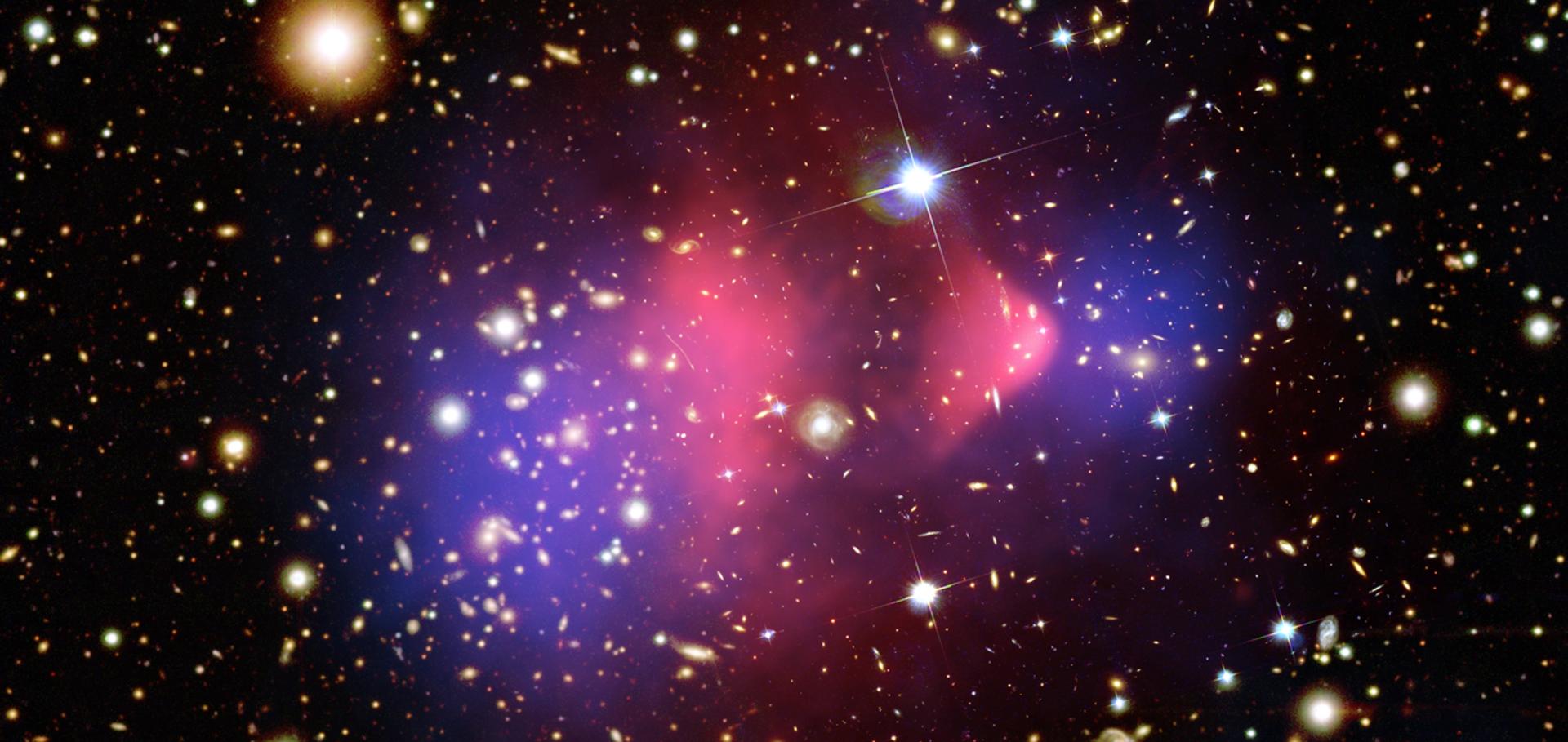
Bullet cluster image
Credit: Credit: X-ray: NASA/CXC/CfA/M.Markevitch et al.; Optical: NASA/STScI; Magellan/U.Arizona/D.Clowe et al.; Lensing Map: NASA/STScI

Professor Jocelyn Monroe

Professor of Particle Physics

Research theme

  • Particle astrophysics & cosmology

Sub department

  • Particle Physics
jocelyn.monroe@physics.ox.ac.uk
Telephone: 273317
en.wikipedia.org/wiki/Jocelyn_Monroe
  • About
  • Publications

First dark matter search results from a surface run of the 10-L DMTPC directional dark matter detector

Physics Letters Section B Nuclear Elementary Particle and High Energy Physics 695:1-4 (2011) 124-129

Authors:

S Ahlen, JBR Battat, T Caldwell, C Deaconu, D Dujmic, W Fedus, P Fisher, F Golub, S Henderson, A Inglis, A Kaboth, G Kohse, R Lanza, A Lee, J Lopez, J Monroe, T Sahin, G Sciolla, N Skvorodnev, H Tomita, H Wellenstein, I Wolfe, R Yamamoto, H Yegoryan

Abstract:

The Dark Matter Time Projection Chamber (DMTPC) is a low pressure (75 Torr CF4) 10 liter detector capable of measuring the vector direction of nuclear recoils with the goal of directional dark matter detection. In this Letter we present the first dark matter limit from DMTPC from a surface run at MIT. In an analysis window of 80-200 keV recoil energy, based on a 35.7 g-day exposure, we set a 90% C.L. upper limit on the spin-dependent WIMP-proton cross section of 2.0×10⁻³³ cm2 for 115 GeV/c2 dark matter particle mass. © 2010 Elsevier B.V.
More details from the publisher
More details

Background rejection in the DMTPC dark matter search using charge signals

Proceedings of the 2011 Meeting of the Division of Particles and Fields of the American Physical Society Dpf 2011 (2011)

Authors:

JP Lopez, T Caldwell, C Deaconu, W Fedus, S Henderson, A Kaboth, A Lee, T Sahin, I Wolfe, R Yamamoto, H Yegoryan, S Ahlen, M Chernicoff, A Inglis, H Tomita, J Battat, D Dujmic, A Dushkin, F Golub, L Kirsch, H Ouyang, G Sciolla, N Skvorodnev, H Wellenstein, P Fisher, G Kohse, R Lanza, J Monroe

Abstract:

The Dark Matter Time Projection Chamber (DMTPC) collaboration is developing low-pressure gas TPC detectors for measuring WIMP-nucleon interactions. Optical readout with CCD cameras allows for the detection for the daily modulation in the direction of the dark matter wind, while several charge readout channels allow for the measurement of additional recoil properties. In this article, we show that the addition of the charge readout analysis to the CCD allows us too obtain a statistics-limited 90% C.L. upper limit on the e- rejection factor of 5.6 × 10⁻⁶ for recoils with energies between 40 and 200 keVee. In addition, requiring coincidence between charge signals and light in the CCD reduces CCD-specific backgrounds by more than two orders of magnitude.

DMTPC: Dark matter detection with directional sensitivity

Proceedings of Science (2010)

Authors:

JBR Battat, S Ahlen, T Caldwell, C Deaconu, D Dujmic, W Fedus, P Fisher, F Golub, S Henderson, A Inglis, A Kaboth, G Kohse, R Lanza, A Lee, J Lopez, J Monroe, T Sahin, G Sciolla, N Skvorodnev, H Tomita, H Wellenstein, I Wolfe, R Yamamoto, H Yegoryan

Abstract:

The Dark Matter Time Projection Chamber (DMTPC) experiment uses CF4 gas at low pressure (0.1 atm) to search for the directional signature of Galactic WIMP dark matter. We describe the DMTPC apparatus and summarize recent results from a 35.7 g-day exposure surface run at MIT. After nuclear recoil cuts are applied to the data, we find 105 candidate events in the energy range 80 - 200 keV, which is consistent with the expected cosmogenic neutron background. Using this data, we obtain a limit on the spin-dependent WIMP-proton cross-section of 2.0 × 10⁻³³ cm2 at a WIMP mass of 115 GeV/c2. This detector is currently deployed underground at the Waste Isolation Pilot Plant in New Mexico. © Copyright owned by the author(s) under the terms of the Creative Commons Attribution-NonCommercial-ShareAlike Licence.

Measurement of the neutrino neutral-current elastic differential cross section on mineral oil at Eν∼1 GeV

Physical Review D American Physical Society (APS) 82:9 (2010) 092005

Authors:

AA Aguilar-Arevalo, CE Anderson, AO Bazarko, SJ Brice, BC Brown, L Bugel, J Cao, L Coney, JM Conrad, DC Cox, A Curioni, R Dharmapalan, Z Djurcic, DA Finley, BT Fleming, R Ford, FG Garcia, GT Garvey, J Grange, C Green, JA Green, TL Hart, E Hawker, R Imlay, RA Johnson, G Karagiorgi, P Kasper, T Katori, T Kobilarcik, I Kourbanis, S Koutsoliotas, EM Laird, SK Linden, JM Link, Y Liu, Y Liu, WC Louis, KBM Mahn, W Marsh, C Mauger, VT McGary, G McGregor, W Metcalf, PD Meyers, F Mills, GB Mills, J Monroe, CD Moore, J Mousseau, RH Nelson, P Nienaber, JA Nowak, B Osmanov, S Ouedraogo, RB Patterson, Z Pavlovic, D Perevalov, CC Polly, E Prebys, JL Raaf, H Ray, BP Roe, AD Russell, V Sandberg, R Schirato, D Schmitz, MH Shaevitz, FC Shoemaker, D Smith, M Soderberg, M Sorel, P Spentzouris, J Spitz, I Stancu, RJ Stefanski, M Sung, HA Tanaka, R Tayloe, M Tzanov, RG Van de Water, MO Wascko, DH White, MJ Wilking, HJ Yang, GP Zeller, ED Zimmerman
More details from the publisher
More details

Low-energy-threshold analysis of the Phase I and Phase II data sets of the Sudbury Neutrino Observatory

Physical Review C - Nuclear Physics 81:5 (2010)

Authors:

B Aharmim, SN Ahmed, AE Anthony, N Barros, EW Beier, A Bellerive, B Beltran, M Bergevin, SD Biller, K Boudjemline, MG Boulay, TH Burritt, B Cai, YD Chan, D Chauhan, M Chen, BT Cleveland, GA Cox, X Dai, H Deng, J Detwiler, M Dimarco, PJ Doe, G Doucas, PL Drouin, CA Duba, FA Duncan, M Dunford, ED Earle, SR Elliott, HC Evans, GT Ewan, J Farine, H Fergani, F Fleurot, RJ Ford, JA Formaggio, N Gagnon, JT Goon, K Graham, E Guillian, S Habib, RL Hahn, AL Hallin, ED Hallman, PJ Harvey, R Hazama, WJ Heintzelman, J Heise, RL Helmer, A Hime, C Howard, MA Howe, M Huang, B Jamieson, NA Jelley, KJ Keeter, JR Klein, LL Kormos, M Kos, C Kraus, CB Krauss, T Kutter, CCM Kyba, J Law, IT Lawson, KT Lesko, JR Leslie, I Levine, JC Loach, R MacLellan, S Majerus, HB Mak, J Maneira, R Martin, N McCauley, AB McDonald, S McGee, ML Miller, B Monreal, J Monroe, B Morissette, BG Nickel, AJ Noble, HM O'Keeffe, NS Oblath, GD Orebi Gann, SM Oser, RA Ott, SJM Peeters, AWP Poon, G Prior, SD Reitzner, K Rielage, BC Robertson, RGH Robertson, MH Schwendener, JA Secrest, SR Seibert, O Simard

Abstract:

Results are reported from a joint analysis of Phase I and Phase II data from the Sudbury Neutrino Observatory. The effective electron kinetic energy threshold used is Teff=3.5 MeV, the lowest analysis threshold yet achieved with water Cherenkov detector data. In units of 106 cm-2 s-1, the total flux of active-flavor neutrinos from B8 decay in the Sun measured using the neutral current (NC) reaction of neutrinos on deuterons, with no constraint on the B8 neutrino energy spectrum, is found to be ΦNC=5.140-0.158+0.160(stat)-0.117+0.132(syst). These uncertainties are more than a factor of 2 smaller than previously published results. Also presented are the spectra of recoil electrons from the charged current reaction of neutrinos on deuterons and the elastic scattering of electrons. A fit to the Sudbury Neutrino Observatory data in which the free parameters directly describe the total B8 neutrino flux and the energy-dependent νe survival probability provides a measure of the total B8 neutrino flux Φ8B=5.046-0.152+0.159(stat) -0.123+0.107(syst). Combining these new results with results of all other solar experiments and the KamLAND reactor experiment yields best-fit values of the mixing parameters of θ12=34.06-0.84+1.16 degrees and Δm212=7.59-0. 21+0.20×10⁻⁵ eV2. The global value of Φ8B is extracted to a precision of -2.95+2.38%. In a three-flavor analysis the best fit value of sin2θ13 is 2.00-1.63+2.09×10⁻². This implies an upper bound of sin2θ13<0.057 (95% C.L.). © 2010 The American Physical Society.
More details from the publisher

Pagination

  • First page First
  • Previous page Prev
  • …
  • Page 14
  • Page 15
  • Page 16
  • Page 17
  • Current page 18
  • Page 19
  • Page 20
  • Page 21
  • Page 22
  • …
  • Next page Next
  • Last page Last

Footer Menu

  • Contact us
  • Giving to the Dept of Physics
  • Work with us
  • Media

User account menu

  • Log in

Follow us

FIND US

Clarendon Laboratory,

Parks Road,

Oxford,

OX1 3PU

CONTACT US

Tel: +44(0)1865272200

University of Oxfrod logo Department Of Physics text logo
IOP Juno Champion logo Athena Swan Silver Award logo

© University of Oxford - Department of Physics

Cookies | Privacy policy | Accessibility statement

Built by: Versantus

  • Home
  • Research
  • Study
  • Engage
  • Our people
  • News & Comment
  • Events
  • Our facilities & services
  • About us
  • Giving to Physics
  • Current students
  • Staff intranet