Home
Department Of Physics text logo
  • Research
    • Our research
    • Our research groups
    • Our research in action
    • Research funding support
    • Summer internships for undergraduates
  • Study
    • Undergraduates
    • Postgraduates
  • Engage
    • For alumni
    • For business
    • For schools
    • For the public
Menu
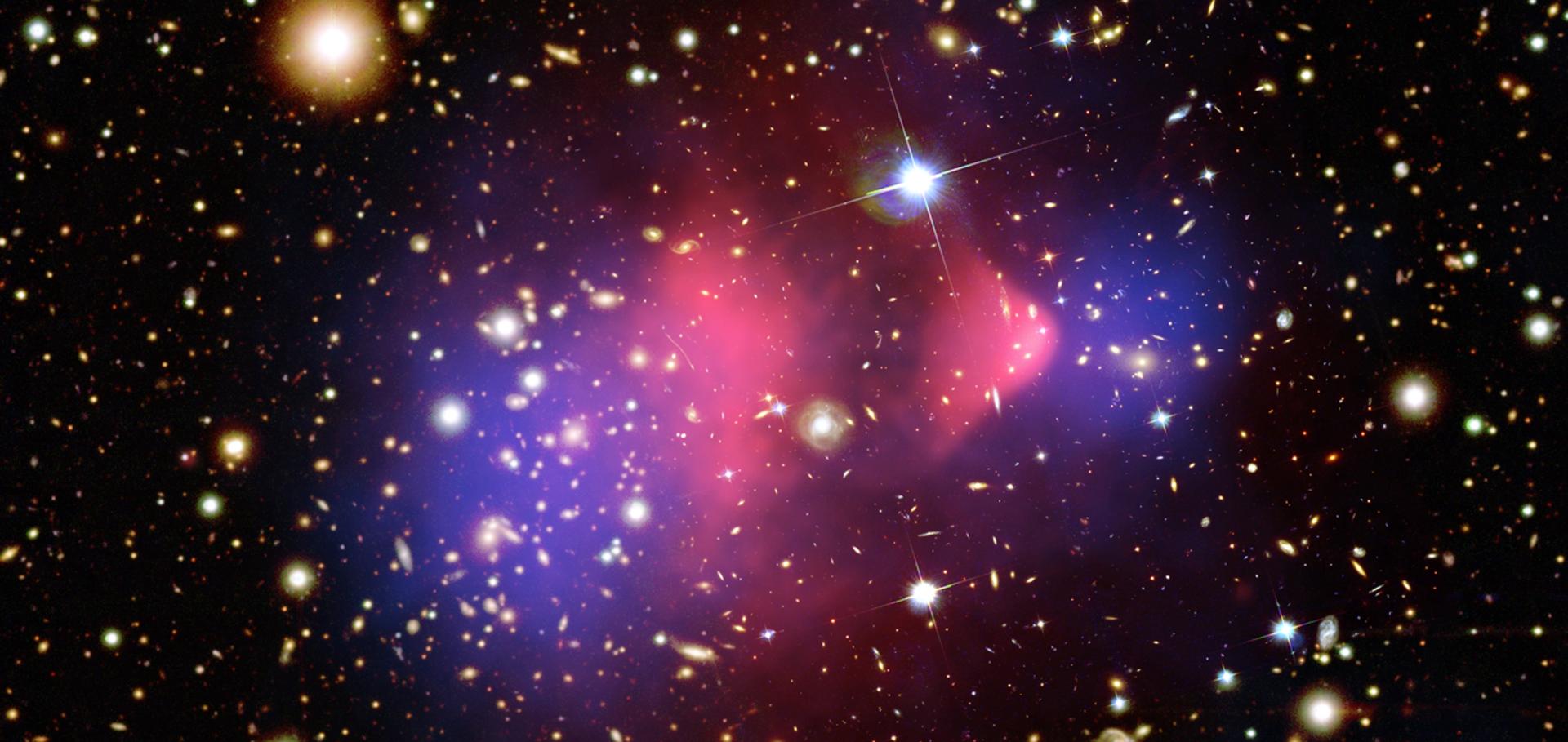
Bullet cluster image
Credit: Credit: X-ray: NASA/CXC/CfA/M.Markevitch et al.; Optical: NASA/STScI; Magellan/U.Arizona/D.Clowe et al.; Lensing Map: NASA/STScI

Professor Jocelyn Monroe

Professor of Particle Physics

Research theme

  • Particle astrophysics & cosmology

Sub department

  • Particle Physics
jocelyn.monroe@physics.ox.ac.uk
Telephone: 273317
en.wikipedia.org/wiki/Jocelyn_Monroe
  • About
  • Publications

Dark matter EFT landscape probed by QUEST-DMC

Journal of Cosmology and Astroparticle Physics IOP Publishing 2025:10 (2025) 44

Authors:

N Darvishi, S Autti, L Bloomfield, A Casey, N Eng, Paolo Franchini, Rp Haley, Pj Heikkinen, A Jennings, A Kemp, Elizabeth Leason, John March-Russell, A Mayer, Jocelyn Monroe, D Münstermann, Mt Noble, Jr Prance, X Rojas, T Salmon, J Saunders, J Smirnov, R Smith, Md Thompson, A Thomson, A Ting, V Tsepelin, Sm West, L Whitehead, De Zmeev

Abstract:

We present the projected sensitivity to non-relativistic Effective Field Theory (EFT) operators for dark matter (DM) direct detection using the QUEST-DMC experiment. QUEST-DMC employs superfluid Helium-3 as a target medium and measures energy deposition via nanomechanical resonators with SQUID-based readout to probe DM interactions. The experiment aims to explore new parameter space in the sub-GeV mass range, probing light DM and a broad range of interaction models. We analyse the sensitivity to a complete set of fourteen independent non-relativistic EFT operators, each parameterised by a Wilson coefficient that quantifies the strength of DM interactions with Standard Model particles. For each interaction channel, we determine the corresponding sensitivity ceiling due to attenuation of the DM flux incident on the detector, caused by DM scattering in the Earth and atmosphere. As a key component of this analysis, we provide the mapping between the non-relativistic EFT operators and the relativistic bilinear DM-nucleon interactions, and assess the interaction sensitivity to sub-GeV DM in the QUEST-DMC detector. Our findings demonstrate that QUEST-DMC provides a unique probe of DM interactions, particularly in previously unexplored parameter space for momentum- and velocity-dependent interactions, thereby expanding the search for viable DM candidates beyond traditional weakly interacting massive particles.
More details from the publisher
Details from ORA
More details

Direct measurement of the 39 Ar half-life from 3.4 years of data with the DEAP-3600 detector

The European Physical Journal C SpringerOpen 85:7 (2025) 728

Authors:

P Adhikari, R Ajaj, M Alpízar-Venegas, P-A Amaudruz, J Anstey, DJ Auty, M Batygov, B Beltran, MA Bigentini, CE Bina, WM Bonivento, MG Boulay, JF Bueno, M Cadeddu, B Cai, M Cárdenas-Montes, S Cavuoti, Y Chen, S Choudhary, BT Cleveland, R Crampton, S Daugherty, P DelGobbo, P Di Stefano

Abstract:

The half-life of 39Ar is measured using the DEAP-3600 detector located 2 km underground at SNOLAB. Between 2016 and 2020, DEAP-3600 used a target mass of (3269 ± 24) kg of liquid argon distilled from the atmosphere in a direct-detection dark matter search. Such an argon mass also enables direct measurements of argon isotope properties. The decay of 39Ar in DEAP-3600 is the dominant source of triggers by two orders of magnitude, ensuring high statistics and making DEAP-3600 well-suited for measuring this isotope’s half-life. Use of the pulse-shape discrimination technique in DEAP-3600 allows powerful discrimination between nuclear recoils and electron recoils, resulting in the selection of a clean sample of 39Ar decays. Observing over a period of 3.4 years, the 39Ar half-life is measured to be (302±8stat±6sys) years. This new direct measurement suggests that the half-life of 39Ar is significantly longer than the accepted value, with potential implications for measurements using this isotope’s half-life as input.
More details from the publisher
Details from ORA
More details

Position reconstruction in the DEAP-3600 dark matter search experiment

Journal of Instrumentation 20:07 (2025)

Authors:

P Adhikari, R Ajaj, M Alpízar-Venegas, P-A Amaudruz, J Anstey, GR Araujo, DJ Auty, M Baldwin, M Batygov, B Beltran, H Benmansour, MA Bigentini, CE Bina, J Bonatt, WM Bonivento, MG Boulay, B Broerman, JF Bueno, PM Burghardt, A Butcher, M Cadeddu, B Cai, M Cárdenas-Montes, S Cavuoti, M Chen, Y Chen, S Choudhary, BT Cleveland, JM Corning, R Crampton, D Cranshaw, S Daugherty, P DelGobbo, K Dering, P Di Stefano, J DiGioseffo, G Dolganov, L Doria, FA Duncan, M Dunford, E Ellingwood, A Erlandson, SS Farahani, N Fatemighomi, G Fiorillo, S Florian, A Flower, RJ Ford, R Gagnon, D Gahan, D Gallacher, A Garai, P García Abia, S Garg, P Giampa, A Giménez-Alcázar, D Goeldi, VV Golovko, P Gorel, K Graham, DR Grant, A Grobov, AL Hallin, M Hamstra, PJ Harvey, S Haskins, C Hearns, J Hu, J Hucker, T Hugues, A Ilyasov, B Jigmeddorj, CJ Jillings, A Joy, O Kamaev, G Kaur, A Kemp, M Khoshraftar Yazdi, M Kuźniak, F La Zia, M Lai, S Langrock, B Lehnert, A Leonhardt, J LePage-Bourbonnais, N Levashko, J Lidgard, T Lindner, M Lissia, J Lock, L Luzzi, I Machulin, P Majewski, A Maru, J Mason, AB McDonald, T McElroy, T McGinn, JB McLaughlin, R Mehdiyev, C Mielnichuk, L Mirasola, A Moharana, J Monroe, A Murray, P Nadeau, C Nantais, C Ng, AJ Noble, E O'Dwyer, G Oliviéro, M Olszewski, C Ouellet, S Pal, D Papi, B Park, P Pasuthip, SJM Peeters, M Perry, V Pesudo, E Picciau, M-C Piro, TR Pollmann, F Rad, ET Rand, C Rethmeier, F Retière, I Rodríguez García, L Roszkowski, JB Ruhland, R Santorelli, FG Schuckman, N Seeburn, S Seth, V Shalamova, K Singhrao, P Skensved, T Smirnova, NJT Smith, B Smith, K Sobotkiewich, T Sonley, J Sosiak, J Soukup, R Stainforth, G Stanic, C Stone, V Strickland, M Stringer, B Sur, J Tang, R Turcotte-Tardif, E Vázquez-Jáuregui, L Veloce, S Viel, B Vyas, M Walczak, J Walding, M Waqar, M Ward, S Westerdale, J Willis, R Wormington, A Zuñiga-Reyes, The DEAP collaboration

Abstract:

In the DEAP-3600 dark matter search experiment, precise reconstruction of the positions of scattering events in liquid argon is key for background rejection and defining a fiducial volume that enhances dark matter candidate events identification. This paper describes three distinct position reconstruction algorithms employed by DEAP-3600, leveraging the spatial and temporal information provided by photomultipliers surrounding a spherical liquid argon vessel. Two of these methods are maximum-likelihood algorithms: the first uses the spatial distribution of detected photoelectrons, while the second incorporates timing information from the detected scintillation light. Additionally, a machine learning approach based on the pattern of photoelectron counts across the photomultipliers is explored.
More details from the publisher
More details

Flow and thermal modelling of the argon volume in the DarkSide-20k TPC

Journal of Instrumentation IOP Publishing 20:06 (2025) P06046

Authors:

F Acerbi, P Adhikari, P Agnes, I Ahmad, S Albergo, IF Albuquerque, T Alexander, AK Alton, P Amaudruz, M Angiolilli, E Aprile, M Atzori Corona, DJ Auty, M Ave, IC Avetisov, O Azzolini, HO Back, Z Balmforth, A Barrado Olmedo, P Barrillon, G Batignani, P Bhowmick, M Bloem, S Blua

Abstract:

The DarkSide-20k dark matter experiment, currently under construction at LNGS, features a dual-phase time projection chamber (TPC) with a ∼ 50 t argon target from an underground well. At this scale, it is crucial to optimise the argon flow pattern for efficient target purification and for fast distribution of internal gaseous calibration sources with lifetimes of the order of hours. To this end, we have performed computational fluid dynamics simulations and heat transfer calculations. The residence time distribution shows that the detector is well-mixed on time-scales of the turnover time (∼ 40 d). Notably, simulations show that despite a two-order-of-magnitude difference between the turnover time and the half-life of 83mKr of 1.83 h, source atoms have the highest probability to reach the centre of the TPC 13 min after their injection, allowing for a homogeneous distribution before undergoing radioactive decay. We further analyse the thermal aspects of dual-phase operation and define the requirements for the formation of a stable gas pocket on top of the liquid. We find a best-estimate value for the heat transfer rate at the liquid-gas interface of 62 W with an upper limit of 144 W and a minimum gas pocket inlet temperature of 89 K to avoid condensation on the acrylic anode. This study also informs the placement of liquid inlets and outlets in the TPC. The presented techniques are widely applicable to other large-scale, noble-liquid detectors.
More details from the publisher
Details from ORA
More details

Quality assurance and quality control of the 26 m 2 SiPM production for the DarkSide-20k dark matter experiment

The European Physical Journal C SpringerOpen 85:5 (2025) 534

Authors:

F Acerbi, P Adhikari, P Agnes, I Ahmad, S Albergo, IF Albuquerque, T Alexander, AK Alton, P Amaudruz, M Angiolilli, E Aprile, M Atzori Corona, DJ Auty, M Ave, IC Avetisov, O Azzolini, HO Back, Z Balmforth, A Barrado Olmedo, P Barrillon, G Batignani, P Bhowmick, M Bloem, S Blua

Abstract:

DarkSide-20k is a novel liquid argon dark matter detector currently under construction at the Laboratori Nazionali del Gran Sasso (LNGS) of the Istituto Nazionale di Fisica Nucleare (INFN) that will push the sensitivity for Weakly Interacting Massive Particle (WIMP) detection into the neutrino fog. The core of the apparatus is a dual-phase Time Projection Chamber (TPC), filled with 50 tonnes of low radioactivity underground argon (UAr) acting as the WIMP target. NUV-HD-cryo Silicon Photomultipliers (SiPM)s designed by Fondazione Bruno Kessler (FBK) (Trento, Italy) were selected as the photon sensors covering two 10.5m2 Optical Planes, one at each end of the TPC, and a total of 5m2 photosensitive surface for the liquid argon veto detectors. This paper describes the Quality Assurance and Quality Control (QA/QC) plan and procedures accompanying the production of FBK NUV-HD-cryo SiPM wafers manufactured by LFoundry s.r.l. (Avezzano, AQ, Italy). SiPM characteristics are measured at 77 K at the wafer level with a custom-designed probe station. As of March 2025, 1314 of the 1400 production wafers (94% of the total) for DarkSide-20k were tested. The wafer yield is 93.2±2.5%, which exceeds the 80% specification defined in the original DarkSide-20k production plan.
More details from the publisher
Details from ORA
More details

Pagination

  • Current page 1
  • Page 2
  • Page 3
  • Page 4
  • Page 5
  • Page 6
  • Page 7
  • Page 8
  • Page 9
  • …
  • Next page Next
  • Last page Last

Footer Menu

  • Contact us
  • Giving to the Dept of Physics
  • Work with us
  • Media

User account menu

  • Log in

Follow us

FIND US

Clarendon Laboratory,

Parks Road,

Oxford,

OX1 3PU

CONTACT US

Tel: +44(0)1865272200

University of Oxfrod logo Department Of Physics text logo
IOP Juno Champion logo Athena Swan Silver Award logo

© University of Oxford - Department of Physics

Cookies | Privacy policy | Accessibility statement

Built by: Versantus

  • Home
  • Research
  • Study
  • Engage
  • Our people
  • News & Comment
  • Events
  • Our facilities & services
  • About us
  • Giving to Physics
  • Current students
  • Staff intranet