Home
Department Of Physics text logo
  • Research
    • Our research
    • Our research groups
    • Our research in action
    • Research funding support
    • Summer internships for undergraduates
  • Study
    • Undergraduates
    • Postgraduates
  • Engage
    • For alumni
    • For business
    • For schools
    • For the public
Menu
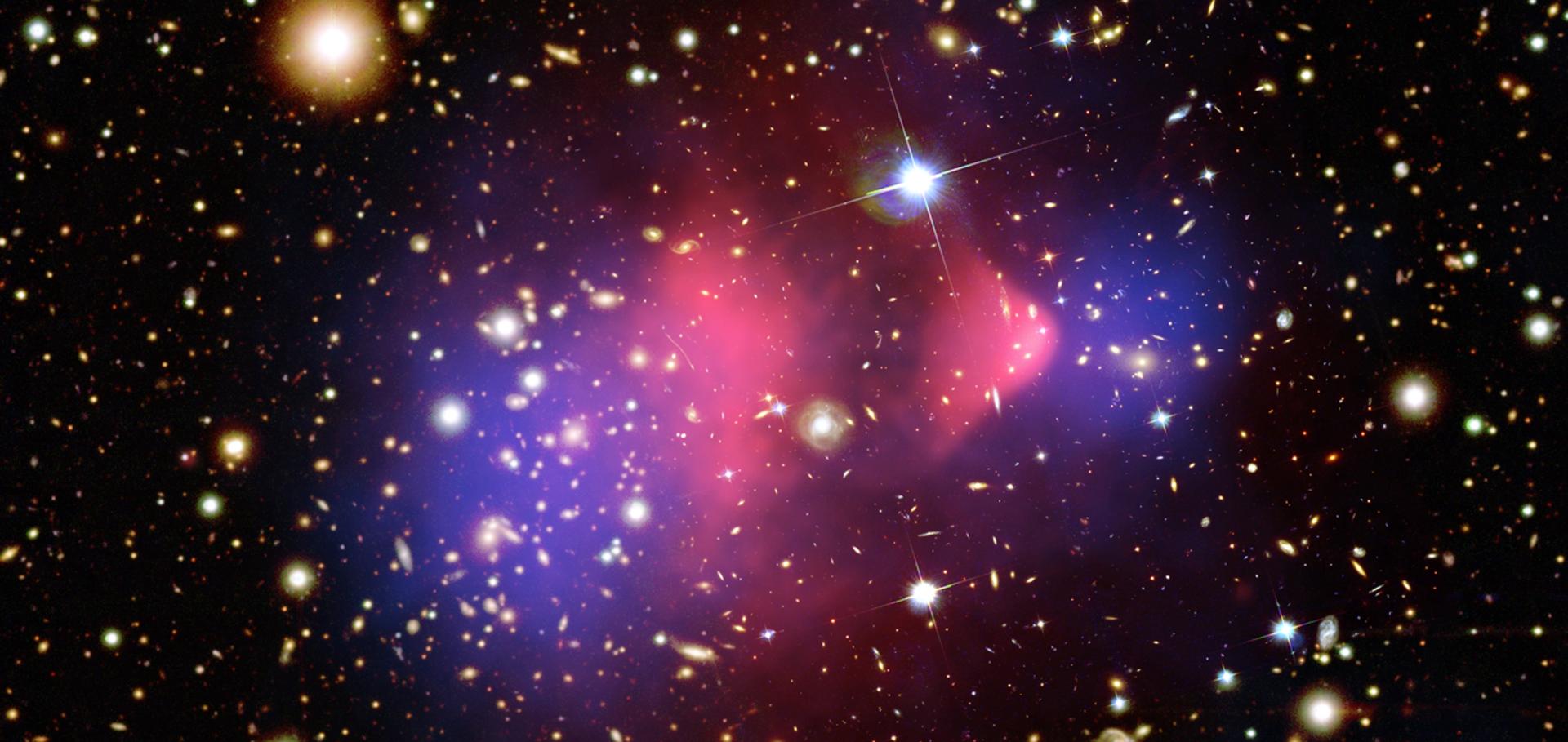
Bullet cluster image
Credit: Credit: X-ray: NASA/CXC/CfA/M.Markevitch et al.; Optical: NASA/STScI; Magellan/U.Arizona/D.Clowe et al.; Lensing Map: NASA/STScI

Professor Jocelyn Monroe

Professor of Particle Physics

Research theme

  • Particle astrophysics & cosmology

Sub department

  • Particle Physics
jocelyn.monroe@physics.ox.ac.uk
Telephone: 273317
en.wikipedia.org/wiki/Jocelyn_Monroe
  • About
  • Publications

THE CASE FOR A DIRECTIONAL DARK MATTER DETECTOR AND THE STATUS OF CURRENT EXPERIMENTAL EFFORTS

International Journal of Modern Physics A World Scientific Publishing 25:01 (2010) 1-51

Authors:

S AHLEN, N AFSHORDI, JBR BATTAT, J BILLARD, N BOZORGNIA, S BURGOS, T CALDWELL, JM CARMONA, S CEBRIAN, P COLAS, T DAFNI, E DAW, D DUJMIC, A DUSHKIN, W FEDUS, E FERRER, D FINKBEINER, PH FISHER, J FORBES, T FUSAYASU, J GALAN, T GAMBLE, C GHAG, I GIOMATARIS, M GOLD, H GOMEZ, ME GOMEZ, P GONDOLO, A GREEN, C GRIGNON, O GUILLAUDIN, C HAGEMANN, K HATTORI, S HENDERSON, N HIGASHI, C IDA, FJ IGUAZ, A INGLIS, IG IRASTORZA, S IWAKI, A KABOTH, S KABUKI, J KADYK, N KALLIVAYALIL, H KUBO, S KUROSAWA, VA KUDRYAVTSEV, T LAMY, R LANZA, TB LAWSON, A LEE, ER LEE, T LIN, D LOOMBA, J LOPEZ, G LUZON, T MANOBU, J MARTOFF, F MAYET, B McCLUSKEY, E MILLER, K MIUCHI, J MONROE, B MORGAN, D MUNA, A St J MURPHY, T NAKA, K NAKAMURA, M NAKAMURA, T NAKANO, GG NICKLIN, H NISHIMURA, K NIWA, SM PALING, J PARKER, A PETKOV, M PIPE, K PUSHKIN, M ROBINSON, A RODRIGUEZ, J RODRIGUEZ-QUINTERO, T SAHIN, R SANDERSON, N SANGHI, D SANTOS, O SATO, T SAWANO, G SCIOLLA, H SEKIYA, TR SLATYER, DP SNOWDEN-IFFT, NJC SPOONER, A SUGIYAMA, A TAKADA, M TAKAHASHI, A TAKEDA, T TANIMORI, K TANIUE, A TOMAS, H TOMITA, K TSUCHIYA, J TURK, E TZIAFERI, K UENO, S VAHSEN, R VANDERSPEK, J VERGADOS, JA VILLAR, H WELLENSTEIN, I WOLFE, RK YAMAMOTO, H YEGORYAN
More details from the publisher
More details

Measurement of νμ and ν¯μ induced neutral current single π0 production cross sections on mineral oil at Eν∼O (1 GeV)

Physical Review D American Physical Society (APS) 81:1 (2010) 013005

Authors:

AA Aguilar-Arevalo, CE Anderson, AO Bazarko, SJ Brice, BC Brown, L Bugel, J Cao, L Coney, JM Conrad, DC Cox, A Curioni, Z Djurcic, DA Finley, BT Fleming, R Ford, FG Garcia, GT Garvey, J Gonzales, J Grange, C Green, JA Green, TL Hart, E Hawker, R Imlay, RA Johnson, G Karagiorgi, P Kasper, T Katori, T Kobilarcik, I Kourbanis, S Koutsoliotas, EM Laird, SK Linden, JM Link, Y Liu, Y Liu, WC Louis, KBM Mahn, W Marsh, C Mauger, VT McGary, G McGregor, W Metcalf, PD Meyers, F Mills, GB Mills, J Monroe, CD Moore, J Mousseau, RH Nelson, P Nienaber, JA Nowak, B Osmanov, S Ouedraogo, RB Patterson, Z Pavlovic, D Perevalov, CC Polly, E Prebys, JL Raaf, H Ray, BP Roe, AD Russell, V Sandberg, R Schirato, D Schmitz, MH Shaevitz, FC Shoemaker, D Smith, M Soderberg, M Sorel, P Spentzouris, J Spitz, I Stancu, RJ Stefanski, M Sung, HA Tanaka, R Tayloe, M Tzanov, RG Van de Water, MO Wascko, DH White, MJ Wilking, HJ Yang, GP Zeller, ED Zimmerman
More details from the publisher
More details

Results from DMTPC 10-liter detector

Journal of Physics Conference Series 203 (2010)

Authors:

D Dujmic, J Battat, T Caldwell, L Fedus, P Fisher, S Henderson, R Lanza, A Lee, J Lopez, A Kaboth, G Kohse, J Monroe, R Vanderspek, T Sahin, G Sciolla, I Wolf, R Yamamoto, H Yegorian, S Ahlen, A Inglis, K Otis, H Tomita, H Wellenstein

Abstract:

The known direction of motion of dark matter particles relative to the Earth may be a key for their unambiguous identification even in the presence of backgrounds. A direction-sensitive detector prototype using a low-density CF4 gas with a 10 liter fiducial volume is operated for several weeks in a basement laboratory. We present initial results that confirm good detector performance and set preliminary limits on spin-dependent dark matter interactions. © 2010 IOP Publishing Ltd.
More details from the publisher
More details

Searches for high-frequency variations in the 8B solar neutrino flux at the sudbury neutrino observatory

Astrophysical Journal 710:1 (2010) 540-548

Authors:

B Aharmim, SN Ahmed, AE Anthony, N Barros, EW Beier, A Bellerive, B Beltran, M Bergevin, SD Biller, K Boudjemline, MG Boulay, TH Burritt, B Cai, YD Chan, D Chauhan, M Chen, BT Cleveland, GA Cox, X Dai, H Deng, J Detwiler, M Dimarco, PJ Doe, G Doucas, PL Drouin, CA Duba, FA Duncan, M Dunford, ED Earle, SR Elliott, HC Evans, GT Ewan, J Farine, H Fergani, F Fleurot, RJ Ford, JA Formaggio, N Gagnon, JT Goon, K Graham, E Guillian, S Habib, RL Hahn, AL Hallin, ED Hallman, PJ Harvey, R Hazama, WJ Heintzelman, J Heise, RL Helmer, A Hime, C Howard, MA Howe, M Huang, B Jamieson, NA Jelley, KJ Keeter, JR Klein, LL Kormos, M Kos, C Kraus, CB Krauss, T Kutter, CCM Kyba, J Law, IT Lawson, KT Lesko, JR Leslie, I Levine, JC Loach, R MacLellan, S Majerus, HB Mak, J Maneira, R Martin, N McCauley, AB McDonald, S McGee, ML Miller, B Monreal, J Monroe, B Morissette, BG Nickel, AJ Noble, HM O'Keeffe, NS Oblath, GDO Gann, SM Oser, RA Ott, SJM Peeters, AWP Poon, G Prior, SD Reitzner, K Rielage, BC Robertson, RGH Robertson, MH Schwendener, JA Secrest, SR Seibert, O Simard

Abstract:

We have performed three searches for high-frequency signals in the solar neutrino flux measured by the Sudbury Neutrino Observatory, motivated by the possibility that solar g-mode oscillations could affect the production or propagation of solar 8B neutrinos. The first search looked for any significant peak in the frequency range 1-144day-1, with a sensitivity to sinusoidal signals with amplitudes of 12% or greater. The second search focused on regions in which g-mode signals have been claimed by experiments aboard the Solar and Heliospheric Observatory satellite, and was sensitive to signals with amplitudes of 10% or greater. The third search looked for extra power across the entire frequency band. No statistically significant signal was detected in any of the three searches. © 2010. The American Astronomical Society.
More details from the publisher

DMTPC: A dark matter detector with directional sensitivity

Aip Conference Proceedings 1182 (2009) 276-279

Authors:

JBR Battat, S Ahlen, T Caldwell, D Dujmic, A Dushkin, P Fisher, F Golub, S Goyal, S Henderson, A Inglis, R Lanza, J Lopez, A Kaboth, G Kohse, J Monroe, G Sciolla, BN Skvorodnev, H Tomita, R Vanderspek, H Wellenstein, RYamamoto

Abstract:

By correlating nuclear recoil directions with the Earth's direction of motion through the Galaxy, a directional dark matter detector can unambiguously detect Weakly Interacting Massive Particles (WIMPs), even in the presence of backgrounds. Here, we describe the Dark Matter TimeProjection Chamber (DMTPC) detector, a TPC filled with CF4 gas at low pressure (0.1 atm). Using this detector, we have measured the vector direction (head-tail) of nuclear recoils down to energies of 100 keV with an angular resolution of ≤15°. To study our detector backgrounds, we have operated in a basement laboratory on the MIT campus for several months. We are currently building a new, high-radiopurity detector for deployment underground at the Waste Isolation Pilot Plant facility in New Mexico. © 2009 American Institute of Physics.
More details from the publisher
More details

Pagination

  • First page First
  • Previous page Prev
  • …
  • Page 15
  • Page 16
  • Page 17
  • Page 18
  • Current page 19
  • Page 20
  • Page 21
  • Page 22
  • Page 23
  • …
  • Next page Next
  • Last page Last

Footer Menu

  • Contact us
  • Giving to the Dept of Physics
  • Work with us
  • Media

User account menu

  • Log in

Follow us

FIND US

Clarendon Laboratory,

Parks Road,

Oxford,

OX1 3PU

CONTACT US

Tel: +44(0)1865272200

University of Oxfrod logo Department Of Physics text logo
IOP Juno Champion logo Athena Swan Silver Award logo

© University of Oxford - Department of Physics

Cookies | Privacy policy | Accessibility statement

Built by: Versantus

  • Home
  • Research
  • Study
  • Engage
  • Our people
  • News & Comment
  • Events
  • Our facilities & services
  • About us
  • Giving to Physics
  • Current students
  • Staff intranet