


On the microscopic scale, Nature behaves according to the laws of quantum physics. Quantum effects – say, superposition and entanglement, in their “weirdness” exemplified by Schrödinger's cat – enable us to process information following fundamentally different rules to that of conventional (classical) computers. A type of computer that's not a Turing machine; what a fascinating prospect! For which applications is it going to beat good old CMOS silicon? (Simulations of chemical compounds and materials, as well as code-breaking, have people excited.) How are we going to program it? What kind of engineering and technology is it going to be based on? And what else will quantum information enable, from long-distance coordination and provably-secure encryption to fundamental science?
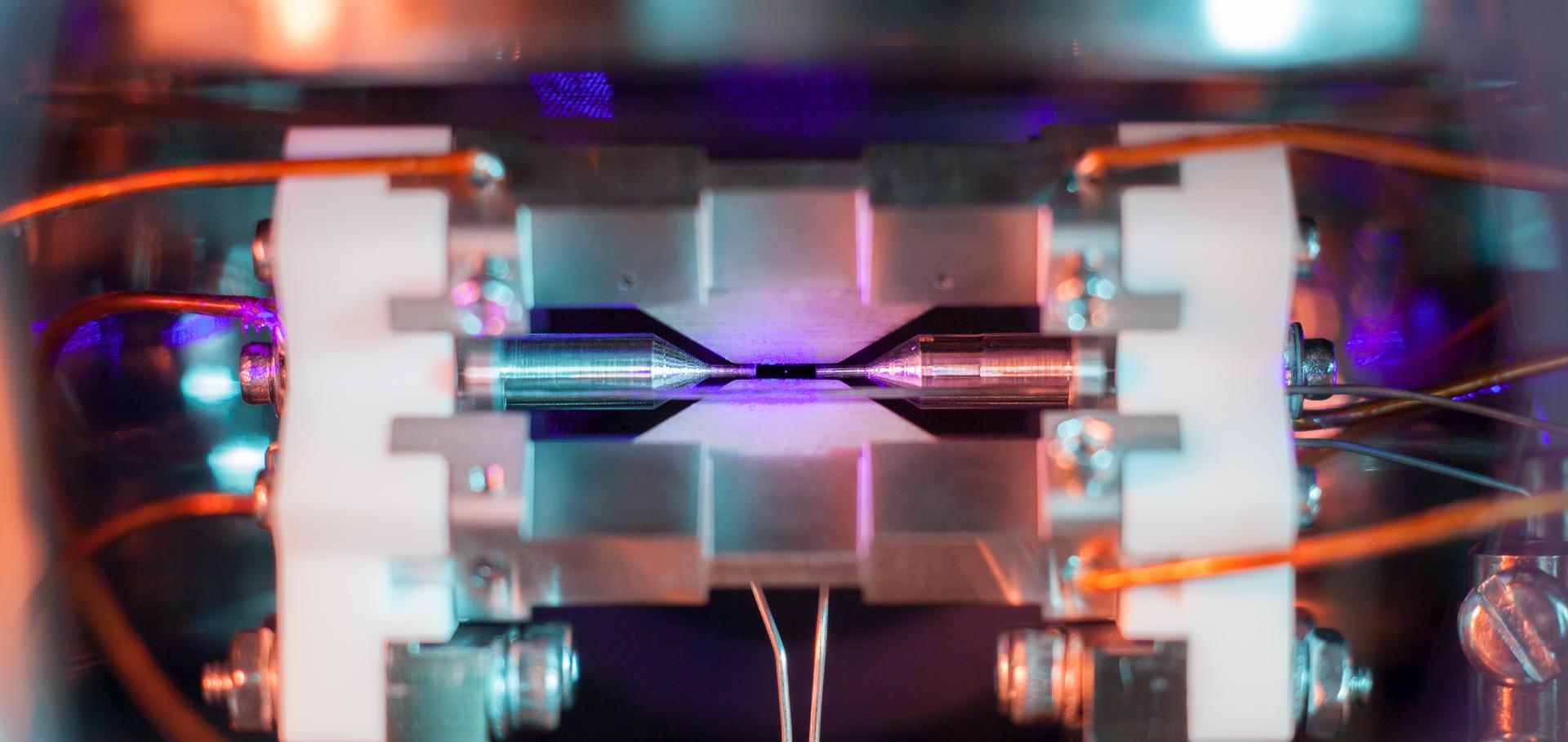
In much of my academic work, I have focussed on the building blocks to turn quantum technology from physical possibility into technological plausibility. That step is hard-won: quantum effects are fragile; if a quantum bit interacts with the rest of the universe at all in an uncontrolled fashion, they disappear. Hence, merely holding on to a piece of information without changing it – trivial in classical computing –, is a formidable challenge in quantum information processing, and so is sending it from one location to another. Most of my research has tackled this using trapped-ion quantum bits (qubits): we can store information in single atoms levitated in vacuum, execute logic operations with exceptional precision, and communicate it across long distances.
I have worked extensively on hybrid quantum systems, where matter-based qubits are entangled with light, combining the complementary strengths of different platforms: trapped-ion qubits offer world-leading performance in storage, logic gates, and read-out, while single photons are the natural messenger qubits, zipping along at the speed of light and barely interacting with anything (not least, they can be “piped around” in optical fibres). We can use single photons to link distant ion qubits, entangling two separate systems that do not directly interact; this “remote entanglement” is a universal resource for quantum protocols. I have pushed the speed and error-rate frontier across all remote entanglement platforms, and have proposed a framework to understand and overcome performance limitations due to atomic motion.
Drawing on the world-leading performance of photon-mediated entanglement in the ion-trap platform my colleagues and I built, we were able to push the envelope for quantum networking applications. My doctoral thesis included the first demonstration of fully device-independent quantum cryptography, and we have shown first-of-their-kind results in “blind” quantum computing, entangled optical clock networks, and remote coordination scenarios. While these are proof-of-principle demonstrations, importantly the excellent control over trapped-ion qubits has allowed us to implement the applications “for real”, without any of the maneuvers (e.g. postselection) often divorcing supposed demonstrations from actual deployments, with the chasm between them being of unclear size. Recently, we demonstrated the first execution of a distributed quantum algorithm across optically-linked computer modules.
While trapped ions make “perfect” natural qubits with few inherent error mechanisms, this needs to be borne out by the control mechanism used to put them to computational use. Beyond networking, a large part of my work has been on methods to control the quantum state of ions more accurately and reliably, as well as their accurate characterisation. This includes entangling gates driven using lasers and microwaves, measuring memory errors at extremely low levels, low-crosstalk optical addressing, the characterisation of ion transport (“shuttling”) and its use for multiplexed logic gates, and the creation and analysis of novel states of the motion of ions in the trap.
I am a Senior Researcher at the Department of Physics at the University of Oxford, working on ion trap quantum computing. Prior to this, I held a Junior Research Fellowship at Merton College, Oxford. I took my DPhil at Balliol College, Oxford in 2023. Previously, I studied Interdisciplinary Sciences and Physics at ETH Zürich, where I was fortunate enough to work in the Trapped Ion Quantum Information Group.