Home
Department Of Physics text logo
  • Research
    • Our research
    • Our research groups
    • Our research in action
    • Research funding support
    • Summer internships for undergraduates
  • Study
    • Undergraduates
    • Postgraduates
  • Engage
    • For alumni
    • For business
    • For schools
    • For the public
Menu
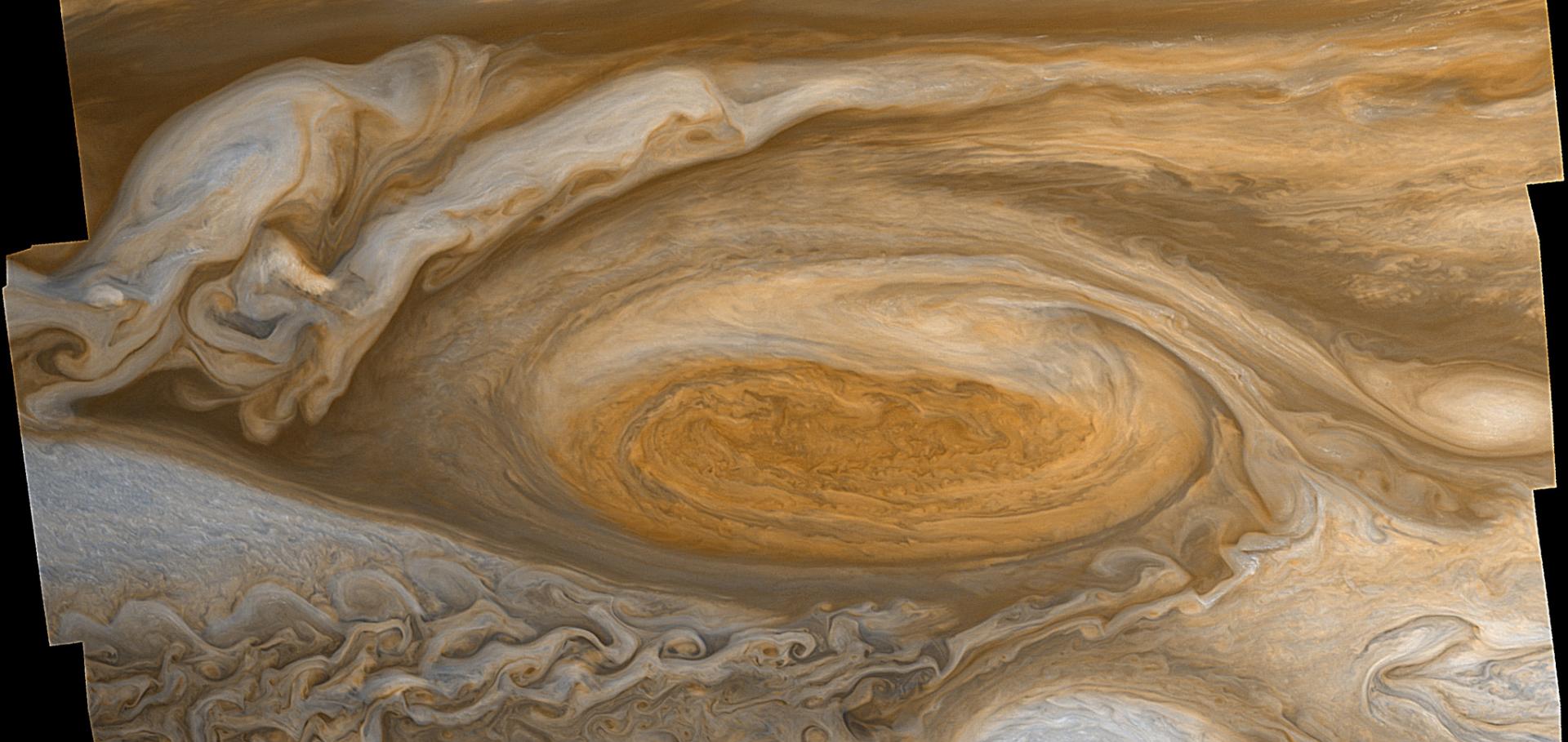
Image of Jupiter's Great Red Spot from Voyager 1

Image of Jupiter's Great Red Spot, obtained during the fly-by of Jupiter by NASA's Voyager 1 spacecraft in 1979.

Credit: NASA/JPL

Prof. Peter Read

Emeritus/researcher

Research theme

  • Climate physics
  • Exoplanets and planetary physics

Sub department

  • Atmospheric, Oceanic and Planetary Physics

Research groups

  • Geophysical and Astrophysical Fluid Dynamics
  • Planetary Climate Dynamics
Peter.Read@physics.ox.ac.uk
Telephone: 01865 (2)72082
Atmospheric Physics Clarendon Laboratory, room 210
  • About
  • Publications

Intense polar temperature inversion in the middle atmosphere on Mars

Nature Geoscience 1:11 (2008) 745-749

Authors:

DJ McCleese, JT Schofield, FW Taylor, WA Abdou, O Aharonson, D Banfield, SB Calcutt, NG Heavens, PGJ Irwin, DM Kass, A Kleinböhl, WG Lawson, CB Leovy, SR Lewis, DA Paige, PL Read, MI Richardson, N Teanby, RW Zurek

Abstract:

Current understanding of weather, climate and global atmospheric circulation on Mars is incomplete, in particular at altitudes above about 30 km. General circulation models for Mars are similar to those developed for weather and climate forecasting on Earth and require more martian observations to allow testing and model improvements. However, the available measurements of martian atmospheric temperatures, winds, water vapour and airborne dust are generally restricted to the region close to the surface and lack the vertical resolution and global coverage that is necessary to shed light on the dynamics of Mars middle atmosphere at altitudes between 30 and 80 km (ref.7). Here we report high-resolution observations from the Mars Climate Sounder instrument on the Mars Reconnaissance Orbiter. These observations show an intense warming of the middle atmosphere over the south polar region in winter that is at least 10-20 K warmer than predicted by current model simulations. To explain this finding, we suggest that the atmospheric downwelling circulation over the pole, which is part of the equator-to-pole Hadley circulation, may be as much as 50 more vigorous than expected, with consequences for the cycles of water, dust and CO"2 that regulate the present-day climate on Mars. © 2008 Macmillan Publishers Limited.
More details from the publisher
More details

Temperature and composition of Saturn's polar hot spots and hexagon.

Science 319:5859 (2008) 79-81

Authors:

LN Fletcher, PGJ Irwin, GS Orton, NA Teanby, RK Achterberg, GL Bjoraker, PL Read, AA Simon-Miller, C Howett, R de Kok, N Bowles, SB Calcutt, B Hesman, FM Flasar

Abstract:

Saturn's poles exhibit an unexpected symmetry in hot, cyclonic polar vortices, despite huge seasonal differences in solar flux. The cores of both vortices are depleted in phosphine gas, probably resulting from subsidence of air into the troposphere. The warm cores are present throughout the upper troposphere and stratosphere at both poles. The thermal structure associated with the marked hexagonal polar jet at 77 degrees N has been observed for the first time. Both the warm cyclonic belt at 79 degrees N and the cold anticyclonic zone at 75 degrees N exhibit the hexagonal structure.
More details from the publisher
More details
More details

Erratum: "Dynamics of convectively driven banded jets in the laboratory" (Journal of the Atmospheric Sciences (2007))

Journal of the Atmospheric Sciences 65:1 (2008) 287

Authors:

PL Read, YH Yamazaki, SR Lewis, PD Williams, R Wordsworth, K Miki-Yamazaki, J Sommeria, H Didelle, AM Fincham
More details from the publisher

Synchronization in baroclinic systems

Journal of Physics: Conference Series 137 (2008)

Authors:

AA Castrejón-Pita, PL Read

Abstract:

Synchronization of periodic and chaotic oscillations between two coupled rotating baroclinic fluid systems will be presented. The numerical part of the study involves a pair of coupled two-layer quasigeostrophic models, and the experimental part comprises two thermally coupled baroclinic fluid annuli, rotating one above the other on the same turntable. Phase synchronization and imperfect synchronization (phase slips) have been found in both model and experiments, and model simulations also exhibit chaos-destroying synchronization. © 2008 IOP Publishing Ltd.
More details from the publisher
Details from ORA

Tubulence, waves, and jets in a differentially heated rotating annulus experiment

Physics of Fluids 20:12 (2008)

Authors:

RD Wordsworth, PL Read, YH Yamazaki

Abstract:

We report an analog laboratory study of planetary-scale turbulence and jet formation. A rotating annulus was cooled and heated at its inner and outer walls, respectively, causing baroclinic instability to develop in the fluid inside. At high rotation rates and low temperature differences, the flow became chaotic and ultimately fully turbulent. The inclusion of sloping top and bottom boundaries caused turbulent eddies to behave like planetary waves at large scales, and eddy interaction with the zonal flow then led to the formation of several alternating jets at mid-depth. The jets did not scale with the Rhines length, and spectral analysis of the flow indicated a distinct separation between jets and eddies in wavenumber space, with direct energy transfer occurring nonlocally between them. Our results suggest that the traditional "turbulent cascade" picture of zonal jet formation may be an inappropriate one in the geophysically important case of large-scale flows forced by differential solar heating.
More details from the publisher

Pagination

  • First page First
  • Previous page Prev
  • …
  • Page 31
  • Page 32
  • Page 33
  • Page 34
  • Current page 35
  • Page 36
  • Page 37
  • Page 38
  • Page 39
  • …
  • Next page Next
  • Last page Last

Footer Menu

  • Contact us
  • Giving to the Dept of Physics
  • Work with us
  • Media

User account menu

  • Log in

Follow us

FIND US

Clarendon Laboratory,

Parks Road,

Oxford,

OX1 3PU

CONTACT US

Tel: +44(0)1865272200

University of Oxfrod logo Department Of Physics text logo
IOP Juno Champion logo Athena Swan Silver Award logo

© University of Oxford - Department of Physics

Cookies | Privacy policy | Accessibility statement

Built by: Versantus

  • Home
  • Research
  • Study
  • Engage
  • Our people
  • News & Comment
  • Events
  • Our facilities & services
  • About us
  • Giving to Physics
  • Current students
  • Staff intranet