Home
Department Of Physics text logo
  • Research
    • Our research
    • Our research groups
    • Our research in action
    • Research funding support
    • Summer internships for undergraduates
  • Study
    • Undergraduates
    • Postgraduates
  • Engage
    • For young people
    • For teachers
    • For the public
    • For alumni
    • For business
  • Support
Menu
Atomic and Laser Physics
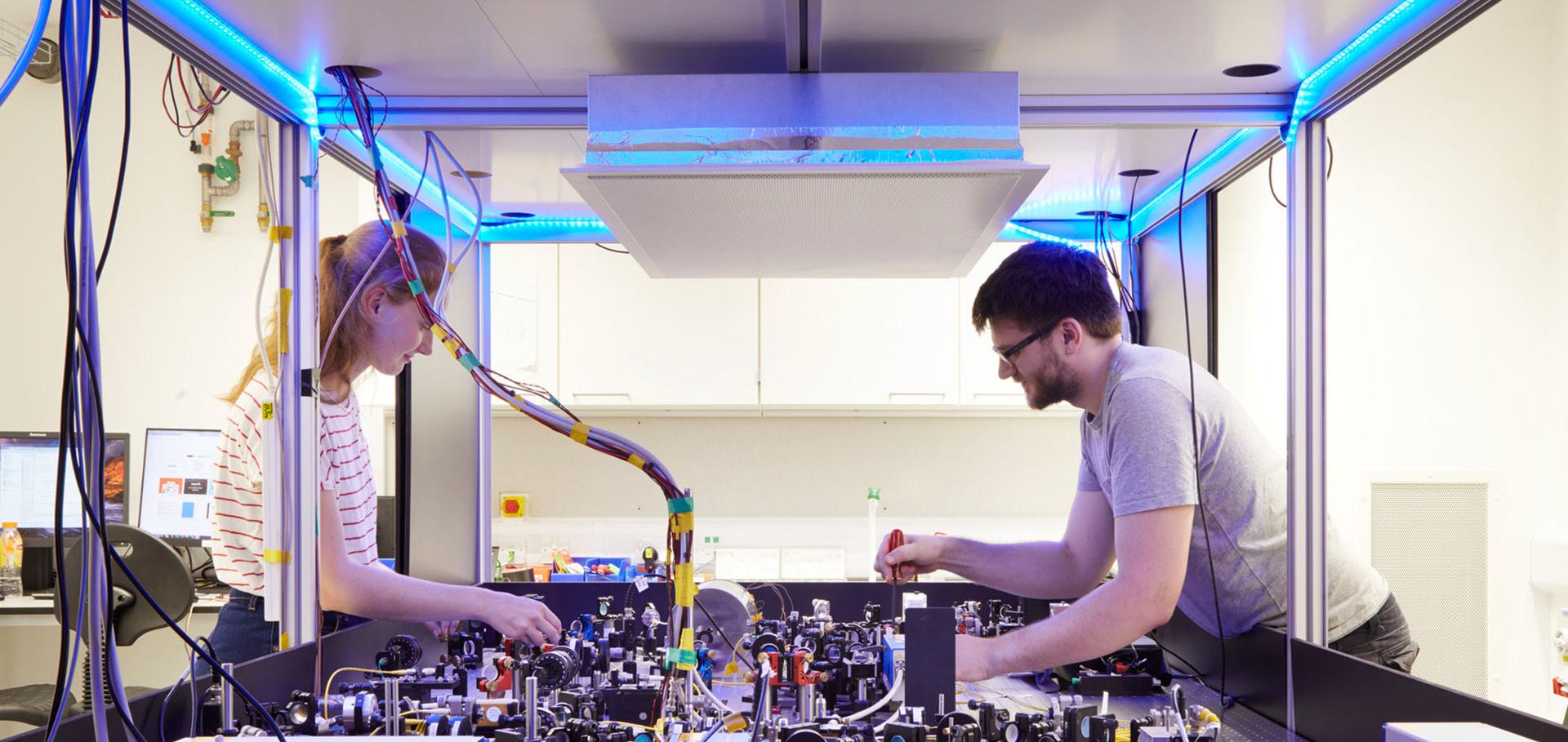
Credit: Jack Hobhouse

Professor Steven Rose

Visiting Professor

Research theme

  • Lasers and high energy density science

Sub department

  • Atomic and Laser Physics

Research groups

  • Oxford Centre for High Energy Density Science (OxCHEDS)
Steven.Rose@physics.ox.ac.uk
Imperial College London webpage
  • About
  • Publications

INTENSITY ENHANCEMENT OF O vi ULTRAVIOLET EMISSION LINES IN SOLAR SPECTRA DUE TO OPACITY

The Astrophysical Journal Letters American Astronomical Society 784:2 (2014) l39

Authors:

FP Keenan, JG Doyle, MS Madjarska, SJ Rose, LA Bowler, J Britton, L McCrink, M Mathioudakis
More details from the publisher
More details

Fast electron beam measurements from relativistically intense, frequency-doubled laser-solid interactions

New Journal of Physics 15 (2013)

Authors:

RHH Scott, F Pérez, MJV Streeter, EL Clark, JR Davies, HP Schlenvoigt, JJ Santos, S Hulin, KL Lancaster, F Dorchies, C Fourment, B Vauzour, AA Soloviev, SD Baton, SJ Rose, PA Norreys

Abstract:

Experimental measurements of the fast electron beam created by the interaction of relativistically intense, frequency-doubled laser light with planar solid targets and its subsequent transport within the target are presented and compared with those of a similar experiment using the laser fundamental frequency. Using frequency-doubled laser light, the fast electron source size is significantly reduced, while evidence suggests the divergence angle may be reduced. Pyrometric measurements of the target rear surface temperature and the Cu Kα imager data indicate the laser to fast electron absorption fraction is reduced using frequency doubled laser light. Bremsstrahlung measurements indicate the fast electron temperature is 125 keV, while the laser energy absorbed into forward-going fast electrons was found to be 16 ± 4% for frequency doubled light at a mean laser intensity of 5 ± 3 × 10¹⁸ W cm-2. © IOP Publishing and Deutsche Physikalische Gesellschaft.
More details from the publisher
More details

A Monte Carlo algorithm for degenerate plasmas

Journal of Computational Physics Elsevier 249 (2013) 13-21

Authors:

AE Turrell, M Sherlock, SJ Rose
More details from the publisher

Electron–positron pair creation in burning thermonuclear plasmas

High Energy Density Physics Elsevier 9:3 (2013) 480-483
More details from the publisher
More details

Measuring fast electron spectra and laser absorption in relativistic laser-solid interactions using differential bremsstrahlung photon detectors.

Rev Sci Instrum 84:8 (2013) 083505

Authors:

RHH Scott, EL Clark, F Pérez, MJV Streeter, JR Davies, H-P Schlenvoigt, JJ Santos, S Hulin, KL Lancaster, SD Baton, SJ Rose, PA Norreys

Abstract:

A photon detector suitable for the measurement of bremsstrahlung spectra generated in relativistically intense laser-solid interactions is described. The Monte Carlo techniques used to extract the fast electron spectrum and laser energy absorbed into forward-going fast electrons are detailed. A relativistically intense laser-solid experiment using frequency doubled laser light is used to demonstrate the effective operation of the detector. The experimental data were interpreted using the 3-spatial-dimension Monte Carlo code MCNPX [D. Pelowitz, MCNPX User's Manual Version 2.6.0, Los Alamos National Laboratory, 2008], and the fast electron temperature found to be 125 keV.
More details from the publisher
More details

Pagination

  • First page First
  • Previous page Prev
  • …
  • Page 11
  • Page 12
  • Page 13
  • Page 14
  • Current page 15
  • Page 16
  • Page 17
  • Page 18
  • Page 19
  • …
  • Next page Next
  • Last page Last

Footer Menu

  • Contact us
  • Giving to the Dept of Physics
  • Work with us
  • Media

User account menu

  • Log in

Follow us

FIND US

Clarendon Laboratory,

Parks Road,

Oxford,

OX1 3PU

CONTACT US

Tel: +44(0)1865272200

University of Oxfrod logo Department Of Physics text logo
IOP Juno Champion logo Athena Swan Silver Award logo

© University of Oxford - Department of Physics

Cookies | Privacy policy | Accessibility statement

Built by: Versantus

  • Home
  • Research
  • Study
  • Engage
  • Our people
  • News & Comment
  • Events
  • Our facilities & services
  • About us
  • Giving to Physics
  • Current students
  • Staff intranet