Home
Department Of Physics text logo
  • Research
    • Our research
    • Our research groups
    • Our research in action
    • Research funding support
    • Summer internships for undergraduates
  • Study
    • Undergraduates
    • Postgraduates
  • Engage
    • For alumni
    • For business
    • For schools
    • For the public
Menu
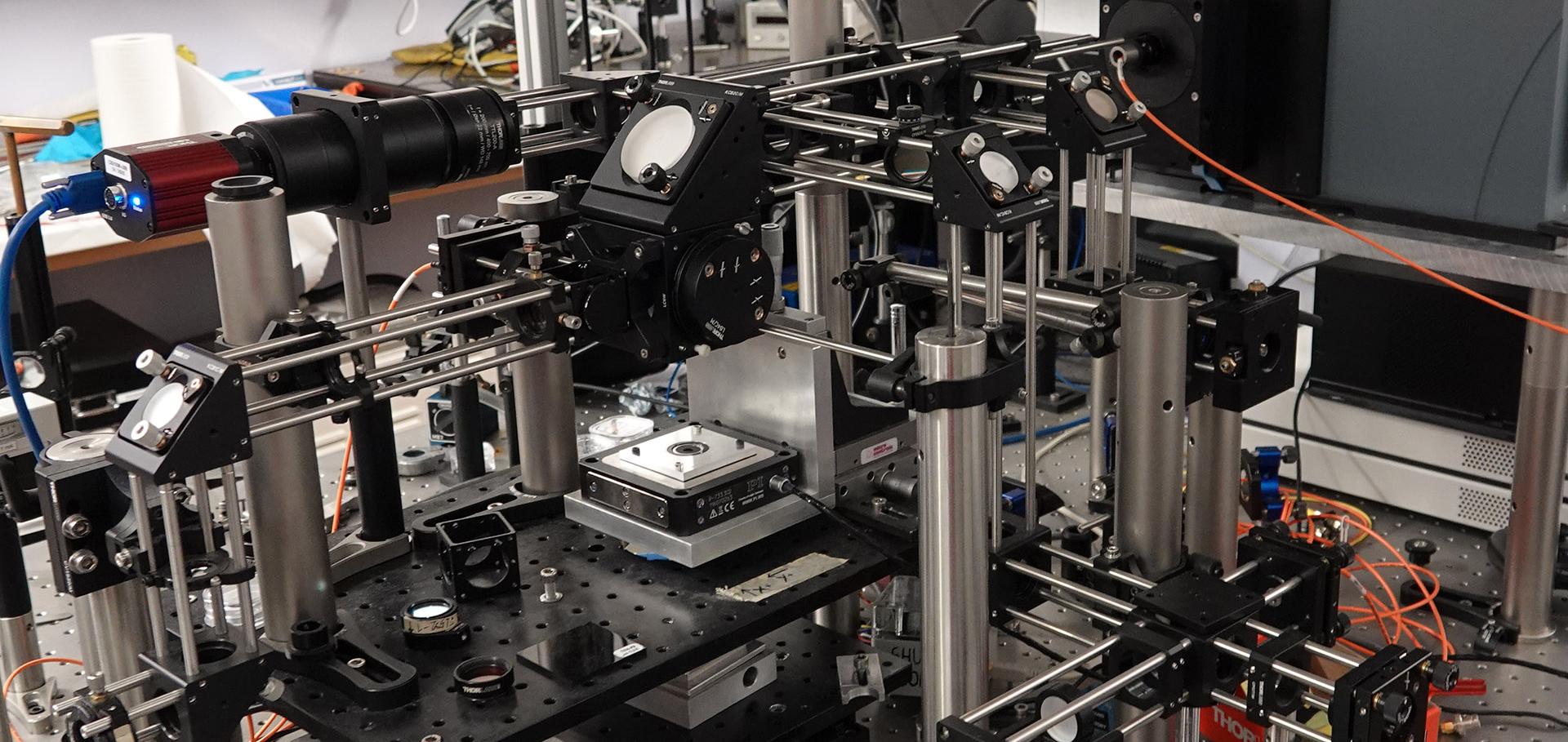
MicroPL optical setup

Professor Robert Taylor

Emeritus Professor of Condensed Matter Physics

Research theme

  • Photovoltaics and nanoscience

Sub department

  • Condensed Matter Physics

Research groups

  • Quantum Optoelectronics
Robert.Taylor@physics.ox.ac.uk
Telephone: 01865 (2)72230
Clarendon Laboratory, room 164
orcid.org/0000-0003-2578-9645
  • About
  • Teaching
  • Positions available
  • Publications

Lasing in perovskite nanocrystals

Image of transverse modes from lasing nanocrystals
Nano Research, 14, 108, 2021

Purcell enhancement of a deterministically coupled quantum dot in an SU-8 laser patterned photonic crystal heterostructure

Applied Physics Letters AIP Publishing 117:4 (2020) 043103-043103

Authors:

H Shao, G Ying, Sa Lennon, Fsf Brossard, Jp Griffiths, Lp Nuttall, V Osokin, E Clarke, H He, Ra Taylor
More details from the publisher
Details from ORA
More details

Transmissivity and reectivity of a transverse-electric polarized wave incident on a microcavity containing strongly coupled excitons with in-plane uniaxially oriented transition dipole moments

physica status solidi (b) Wiley 257:9 (2020) 2000235

Authors:

Robert Taylor, Florian Le Roux, Donal Bradley

Abstract:

This work examines the reflectivity and transmissivity of a transverse‐electric (TE) polarized wave incident on a microcavity containing strongly coupled excitons with in‐plane uniaxially oriented transition dipole moments, and a different interpretation to a previous report is presented. The propagation of the electric field inside the cavity is discussed, and a distinction is made between two different physical cases: the first, previously observed, and the second, which enables the interpretation of measurements carried out on a microcavity containing an oriented layer of liquid‐crystalline poly(9,9‐dioctylfluorene). In all cases, the reflected and transmitted electric fields derive from photons leaking parallel and perpendicular to the transition dipole moment orientation.
More details from the publisher
Details from ORA
More details

Non-polar nitride single-photon sources

Journal of Optics IOP Publishing 22:7 (2020) 073001-073001

Authors:

Tong Wang, Rachel A Oliver, Robert A Taylor
More details from the publisher
Details from ORA
More details

Optical shaping of the polarization anisotropy in a laterally coupled quantum dot dimer

Light: Science and Applications Springer Nature 9:1 (2020) 100

Authors:

Heedae Kim, Kwangseuk Kyhm, Robert A Taylor, Jong Su Kim, Jin Dong Song, Sungkyun Park

Abstract:

We find that the emission from laterally coupled quantum dots is strongly polarized along the coupled direction [1 1¯ 0], and its polarization anisotropy can be shaped by changing the orientation of the polarized excitation. When the nonresonant excitation is linearly polarized perpendicular to the coupled direction [110], excitons (X1 and X2) and local biexcitons (X1X1 and X2X2) from the two separate quantum dots (QD1 and QD2) show emission anisotropy with a small degree of polarization (10%). On the other hand, when the excitation polarization is parallel to the coupled direction [1 1¯ 0], the polarization anisotropy of excitons, local biexcitons, and coupled biexcitons (X1X2) is enhanced with a degree of polarization of 74%. We also observed a consistent anisotropy in the time-resolved photoluminescence. The decay rate of the polarized photoluminescence intensity along the coupled direction is relatively high, but the anisotropic decay rate can be modified by changing the orientation of the polarized excitation. An energy difference is also observed between the polarized emission spectra parallel and perpendicular to the coupled direction, and it increases by up to three times by changing the excitation polarization orientation from [110] to [1 1¯ 0]. These results suggest that the dipole-dipole interaction across the two separate quantum dots is mediated and that the anisotropic wavefunctions of the excitons and biexcitons are shaped by the excitation polarization.
More details from the publisher
Details from ORA
More details
More details

Optical shaping of the polarization anisotropy in a laterally coupled quantum dot dimer.

Light, science & applications 9:1 (2020) 100

Authors:

Heedae Kim, Kwangseuk Kyhm, Robert A Taylor, Jong Su Kim, Jin Dong Song, Sungkyun Park

Abstract:

We find that the emission from laterally coupled quantum dots is strongly polarized along the coupled direction [1[Formula: see text]0], and its polarization anisotropy can be shaped by changing the orientation of the polarized excitation. When the nonresonant excitation is linearly polarized perpendicular to the coupled direction [110], excitons (X<sub>1</sub> and X<sub>2</sub>) and local biexcitons (X<sub>1</sub>X<sub>1</sub> and X<sub>2</sub>X<sub>2</sub>) from the two separate quantum dots (QD<sub>1</sub> and QD<sub>2</sub>) show emission anisotropy with a small degree of polarization (10%). On the other hand, when the excitation polarization is parallel to the coupled direction [1[Formula: see text]0], the polarization anisotropy of excitons, local biexcitons, and coupled biexcitons (X<sub>1</sub>X<sub>2</sub>) is enhanced with a degree of polarization of 74%. We also observed a consistent anisotropy in the time-resolved photoluminescence. The decay rate of the polarized photoluminescence intensity along the coupled direction is relatively high, but the anisotropic decay rate can be modified by changing the orientation of the polarized excitation. An energy difference is also observed between the polarized emission spectra parallel and perpendicular to the coupled direction, and it increases by up to three times by changing the excitation polarization orientation from [110] to [1[Formula: see text]0]. These results suggest that the dipole-dipole interaction across the two separate quantum dots is mediated and that the anisotropic wavefunctions of the excitons and biexcitons are shaped by the excitation polarization.
More details from the publisher
More details

Pagination

  • First page First
  • Previous page Prev
  • …
  • Page 12
  • Page 13
  • Page 14
  • Page 15
  • Current page 16
  • Page 17
  • Page 18
  • Page 19
  • Page 20
  • …
  • Next page Next
  • Last page Last

Footer Menu

  • Contact us
  • Giving to the Dept of Physics
  • Work with us
  • Media

User account menu

  • Log in

Follow us

FIND US

Clarendon Laboratory,

Parks Road,

Oxford,

OX1 3PU

CONTACT US

Tel: +44(0)1865272200

University of Oxfrod logo Department Of Physics text logo
IOP Juno Champion logo Athena Swan Silver Award logo

© University of Oxford - Department of Physics

Cookies | Privacy policy | Accessibility statement

Built by: Versantus

  • Home
  • Research
  • Study
  • Engage
  • Our people
  • News & Comment
  • Events
  • Our facilities & services
  • About us
  • Giving to Physics
  • Current students
  • Staff intranet