Home
Department Of Physics text logo
  • Research
    • Our research
    • Our research groups
    • Our research in action
    • Research funding support
    • Summer internships for undergraduates
  • Study
    • Undergraduates
    • Postgraduates
  • Engage
    • For alumni
    • For business
    • For schools
    • For the public
Menu
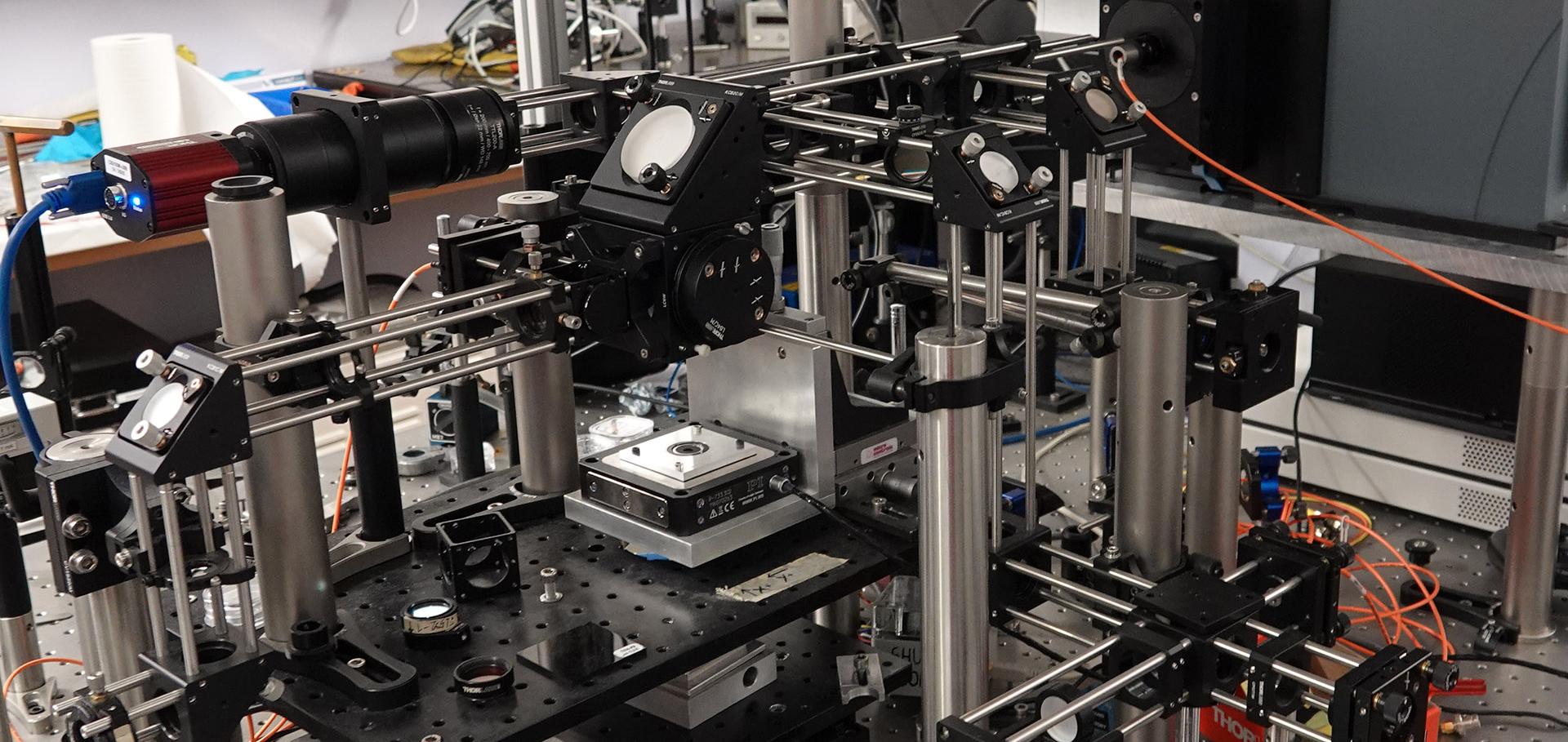
MicroPL optical setup

Professor Robert Taylor

Emeritus Professor of Condensed Matter Physics

Research theme

  • Photovoltaics and nanoscience

Sub department

  • Condensed Matter Physics

Research groups

  • Quantum Optoelectronics
Robert.Taylor@physics.ox.ac.uk
Telephone: 01865 (2)72230
Clarendon Laboratory, room 164
orcid.org/0000-0003-2578-9645
  • About
  • Teaching
  • Positions available
  • Publications

Lasing in perovskite nanocrystals

Image of transverse modes from lasing nanocrystals
Nano Research, 14, 108, 2021

Quantification of temperature-dependent charge separation and recombination dynamics in non-fullerene organic photovoltaics

Advanced Functional Materials Wiley 31:48 (2021) 2107157

Authors:

Christopher CS Chan, Chao Ma, Xinhui Zou, Zengshan Xing, Guichuan Zhang, Hin‐Lap Yip, Robert Taylor, Yan He, Kam Sing Wong, Philip CY Chow

Abstract:

Transient optical spectroscopy is used to quantify the temperature-dependence of charge separation and recombination dynamics in P3TEA:SF-PDI2 and PM6:Y6, two non-fullerene organic photovoltaic (OPV) systems with a negligible driving force and high photocurrent quantum yields. By tracking the intensity of the transient electroabsorption response that arises upon interfacial charge separation in P3TEA:SF-PDI2, a free charge generation rate constant of ≈2.4 × 10¹⁰ s−1 is observed at room temperature, with an average energy of ≈230 meV stored between the interfacial charge pairs. Thermally activated charge separation is also observed in PM6:Y6, and a faster charge separation rate of ≈5.5 × 10¹⁰ s−1 is estimated at room temperature, which is consistent with the higher device efficiency. When both blends are cooled down to cryogenic temperature, the reduced charge separation rate leads to increasing charge recombination either directly at the donor-acceptor interface or via the emissive singlet exciton state. A kinetic model is used to rationalize the results, showing that although photogenerated charges have to overcome a significant Coulomb potential to generate free carriers, OPV blends can achieve high photocurrent generation yields given that the thermal dissociation rate of charges outcompetes the recombination rate.
More details from the publisher
Details from ORA
More details

Resonantly pumped bright-triplet exciton lasing in cesium lead bromide perovskites

ACS Photonics American Chemical Society 8:9 (2021) 2699-2704

Authors:

Guanhua Ying, Tristan Farrow, Atanu Jana, Hanbo Shao, Hyunsik Im, Vitaly Osokin, Seung Bin Baek, Mutibah Alanazi, Sanjit Karmakar, Manas Mukherjee, Youngsin Park, Robert A Taylor

Abstract:

The surprising recent observation of highly emissive triplet-states in lead halide perovskites accounts for their orders-of-magnitude brighter optical signals and high quantum efficiencies compared to other semiconductors. This makes them attractive for future optoelectronic applications, especially in bright low-threshold nanolasers. While nonresonantly pumped lasing from all-inorganic lead-halide perovskites is now well-established as an attractive pathway to scalable low-power laser sources for nano-optoelectronics, here we showcase a resonant optical pumping scheme on a fast triplet-state in CsPbBr<sub>3</sub> nanocrystals. The scheme allows us to realize a polarized triplet-laser source that dramatically enhances the coherent signal by 1 order of magnitude while suppressing noncoherent contributions. The result is a source with highly attractive technological characteristics, including a bright and polarized signal and a high stimulated-to-spontaneous emission signal contrast that can be filtered to enhance spectral purity. The emission is generated by pumping selectively on a weakly confined excitonic state with a Bohr radius ∼10 nm in the nanocrystals. The exciton fine-structure is revealed by the energy-splitting resulting from confinement in nanocrystals with tetragonal symmetry. We use a linear polarizer to resolve 2-fold nondegenerate sublevels in the triplet exciton and use photoluminescence excitation spectroscopy to determine the energy of the state before pumping it resonantly.
More details from the publisher
Details from ORA
More details
More details

Exciton dynamics in monolayer graphene grown on a Cu(111) surface

npj 2D Materials and Applications Springer Nature 5:1 (2021) 69

Authors:

Youngsin Park, Guanhua Ying, Robert Taylor, Chan C Hwang

Abstract:

We have characterized the carrier dynamics of the excitonic emission emerging from a monolayer of graphene grown on a Cu(111) surface. Excitonic emission from the graphene, with strong and sharp peaks both with a full-width at half-maximum of 2.7 meV, was observed near ~3.16 and ~3.18 eV at 4.2 K. The carrier recombination parameters were studied by measuring both temperature-dependent and time-resolved photoluminescence. The intensity variation with temperature of these two peaks shows an opposing trend. The time-resolved emission was modelled using coupled differential equations and the decay time was found to be dominated by carrier trapping and Auger recombination as the temperature increased.
More details from the publisher
Details from ORA
More details

Resonantly pumped bright-triplet exciton lasing in caesium lead bromide perovskites

(2021)

Authors:

Guanhua Ying, Tristan Farrow, Atanu Jana, Hanbo Shao, Hyunsik Im, Vitaly Osokin, Seung Bin Baek, Mutibah Alanazi, Sanjit Karmakar, Manas Mukherjee, Youngsin Park, Robert A Taylor
More details from the publisher

Imaging nonradiative point defects buried in quantum wells using cathodoluminescence

Nano Letters American Chemical Society 21:12 (2021) 5217-5224

Authors:

Thomas FK Weatherley, Wei Liu, Vitaly Osokin, Duncan TL Alexander, Robert A Taylor, Jean-François Carlin, Raphaël Butté, Nicolas Grandjean

Abstract:

Crystallographic point defects (PDs) can dramatically decrease the efficiency of optoelectronic semiconductor devices, many of which are based on quantum well (QW) heterostructures. However, spatially resolving individual nonradiative PDs buried in such QWs has so far not been demonstrated. Here, using high-resolution cathodoluminescence (CL) and a specific sample design, we spatially resolve, image, and analyze nonradiative PDs in InGaN/GaN QWs at the nanoscale. We identify two different types of PDs by their contrasting behavior with temperature and measure their densities from 1014 cm–3 to as high as 1016 cm–3. Our CL images clearly illustrate the interplay between PDs and carrier dynamics in the well: increasing PD concentration severely limits carrier diffusion lengths, while a higher carrier density suppresses the nonradiative behavior of PDs. The results in this study are readily interpreted directly from CL images and represent a significant advancement in nanoscale PD analysis.

More details from the publisher
Details from ORA
More details
More details

Pagination

  • First page First
  • Previous page Prev
  • …
  • Page 8
  • Page 9
  • Page 10
  • Page 11
  • Current page 12
  • Page 13
  • Page 14
  • Page 15
  • Page 16
  • …
  • Next page Next
  • Last page Last

Footer Menu

  • Contact us
  • Giving to the Dept of Physics
  • Work with us
  • Media

User account menu

  • Log in

Follow us

FIND US

Clarendon Laboratory,

Parks Road,

Oxford,

OX1 3PU

CONTACT US

Tel: +44(0)1865272200

University of Oxfrod logo Department Of Physics text logo
IOP Juno Champion logo Athena Swan Silver Award logo

© University of Oxford - Department of Physics

Cookies | Privacy policy | Accessibility statement

Built by: Versantus

  • Home
  • Research
  • Study
  • Engage
  • Our people
  • News & Comment
  • Events
  • Our facilities & services
  • About us
  • Giving to Physics
  • Current students
  • Staff intranet