Home
Department Of Physics text logo
  • Research
    • Our research
    • Our research groups
    • Our research in action
    • Research funding support
    • Summer internships for undergraduates
  • Study
    • Undergraduates
    • Postgraduates
  • Engage
    • For alumni
    • For business
    • For schools
    • For the public
Menu
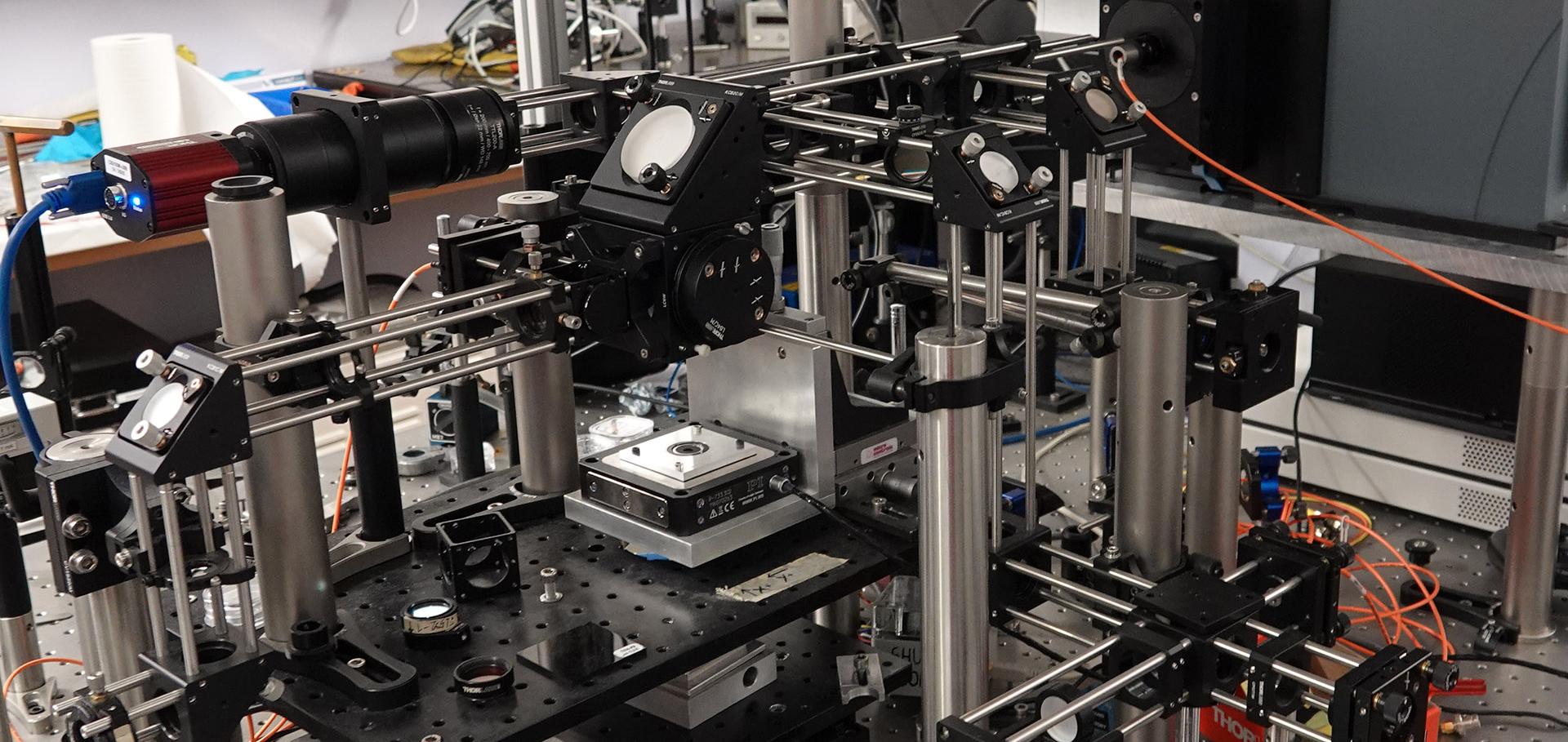
MicroPL optical setup

Professor Robert Taylor

Emeritus Professor of Condensed Matter Physics

Research theme

  • Photovoltaics and nanoscience

Sub department

  • Condensed Matter Physics

Research groups

  • Quantum Optoelectronics
Robert.Taylor@physics.ox.ac.uk
Telephone: 01865 (2)72230
Clarendon Laboratory, room 164
orcid.org/0000-0003-2578-9645
  • About
  • Teaching
  • Positions available
  • Publications

Lasing in perovskite nanocrystals

Image of transverse modes from lasing nanocrystals
Nano Research, 14, 108, 2021

Long Stokes shifts and vibronic couplings in perfluorinated polyanilines

Chemical Communications Royal Society of Chemistry 53:17 (2017) 2602-2605

Authors:

Panagiotis Dallas, Iljia Rasovic, Tim Puchtler, Robert A Taylor, Kyriakos Porfyrakis

Abstract:

We report the effect of surfactant addition on the optical properties of perfluorinated polyanilines synthesized through liquid-liquid interfaces. We obtained very long Stokes shifts, 205 nm, for oligomers derived from a hydrofluoroether-water system in the presence of Triton X-100 as a surfactant, and vibronic fine features from a toluene-water system.
More details from the publisher
Details from ORA
More details
More details

Electrically tunable organic-inorganic hybrid polaritons with monolayer WS2.

Nat Commun 8 (2017) 14097-14097

Authors:

LC Flatten, DM Coles, Z He, DG Lidzey, RA Taylor, JH Warner, JM Smith

Abstract:

Exciton-polaritons are quasiparticles consisting of a linear superposition of photonic and excitonic states, offering potential for nonlinear optical devices. The excitonic component of the polariton provides a finite Coulomb scattering cross section, such that the different types of exciton found in organic materials (Frenkel) and inorganic materials (Wannier-Mott) produce polaritons with different interparticle interaction strength. A hybrid polariton state with distinct excitons provides a potential technological route towards in situ control of nonlinear behaviour. Here we demonstrate a device in which hybrid polaritons are displayed at ambient temperatures, the excitonic component of which is part Frenkel and part Wannier-Mott, and in which the dominant exciton type can be switched with an applied voltage. The device consists of an open microcavity containing both organic dye and a monolayer of the transition metal dichalcogenide WS2. Our findings offer a perspective for electrically controlled nonlinear polariton devices at room temperature.
More details from the publisher
Details from ORA
More details
More details

Quasi-one-dimensional density of states in a single quantum ring.

Scientific Reports Springer Nature 7 (2017) 40026

Authors:

Heedae Kim, W Lee, S Park, K Kyhm, K Je, Robert Taylor, G Nogues, LS Dang, JD Song

Abstract:

Generally confinement size is considered to determine the dimensionality of nanostructures. While the exciton Bohr radius is used as a criterion to define either weak or strong confinement in optical experiments, the binding energy of confined excitons is difficult to measure experimentally. One alternative is to use the temperature dependence of the radiative recombination time, which has been employed previously in quantum wells and quantum wires. A one-dimensional loop structure is often assumed to model quantum rings, but this approximation ceases to be valid when the rim width becomes comparable to the ring radius. We have evaluated the density of states in a single quantum ring by measuring the temperature dependence of the radiative recombination of excitons, where the photoluminescence decay time as a function of temperature was calibrated by using the low temperature integrated intensity and linewidth. We conclude that the quasi-continuous finely-spaced levels arising from the rotation energy give rise to a quasi-one-dimensional density of states, as long as the confined exciton is allowed to rotate around the opening of the anisotropic ring structure, which has a finite rim width.
More details from the publisher
Details from ORA
More details
More details

Dataset: Deterministic optical polarisation in nitride quantum dots at thermoelectrically cooled temperatures

University of Oxford (2017)

Authors:

Tong Wang, Timothy Puchtler, Saroj K Patra, Stefan Schulz, Robert Taylor

Abstract:

These data were created in order to assess the high temperature polarisation properties of a-plane InGaN quantum dots, in micro-photoluminescence experiments and kp band simulations, from 2015 to 2017. OriginPro has been used to analyse the data.
More details from the publisher
Details from ORA

Dataset: Optical fabrication and characterisation of SU-8 disk photonic waveguide heterostructure cavities - version 2

University of Oxford (2017)

Authors:

Robert Taylor, Luke Nuttall, Stephen Lennon, Benjamin Reid, Frederic Brossard

Abstract:

These data all relate to GaAs photonic crystal waveguides with SU-8 photoresist disks patterened on top them to create cavities. The waveguides contain high-density embedded InGaAs quantum dots which couple to the cavity modes.

The folder fig2 contains data from an FDTD simulation measuring cavity Q factor and mode volume against disk diameter.

The folder fig3 contains micro-photoluminescence (uPL) spectra of the waveguides taken before and after cavity fabrication. See fig3/readme.txt for more information.

The folder fig4 contains the Q factor, disk thickness, and disk diameter data for all the devices studied.

The folder fig5 contains a scanning electron microscope image and associated 2D uPL map of one of the cavities.

More information and details of file formats is contained in the following files:
readme.txt
asc_file_format.txt
fig2/readme.txt
fig3/readme.txt

Note that those .txt files use unix-style line endings (LF), not Windows-style ones (CRLF). They may not display correctly in Notepad. The difficulty of achieving reliable spectral and spatial overlap is a serious problem when fabricating photonic crystal (PhC) cavities around self-assembled quantum dots. We present a method for using photoresist to optically fabricate heterostructure cavities in a PhC waveguide with a combined photolithography and micro-photoluminescence spectroscopy system. We confirm the creation of cavity modes with high quality factors (mean = 3.8*10^3, maximum = 7.4(2)*10^3). This method offers a promising route towards bright, on-chip single photon sources for quantum information applications.
More details from the publisher
Details from ORA

Pagination

  • First page First
  • Previous page Prev
  • …
  • Page 20
  • Page 21
  • Page 22
  • Page 23
  • Current page 24
  • Page 25
  • Page 26
  • Page 27
  • Page 28
  • …
  • Next page Next
  • Last page Last

Footer Menu

  • Contact us
  • Giving to the Dept of Physics
  • Work with us
  • Media

User account menu

  • Log in

Follow us

FIND US

Clarendon Laboratory,

Parks Road,

Oxford,

OX1 3PU

CONTACT US

Tel: +44(0)1865272200

University of Oxfrod logo Department Of Physics text logo
IOP Juno Champion logo Athena Swan Silver Award logo

© University of Oxford - Department of Physics

Cookies | Privacy policy | Accessibility statement

Built by: Versantus

  • Home
  • Research
  • Study
  • Engage
  • Our people
  • News & Comment
  • Events
  • Our facilities & services
  • About us
  • Giving to Physics
  • Current students
  • Staff intranet