

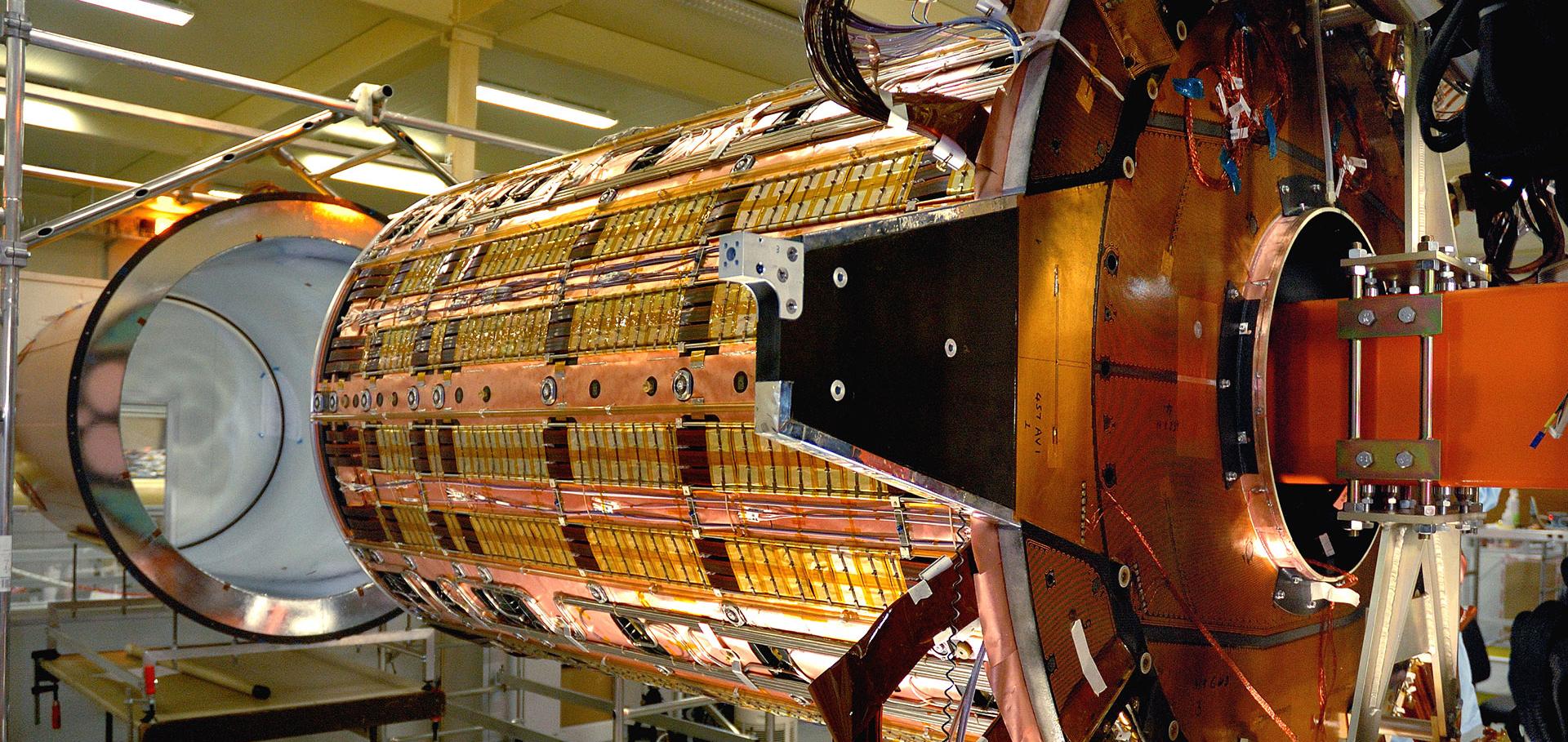

Effects of curved superconducting magnets on beam stability in a compact ion therapy synchrotron
Physical Review Accelerators and Beams 28:9 (2025)
Abstract:
Superconducting, curved magnets can reduce accelerator footprints by producing strong fields (> 3 T) and reducing the total number of magnets through their capability for combined-function multipolar fields, making them an attractive choice for applications such as heavy ion therapy. There exists the problem that the effect of strongly curved harmonics and fringe fields on compact accelerator beam dynamics is not well represented: existing approaches use integrated cylindrical multipoles to describe and model the fields for beam dynamics studies, which are invalid in curved coordinate systems and assume individual errors cancel out over the full machine. In the modeling of these machines, the effects of strongly curved harmonics and fringe fields on compact accelerator beam dynamics need to be properly included. An alternative approach must be introduced for capturing off-axis fields in a strongly curved magnet, which may affect long-term beam stability in a compact accelerator. In this article, we investigate the impacts of deploying a curved canted-cosine-theta (CCT) superconducting magnet in a synchrotron for the first time. We develop a method to analyze and characterize the 3D curved fields of an electromagnetic model of a CCT developed for the main bending magnets of a compact (27 m circumference) carbon ion therapy synchrotron, designed within the Heavy Ion Therapy Research Integration Plus European project (HITRIPlus), and the CERN Next Ion Medical Machine Study (NIMMS). The fields are modelled in the compact synchrotron in mad-x/ptc to study their effects on beam dynamics and long-term beam stability. Results indicate that the synchrotron is able to operate with the presence of the magnetic field gradients, with considerable improvement to the long-term beam stability in the machine after tuning the higher order field gradients. The insights gained through the methods presented allow the optimisation of both magnet and synchrotron designs, with the potential to impact the operational performance of future ion therapy facilities.Design of a large energy acceptance beamline using fixed field accelerator optics
Physical Review Accelerators and Beams American Physical Society (APS) 27:7 (2024) 071601
Corrigendum to “Comparative Analysis of Radiotherapy Linear Accelerator Downtime and Failure Modes in the UK, Nigeria and Botswana” [Clinical Oncology 32 (2020) e111–e118]
Clinical Oncology Elsevier 35:5 (2023) e347
Creating exact multipolar fields with azimuthally modulated rf cavities
Physical Review Accelerators and Beams American Physical Society (APS) 25:6 (2022) 062001
A study of coherent and incoherent resonances in high intensity beams using a linear Paul trap
New Journal of Physics IOP Publishing 21 (2019)