Home
Department Of Physics text logo
  • Research
    • Our research
    • Our research groups
    • Our research in action
    • Research funding support
    • Summer internships for undergraduates
  • Study
    • Undergraduates
    • Postgraduates
  • Engage
    • For alumni
    • For business
    • For schools
    • For the public
  • Support
Menu
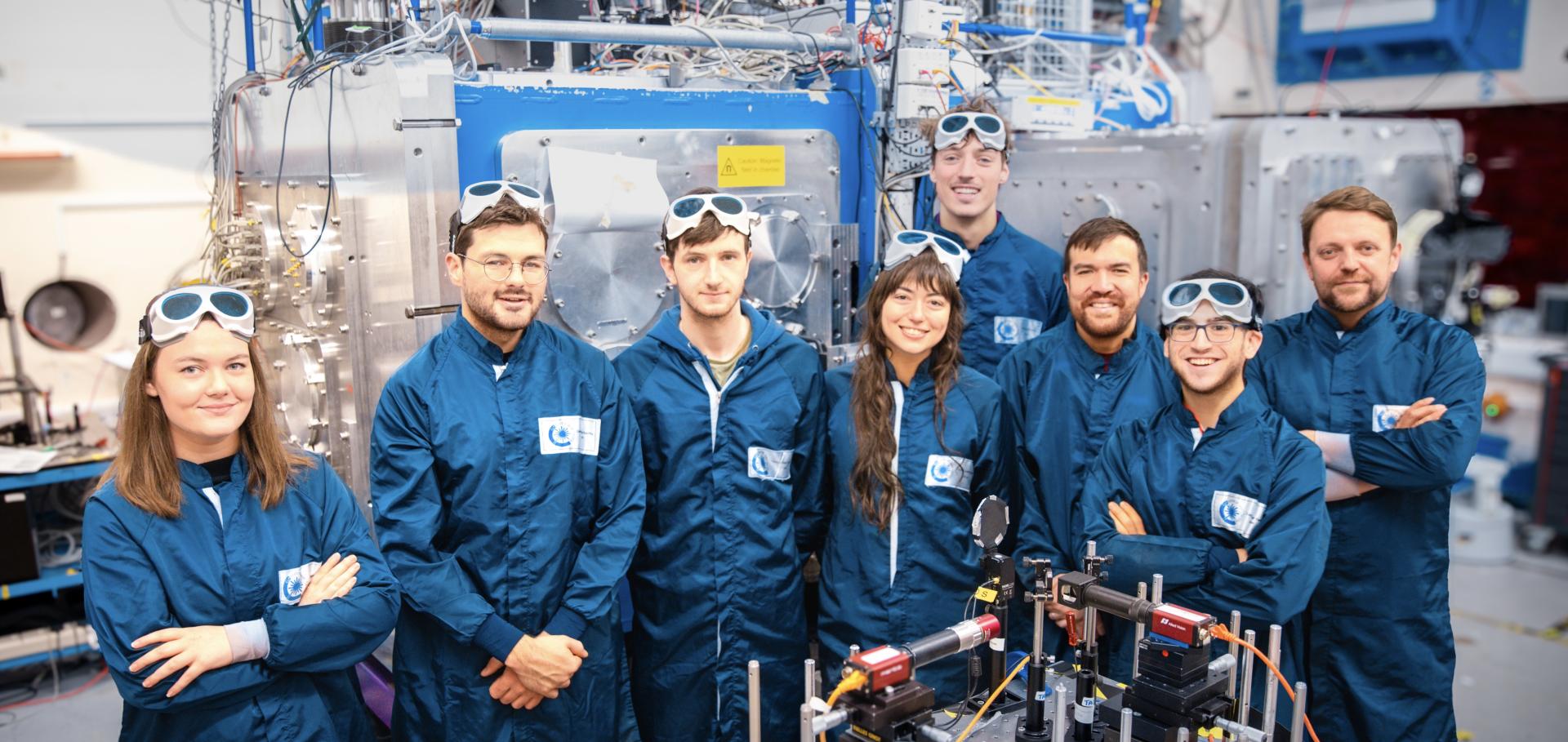
Team of laser scientists in front of the GEMINI laser target chamber at the CLF.

The team in the GEMINI laser target area at the Central Laser Facility, Harwell.

Dr Robin Timmis

Post doctoral research assistant

Research theme

  • Accelerator physics
  • Lasers and high energy density science
  • Plasma physics

Sub department

  • Atomic and Laser Physics

Research groups

  • Laser fusion and extreme field physics
  • Oxford Centre for High Energy Density Science (OxCHEDS)
robin.timmis@physics.ox.ac.uk
Clarendon Laboratory, room 244
  • About
  • Publications

Relativistic harmonics in the efficiency limit

Nature Springer Nature

Authors:

Robin Timmis, Colm Fitzpatrick, Jonathan Kennedy, Holly Huddleston, Elliott Denis, Abigail James, Chris Baird, Dan Symes, David McGonegle, Eduard Atonga, Heath Martin, Jeremy Rebenstock, John Neely, Jordan Lee, Nicolas Bourgeois, Oliver Finlay, Rusko Ruskov, Sam Astbury, Steve Hawkes, Zixin Zhang, Matt Zepf, Karl Krushelnick, Edward Gumbrell, Rajeev Pattathil, Mark Yeung, Brendan Dromey, Peter Norreys

Abstract:

Bright high harmonic radiation from relativistically oscillating laser-plasmas offers a direct route to generating extreme electromagnetic fields. Theory shows that under optimised conditions the plasma medium can support strong spatiotemporal compression of laser energy into a Coherent Harmonic Focus (CHF), delivering intensity boosts many orders of magnitude above that of the incident driving laser pulse [1–4]. Although diffraction-limited performance [5] (spatial compression) and attosecond phase-locking [6] (temporal compression) have been demonstrated in the laboratory, efficient coupling of highly relativistic laser pulse energy into the emitted harmonic cone has not been realised to date. Here, conclusive evidence confirms that the relativistic laserplasma interaction can be tailored to deliver the maximum conversion efficiencies predicted from simulations. By fine-tuning the temporal profile of the driving laser pulse on femtosecond (fs, 10−15 s) timescales, energies > 9 mJ between the 12th and 47th harmonics (18 eV to 73 eV) are observed. These results are shown to be in excellent agreement with the theoretically expected efficiency dependence on harmonic order, indicating that optimal conditions have been achieved in the generation process. This is the important final element required to achieve the expected intensity boosts from a CHF in the laboratory. Although obtaining spatiotemporal compression and optimal efficiency simultaneously remains challenging, the path to realising extreme optical field strengths approaching the critical field of quantum electrodynamics (the Schwinger limit at > 1016V/m or > 1029 W cm−2 ) is now open, permitting all-optical studies of the quantum vacuum and drawing new horizons for intense attosecond science.
Details from ORA

Relativistic harmonics in the efficiency limit

Authors:

Robin Timmis, Colm Fitzpatrick, Jonathan Kennedy, Holly Huddleston, Elliott Denis, Abigail James, Chris Baird, Dan Symes, David McGonegle, Eduard Atonga, Heath Martin, Jeremy Rebenstock, John Neely, Jordan Lee, Nicolas Bourgeois, Oliver Finlay, Rusko Ruskov, Sam Astbury, Steve Hawkes, Matt Zepf, Karl Krushelnick, Edward Gumbrell, Paramel Pattathil Rajeev, Mark Yeung, Brendan Dromey, Peter Norreys
More details from the publisher

Pagination

  • First page First
  • Previous page Prev
  • Page 1
  • Page 2
  • Page 3
  • Current page 4

Footer Menu

  • Contact us
  • Giving to the Dept of Physics
  • Work with us
  • Media

User account menu

  • Log in

Follow us

FIND US

Clarendon Laboratory,

Parks Road,

Oxford,

OX1 3PU

CONTACT US

Tel: +44(0)1865272200

University of Oxfrod logo Department Of Physics text logo
IOP Juno Champion logo Athena Swan Silver Award logo

© University of Oxford - Department of Physics

Cookies | Privacy policy | Accessibility statement

Built by: Versantus

  • Home
  • Research
  • Study
  • Engage
  • Our people
  • News & Comment
  • Events
  • Our facilities & services
  • About us
  • Giving to Physics
  • Current students
  • Staff intranet