Home
Department Of Physics text logo
  • Research
    • Our research
    • Our research groups
    • Our research in action
    • Research funding support
    • Summer internships for undergraduates
  • Study
    • Undergraduates
    • Postgraduates
  • Engage
    • For alumni
    • For business
    • For schools
    • For the public
  • Support
Menu
Atomic and Laser Physics
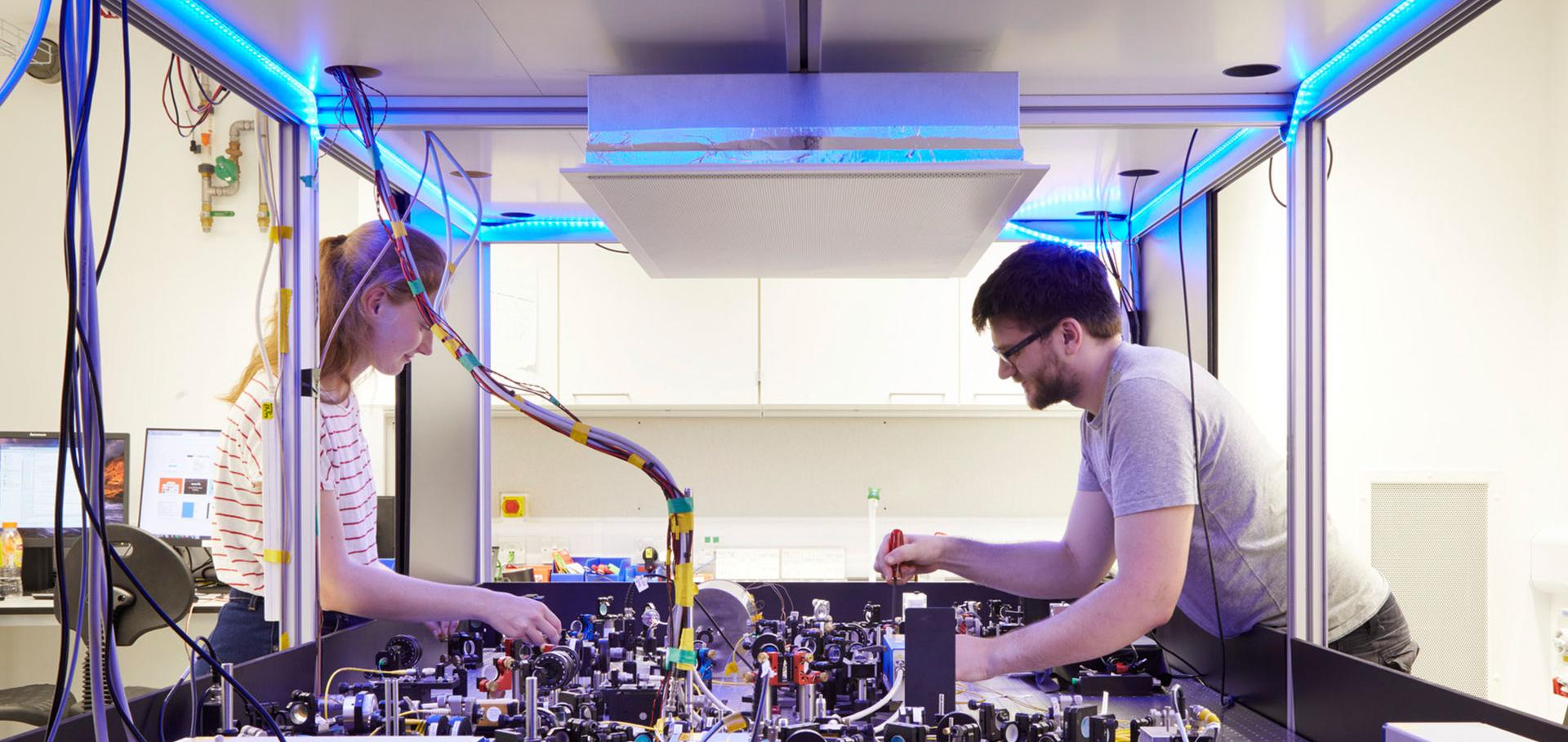
Credit: Jack Hobhouse

Prof Vlatko Vedral FInstP

Professor of Quantum Information Science

Sub department

  • Atomic and Laser Physics

Research groups

  • Frontiers of quantum physics
vlatko.vedral@physics.ox.ac.uk
Telephone: 01865 (2)72389
Clarendon Laboratory, room 241.8
  • About
  • Publications

The Meissner effect and massive particles as witnesses of macroscopic entanglement

(2004)
More details from the publisher

High-temperature macroscopic entanglement

New Journal of Physics 6 (2004) 1-19

Abstract:

In this paper, we intend to show that macroscopic entanglement is possible at high temperatures. We have analysed multipartite entanglement produced by the η-pairing mechanism, which features strongly in the fermionic lattice models of high Tc superconductivity. This problem is shown to be equivalent to calculating multipartite entanglement in totally symmetric states of qubits. It is demonstrated that we can conclusively calculate the relative entropy of entanglement within any subset of qubits in the overall symmetric state. Three main results are then presented. First, the condition for superconductivity, namely existence of the off-diagonal long-range order (ODLRO), is dependent not on two-site entanglement but just classical correlations as the sites become more and more distant. Secondly, the entanglement that does survive in the thermodynamical limit is the entanglement of the total lattice and, at half-filling, it scales with the log of the number of sites. It is this entanglement that will exist at temperatures below the superconducting critical temperature, which can currently be as high as 160 K. Finally, it is proved that a complete mixture of symmetric states does not contain any entanglement in the macroscopic limit. On the other hand, a mixture of symmetric states possesses the same two qubit entanglement features as the pure states involved, in the sense that the mixing does not destroy entanglement for a finite number of qubits, albeit it does decrease it. Furthermore, maximal mixing of symmetric states does not destroy ODLRO and classical correlations. We discuss generalizations to the subsystems of any dimensionality (i.e. higher than spin-half).
More details from the publisher
Details from ORA
More details

Thermodynamical Cost of Accessing Quantum Information

(2004)

Authors:

K Maruyama, C Brukner, V Vedral
More details from the publisher

Macroscopic Thermodynamical Witnesses of Quantum Entanglement

(2004)

Authors:

Caslav Brukner, Vlatko Vedral
More details from the publisher

Accessibility of physical states and non-uniqueness of entanglement measure

Journal of Physics A Mathematical and General 37:22 (2004) 5887-5893

Authors:

F Morikoshi, MF Santos, V Vedral

Abstract:

Ordering physical states is the key to quantifying some physical property of the states uniquely. Bipartite pure entangled states are totally ordered under local operations and classical communication (LOCC) in the asymptotic limit and uniquely quantified by the well-known entropy of entanglement. However, we show that mixed entangled states are partially ordered under LOCC even in the asymptotic limit. Therefore, non-uniqueness of entanglement measure is understood on the basis of an operational notion of asymptotic convertibility.
More details from the publisher
More details

Pagination

  • First page First
  • Previous page Prev
  • …
  • Page 129
  • Page 130
  • Page 131
  • Page 132
  • Current page 133
  • Page 134
  • Page 135
  • Page 136
  • Page 137
  • …
  • Next page Next
  • Last page Last

Footer Menu

  • Contact us
  • Giving to the Dept of Physics
  • Work with us
  • Media

User account menu

  • Log in

Follow us

FIND US

Clarendon Laboratory,

Parks Road,

Oxford,

OX1 3PU

CONTACT US

Tel: +44(0)1865272200

University of Oxfrod logo Department Of Physics text logo
IOP Juno Champion logo Athena Swan Silver Award logo

© University of Oxford - Department of Physics

Cookies | Privacy policy | Accessibility statement

Built by: Versantus

  • Home
  • Research
  • Study
  • Engage
  • Our people
  • News & Comment
  • Events
  • Our facilities & services
  • About us
  • Giving to Physics
  • Current students
  • Staff intranet